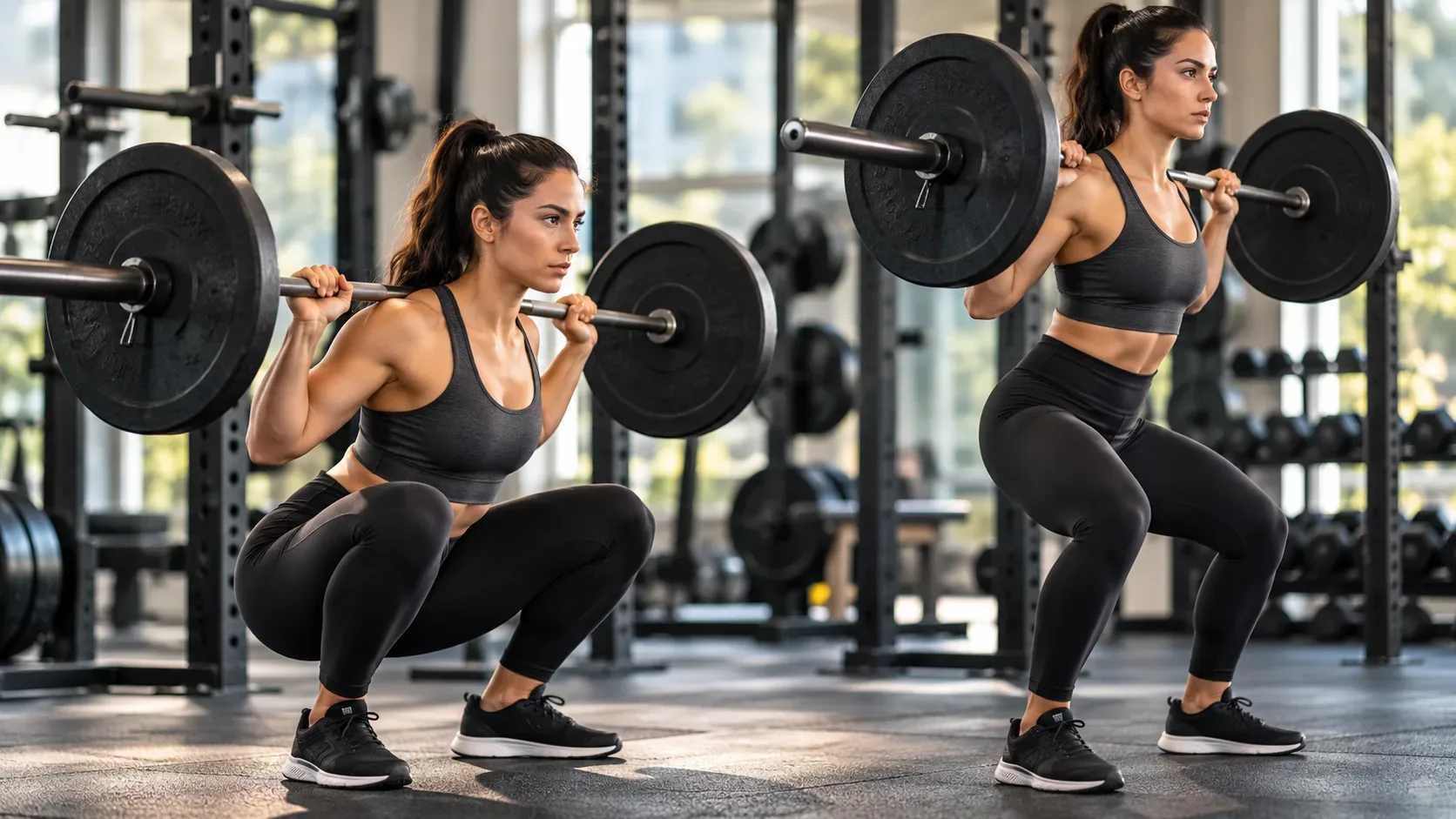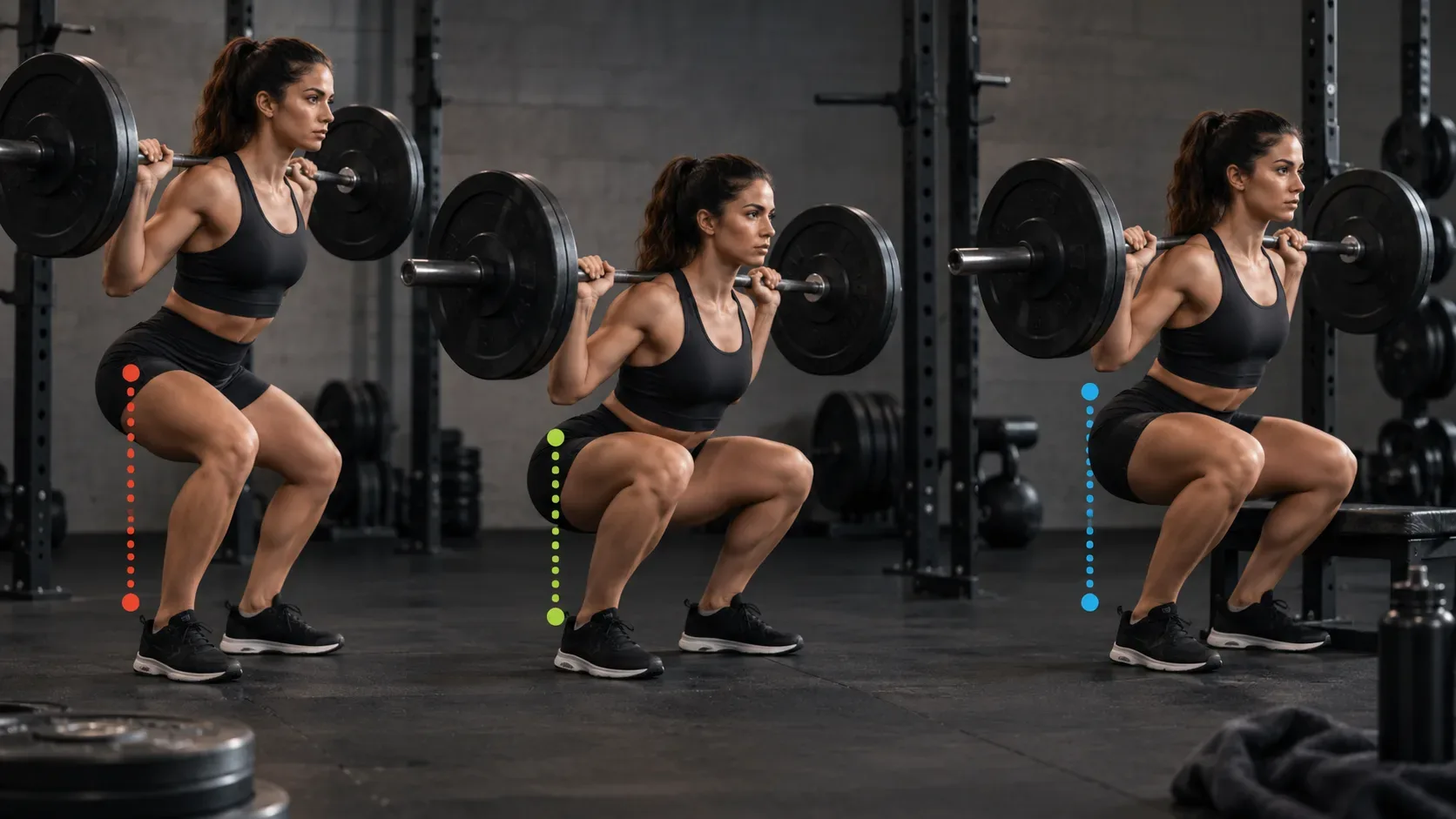
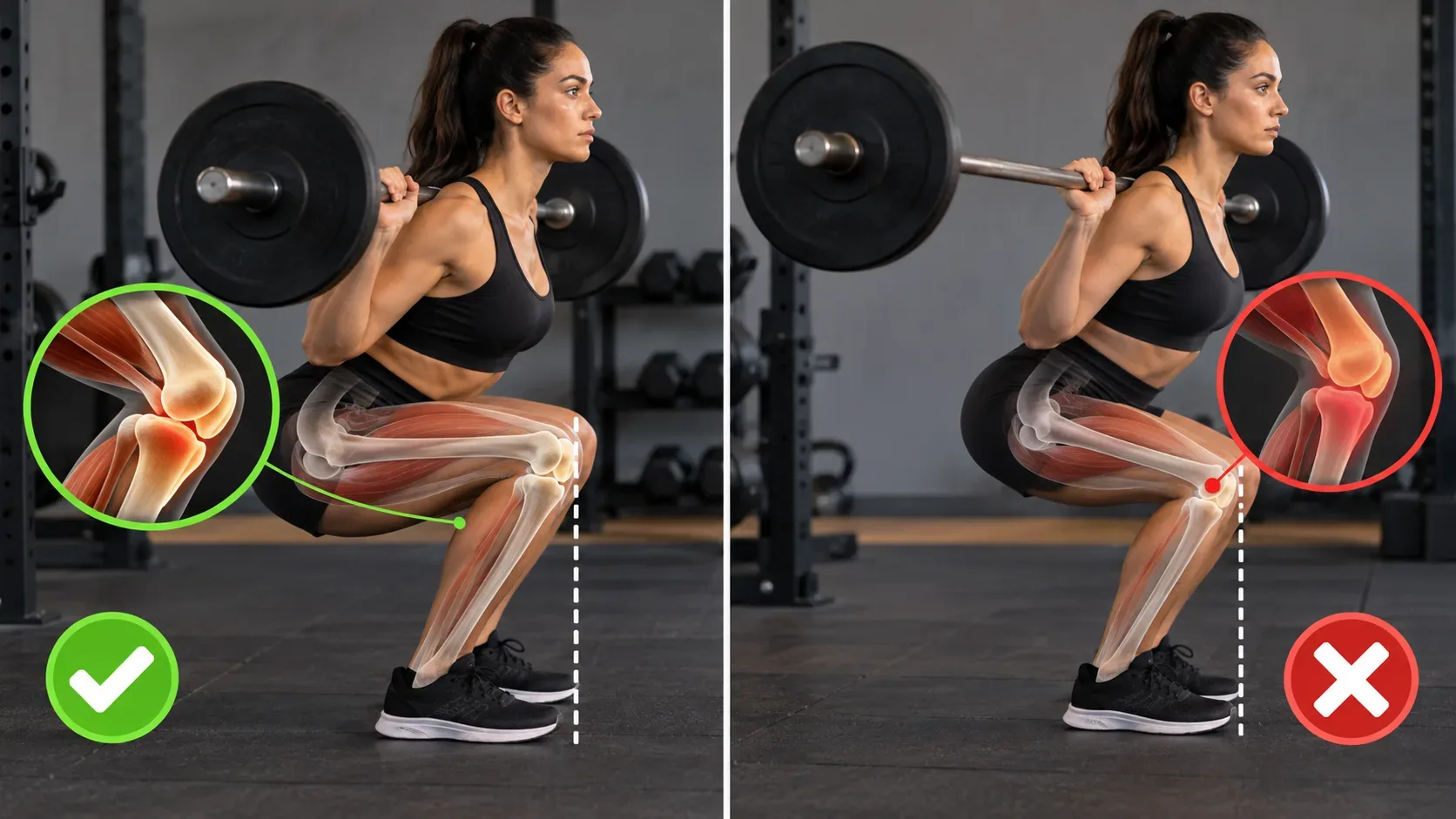
Yes: in people without a condition that contraindicates the movement, the knees can travel past the toes during a squat. The vertical line at the toes is not an anatomical boundary where the movement automatically becomes dangerous. What changes when the knee moves forward or is deliberately held back is mainly how mechanical demand is distributed across the knee, hip and trunk.
This distinction matters because torque, joint contact force and compression are biomechanical measures; they are not synonyms for injury. The literature also does not support a universal point, defined by the toes, beyond which injury risk suddenly rises. Appropriate positioning depends on factors such as body proportions, ankle mobility, squat depth, squat style, load and training goal.
What happens when you let the knee travel forward
When the knee moves farther forward in the sagittal plane, the shin generally becomes more inclined and the external moment arm at the knee can increase. This raises the demand on the knee extensors, especially the quadriceps. At the same time, a relatively more upright trunk usually reduces the moment arm at the hip.
In a classic 2003 comparison, seven resistance-trained men performed parallel squats with a barbell load equal to body weight. In the unrestricted condition, the knees could move beyond the toes; in the restricted condition, a barrier prevented that forward travel. Estimated knee torque was higher in the unrestricted squat, while hip torque rose sharply when knee travel was blocked. The authors reported about 150 N·m at the knee and 28 N·m at the hip in the unrestricted condition, versus 117 N·m at the knee and 303 N·m at the hip in the restricted condition. The study was small and did not measure injuries, but it clearly illustrates a redistribution of demand, not a safety boundary at the toes. See the study on PubMed.
What changes when you prevent the knee from passing the toes
Deliberately restricting forward knee travel tends to reduce the knee extension moment, but the body still has to keep its center of mass balanced over the base of support. It usually does so with more hip flexion and greater forward trunk inclination. Kinematic studies comparing restricted and unrestricted squats have observed greater trunk inclination and changes in lumbar mechanics when the knees are prevented from moving forward. See the kinematic study.
A comprehensive review of anterior knee displacement summarizes the same principle: limiting forward travel can reduce knee demand, but it changes knee-hip coordination, increases trunk inclination and may reduce achievable depth. For many healthy, trained lifters, the authors conclude that a blanket rule to keep the knees behind the toes is unnecessary. Read the review.
| Strategy | Biomechanical tendency | What it does not prove |
|---|---|---|
| Allow natural forward knee travel | Greater knee moment and, in many patterns, a more upright trunk | That moving past the toes causes injury |
| Restrict forward knee travel | Lower knee moment, greater hip demand and more forward trunk inclination | That keeping the knees behind the toes makes the squat universally safer |
| Increase squat depth | May raise joint contact/compressive forces through parts of the range and demand more mobility | That higher joint force automatically equals tissue damage |
More knee torque and compression do not automatically mean injury
As squat depth increases, tibiofemoral and patellofemoral compressive forces can rise with knee flexion. That is expected in a joint transmitting force under load. Biomechanical reviews describe this increase, but they also show that estimated force magnitude depends heavily on the model, technique and joint angle being analyzed. Review of knee biomechanics during the squat.
The safety question requires a different test: is this loading associated with tissue damage or a higher injury incidence in healthy people? A 2024 scoping review included 15 studies on deep squats and osteoarticular knee health. Fourteen did not show a negative effect on knee health, and the authors concluded that deep squatting appears safe for people without prior pathology when technique, load and volume are appropriate. The review also notes important limitations, including heterogeneous studies, relatively short follow-up in many trials and a need for long-term data. See the 2024 review.
Why the “toe line” rule fails across different bodies
How far the knee travels forward depends on the proportions of the femur, tibia, trunk and foot, as well as available ankle dorsiflexion. Two people can reach similar depths with very different positions: someone with relatively long femurs may need more trunk inclination or more knee travel, while another person can remain more upright with less forward displacement.
Squat style also matters. Bar position, stance width, heel elevation, external load and movement speed all change the center of mass and joint moments. Using the toes as the only visual criterion therefore ignores much of the exercise's actual mechanics. A clinical biomechanical review highlights that trunk inclination changes hip and knee moments at the same time: a more upright trunk tends to increase knee demand and reduce hip demand, while a more inclined trunk tends to do the opposite. See the clinical biomechanics review.
So what is a more useful way to assess the movement?
Instead of asking only whether the knee crossed the toes, it is more useful to assess the movement as a whole: the foot remains stable, the heel stays supported, the knee follows a controlled path, the spine and trunk are organized appropriately for the chosen style, and the load allows the technique to be repeated without major loss of control.
This does not mean every lifter should deliberately maximize forward knee travel. In rehabilitation, with pain or in specific conditions, temporarily limiting depth or anterior knee displacement can be a way to modulate symptoms and load. That decision, however, becomes clinical and individual rather than a universal “knees never past the toes” rule.
What the evidence supports — and what it does not
- Supported: restricting forward knee travel changes the mechanics and tends to shift demand from the knee toward the hip and trunk.
- Supported: in healthy people, crossing the toe line has not been established as an independent injury threshold.
- Supported: compressive forces and joint torques can increase with depth and certain techniques without proving tissue damage.
- Not supported: that one technique is ideal for every anatomy, goal and injury history.
- Not supported: automatically applying findings from healthy participants to people with patellofemoral pain, ligament injury, symptomatic osteoarthritis or other pathology.
For people training without symptoms or contraindications, the key point is to move away from the idea that the toes create a universal “red line.” Forward knee travel is one biomechanical variable among many. When it is restricted, load does not disappear; it is redistributed. Persistent pain, swelling, instability or return from injury calls for an individualized assessment by a qualified health or exercise professional rather than reliance on a single visual rule.