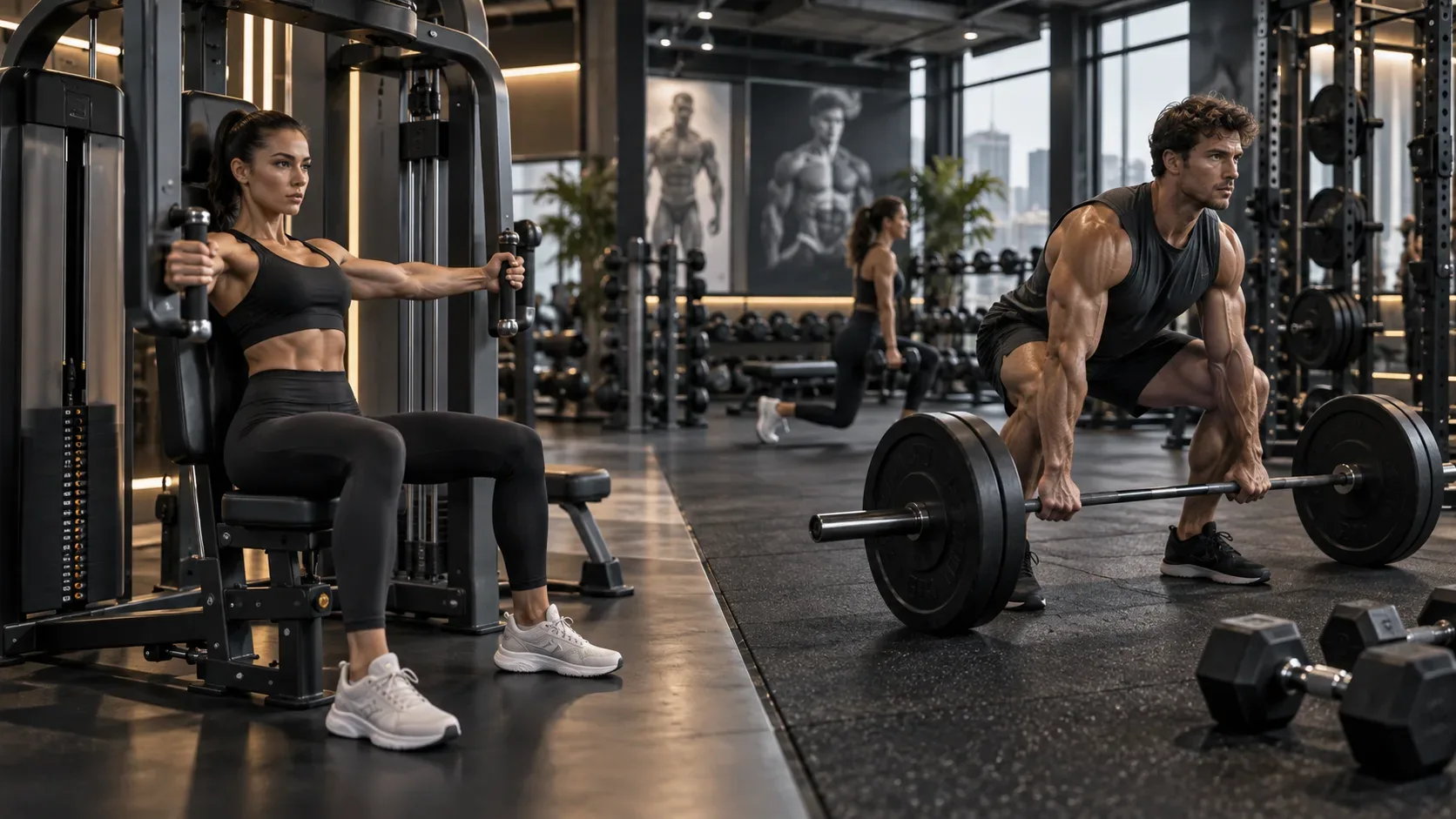
Short answer: machines and free weights can both build strength and muscle. The main difference is not that one is always better, but that each modality imposes different demands on coordination, stability, and skill. For hypertrophy, direct comparisons tend to find similar average results. For strength, the principle of specificity matters more: you usually improve most in the type of exercise and equipment you actually practice.
What really changes between machines and free weights
Machines guide resistance along a path defined by the equipment or restrict some of the movement's degrees of freedom. Free weights, such as barbells and dumbbells, allow the lifter to control the path. This changes the motor task, the need to organize the body in space, and the way the exercise is learned.
That difference, however, does not justify concluding that free weights automatically build more muscle or that machines are only for beginners. Results depend on the goal, progression of load and volume, tolerable execution, equipment availability, and, when specific strength matters, the exercise in which you want to become strong.
What direct comparisons show
A 2023 systematic review and meta-analysis pooled 13 studies with 1,016 adult participants who compared free-weight and machine training for at least six weeks. The analysis detected no difference between modalities for hypertrophy, jump performance, or strength measures when the comparison did not favor the same test used during training.
When strength was tested with a free-weight exercise, participants who trained with free weights improved more on that type of test. The opposite pattern appeared for machine tests. An earlier meta-analysis found the same signal: the strength advantage follows the practiced modality, while results measured with more neutral tests tend to be closer.
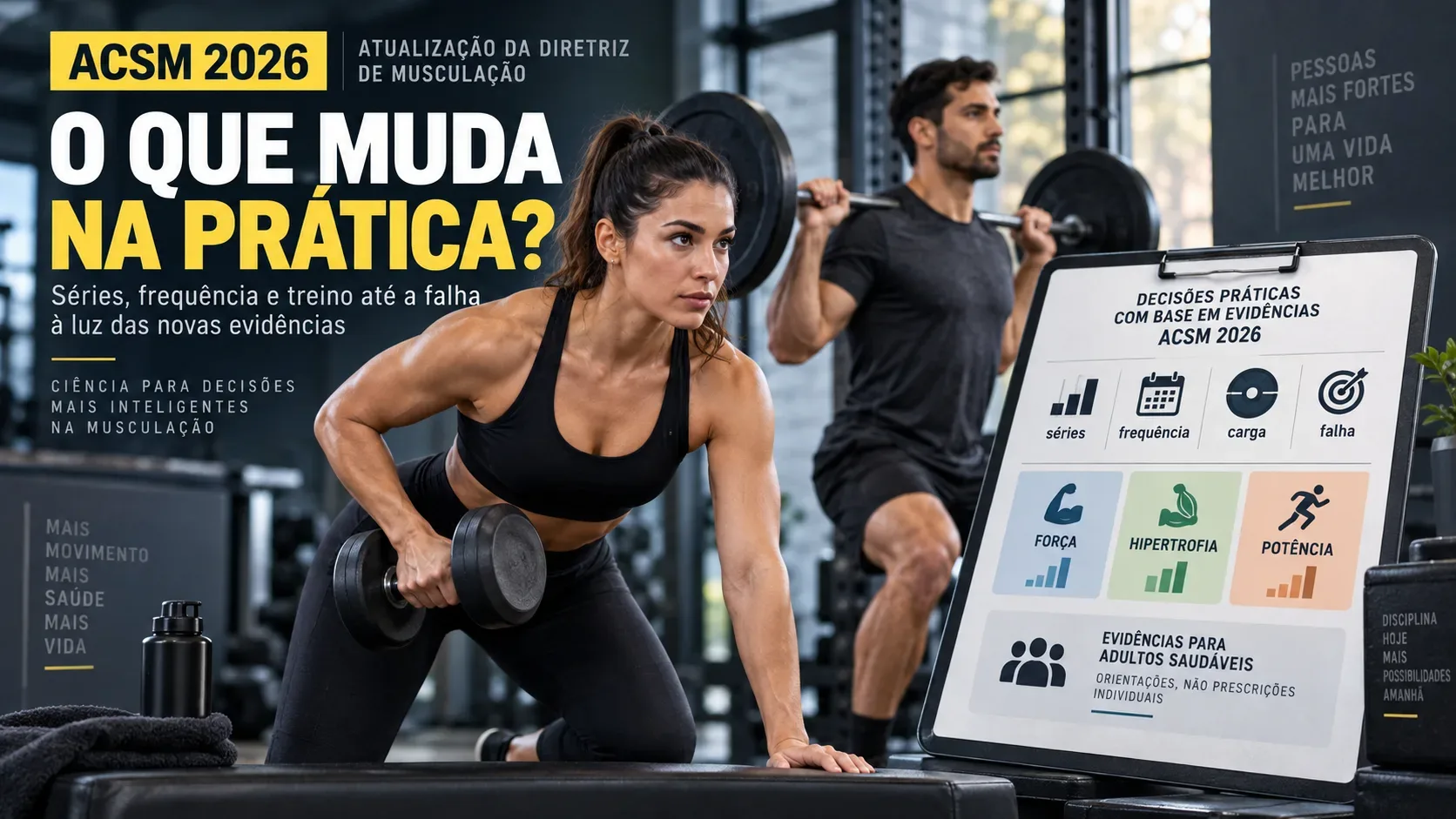
This picture is also consistent with the 2026 American College of Sports Medicine position stand, which synthesized 137 systematic reviews involving more than 30,000 participants. Across the evidence base, equipment type was not a variable that consistently changed the main resistance-training outcomes in healthy adults. Other variables, such as load, volume, frequency, and range of motion, may matter more depending on the outcome.
Goal-based matrix
| Goal | Machines | Free weights | Practical interpretation |
|---|---|---|---|
| Hypertrophy | Can provide more external stability and make local effort easier to focus on | Also allow progressive overload and a strong muscular stimulus | There is no consistent overall advantage for one modality |
| Specific strength | Greater transfer to the machine exercise itself | Greater transfer to the barbell or dumbbell exercise itself | Train in a way that resembles the task in which you want to display strength |
| Technical learning | Reduces some decisions about path and balance | Requires learning path, positioning, and control of the implement | Useful complexity depends on the skill you want to develop |
| Stability | The equipment provides more support for the movement path | The lifter controls more degrees of freedom | Higher stabilization demand does not automatically mean more hypertrophy |
| Operational safety | Can simplify setup, load changes, and ending a set | May require a rack, collars, space, and, for some lifts, a spotter | Evidence does not show that one modality is always safer |
| Availability | Depends on the design and machines available in the gym | Barbells and dumbbells allow many variations with fewer equipment types | The best plan has to fit the environment where you actually train |
For hypertrophy, equipment is usually a secondary variable
If the main goal is to gain muscle, the useful question is not only whether an exercise uses a cable, machine, barbell, or dumbbell. It is whether the movement lets the target muscle be trained consistently, with an appropriate range of motion for the exercise, enough effort, and progression over time.
Machines can be convenient when you want to reduce the need to balance the implement and focus more attention on local effort. That can be useful for accessory exercises, late in a session, or when the technical limitation of a free-weight movement prevents the target muscle from receiving the intended work.
Free weights can serve the same purpose and, in many movements, allow fine adjustments in path and positioning. The key point is that comparative research does not support the idea that simply being free or guided determines how much muscle an exercise will build.
For strength, specificity explains much of the difference
Strength is not only an abstract property of a muscle. It also involves coordination, technique, and familiarity with the task. That is why getting strong at a barbell squat requires practicing the barbell squat; getting strong at the leg press requires practice on the leg press. Transfer exists, but it is not complete.
This helps interpret studies correctly. When a free-weight program beats a machine program on a barbell test, part of the result may reflect learning and adaptation to that specific task. The same reasoning applies when machine training has the advantage on a test performed with that machine.
For people who compete in weightlifting, powerlifting, or any sport in which a specific lift is tested, training priorities should include frequent practice of that movement. For someone seeking general strength without a specific test, machines and free weights can coexist without choosing only one side.
Stability and coordination: more demand is not always more benefit
Free weights usually require the lifter to control the path of the implement and organize more body segments during the movement. Machines reduce some of that freedom because the equipment guides or restricts the path. This is a real difference in the motor task.
A common mistake is to turn that difference into a rule of superiority. Requiring more stabilization can be desirable when controlling the body and implement is part of the goal. But that demand can also limit the load or number of repetitions the target muscle can produce. For isolated hypertrophy goals, therefore, greater instability is not automatically better.
Likewise, a machine does not eliminate all stabilization. The lifter still has to position the body, maintain proper contact with supports, and produce force in the intended direction. The amount of external support varies greatly between machines.
Safety depends more on context than on the label
It is reasonable to say that many machines simplify load handling and reduce the possibility of dropping a barbell or dumbbell on the body. It is also reasonable to say that free weights can be used safely when technique, load progression, space, and safety tools such as collars, supports, and safety bars are appropriate.
The 2023 review itself notes that there is not enough longitudinal evidence to conclude that one modality has a lower overall injury risk. Operational safety should therefore be assessed exercise by exercise. Poor seat or support adjustment, an intolerable range of motion, excessive load, and fatigue can create problems with both machines and free weights.
If an exercise causes persistent pain or worsens symptoms, the criterion should not be to keep forcing it because it belongs to a supposedly superior modality. Changing the variation and, when needed, seeking professional assessment is more useful.
When combining both tends to make sense
Combining machines and free weights is often the most flexible solution because it preserves specificity where it matters and lets the rest of the program accumulate work with a lower technical cost.
- Hypertrophy priority: choose free weights or machines for main movements based on comfort, range of motion, and progression; use the other modality to complete volume for the desired muscles.
- Barbell strength priority: place the competitive or specific lift early in the session, then use machines for accessory work to increase training volume without turning the entire session into heavy technical practice.
- Learning a movement pattern: a machine can provide a more constrained task while the lifter learns to produce effort; free weights can then be introduced if controlling a free path is part of the goal.
- Training in a busy gym or with limited equipment: keep equivalent alternatives. If the rack is occupied, a machine can preserve the intended effort pattern; if a desired machine is unavailable, dumbbells can serve the same muscular function with a different motor task.
How to decide exercise by exercise
Instead of choosing a side, answer five questions:
- What result will be measured? If there is a specific test, training should include that task.
- Can the target muscle work well? Check whether technique and stability allow you to produce effort in the intended region.
- Can you progress? The exercise should allow increases in load, repetitions, sets, or execution quality over time.
- Is the movement tolerable? Repeated joint discomfort may justify changing the exercise regardless of equipment type.
- Is the exercise sustainable in the available environment? A perfect plan on paper loses value if it depends on a rare machine or a space you can never use.
The central point
Machines and free weights are different tools for organizing resistance. For hypertrophy, direct evidence does not show a consistent overall superiority. For strength, task specificity explains why training in one modality improves performance measured in that same modality more. Free weights usually require more control of the path; machines usually provide more external support. Neither characteristic, by itself, defines the better choice.
In practice, the most robust approach is to keep specific what needs to be specific and remain flexible with the rest. If you need to demonstrate strength in a barbell lift, practice that lift. If the goal is to accumulate muscular work with good execution and progression, a machine can be excellent. For most gym routines, combining both modalities is fully compatible with strength and hypertrophy.