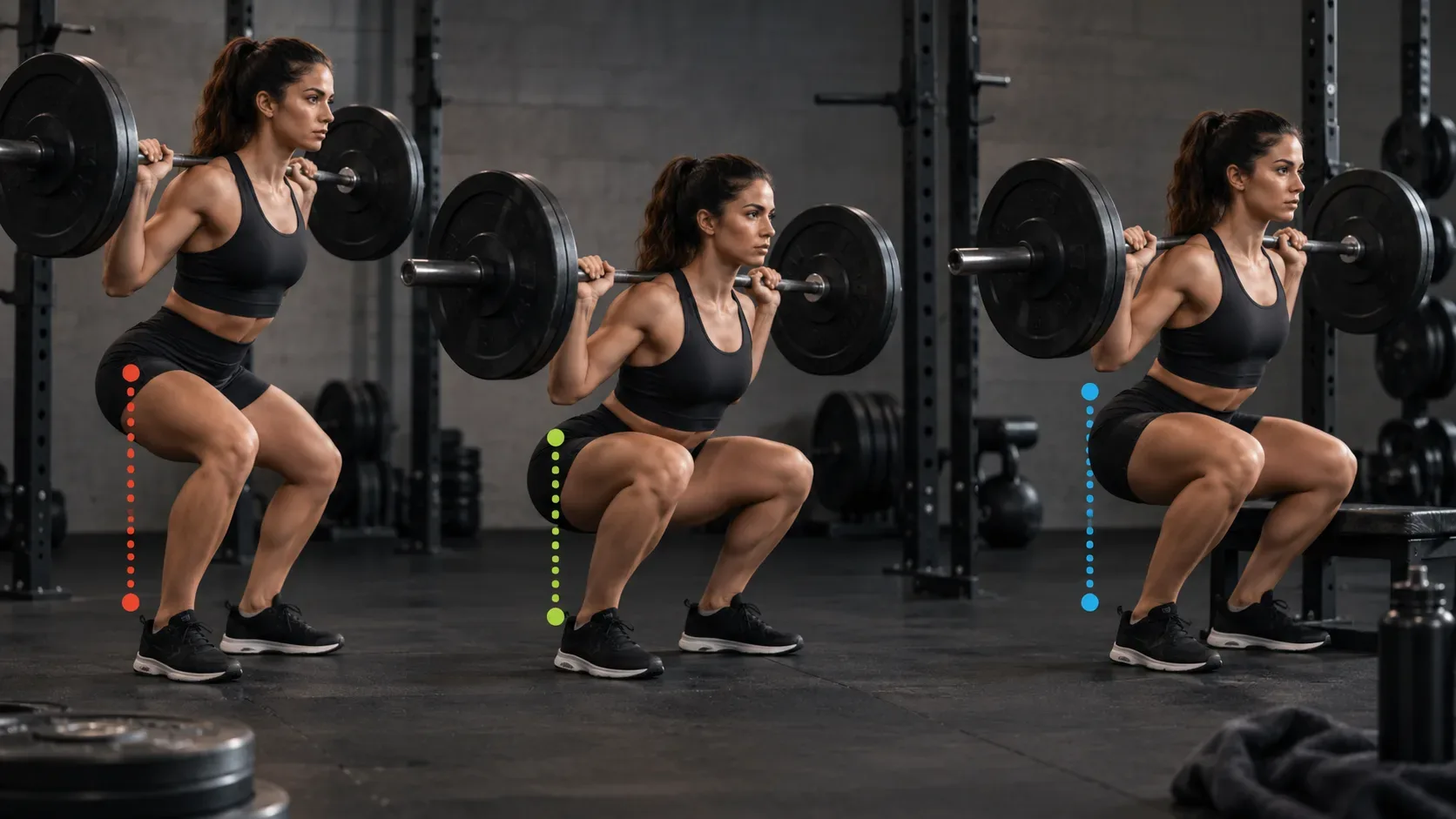

RIR is useful, but it is not equally accurate in every situation. The systematic review by Filipe Russo and colleagues, published online in October 2025 and including 26 studies, found a consistent pattern: repetitions-in-reserve estimates tend to become more accurate when a set ends closer to failure and when relative load is higher. In the opposite direction, error tends to increase as the number of repetitions rises and the percentage of load relative to 1RM falls. The review also found greater accuracy overall in upper-limb exercises.
This changes the practical question. Instead of treating “2 RIR” or “3 RIR” as exact measures in any exercise, it makes more sense to ask in which context the estimate deserves more or less confidence. The evidence gives a contextual answer: RIR works better as an autoregulation tool when the lifter understands that there is a margin of error.
What RIR measures — and what it means to miss the estimate
RIR stands for repetitions in reserve. When ending a set, a person estimates how many additional repetitions they could still complete before reaching task failure under the conditions of that exercise. If someone stops the set and reports 2 RIR, the prediction is that roughly two repetitions remain.
In validity studies, a common way to test that prediction is to ask the participant to report RIR and then continue the set until they can no longer complete another repetition under the protocol's failure criterion. The difference between the predicted number and the number actually completed after the estimate reveals the size and direction of the error. Therefore, “getting RIR right” is not merely feeling that a set was hard; it means estimating the real distance to failure reasonably closely.
What the 26-study review found
The review searched PubMed, Scopus, Web of Science, and SPORTDiscus, identified 520 potential records, and included 26 studies. Methodological quality was assessed with the Newcastle-Ottawa Scale. The goal was to identify factors that influence RIR accuracy in adults performing resistance training. The article was published online on October 11, 2025 and appears in volume 31, issue 1, of the 2026 Physical Therapy Reviews.
| Context | Observed tendency | Practical reading |
|---|---|---|
| Closer to failure | Greater accuracy | There is less “distance” to estimate, so RIR tends to represent remaining repetitions better. |
| Farther from failure | Lower accuracy | The estimate becomes more uncertain when many possible repetitions still remain. |
| Higher relative load | Greater accuracy | Heavier sets, usually involving fewer repetitions, favored estimates that were closer to the actual value. |
| Lower relative load | Lower accuracy | At lower percentages of 1RM and with more repetitions, error tended to increase. |
| More repetitions in the set | Lower accuracy | As repetition count increased, accuracy generally worsened. |
| Upper limbs | Greater accuracy in the overall comparison | The review found an advantage for upper-limb exercises, but this does not make the effect a rule for every exercise. |
The key result is the interaction among proximity to failure, repetition count, and relative load. These factors are not independent: lower relative loads usually allow more repetitions, precisely the kind of setting in which the review found poorer accuracy.
Why 2 RIR near failure may be more informative than 5 RIR
When a set is close to failure, the person has fewer remaining possibilities to distinguish between. Far from failure, deciding whether four, six, or eight repetitions remain requires predicting a longer section of the set, during which speed, technique, discomfort, and fatigue can still change. This is a plausible interpretation of the observed pattern, not proof of a single physiological mechanism.
An earlier scoping review of RIR scales had already found the same general direction: estimates tended to worsen as distance from failure increased, and some studies also found lower accuracy when more repetitions were performed. In a study of resistance-trained men using the squat, bench press, overhead press, and prone row, 2-RIR estimates were more accurate at 85% of 1RM than at 75% and 65% of 1RM, reinforcing the role of relative load. That study is available on PubMed.
“More accurate” does not mean “exact”
The review does not guarantee that a given RIR reading will be correct in an individual set. It summarizes tendencies across studies with different protocols, exercises, participants, and criteria. Even under favorable conditions, a person can underestimate or overestimate how many repetitions were actually left.
It would also be wrong to turn the finding into a rule such as “RIR only works with heavy loads.” The conclusion is comparative: accuracy tends to improve with greater proximity to failure and higher relative intensity. That does not make light sets useless, nor does it say that every training set should be taken close to failure. The review assessed estimation accuracy, not which training strategy produces the best outcomes for strength, hypertrophy, health, or rehabilitation.
A simple map of when to trust RIR more or less
- Relatively higher confidence: sets with a higher relative load, fewer repetitions, and estimates made closer to failure.
- Relatively lower confidence: light, long sets, especially when the lifter is trying to estimate many remaining repetitions.
- Exercise matters: the synthesis favored upper limbs, but differences between exercises should not be reduced to a universal rule.
- Use the trend, not false precision: RIR can guide decisions across training, but a single reading should not be treated like a laboratory instrument.
- Calibration helps interpret the scale: occasionally comparing an estimate with what actually happens in controlled sets can reveal whether you routinely stop too early or overestimate your reserve. This should respect technique, safety, and individual context.
What are the limits of the evidence?
Four limits matter when interpreting the review. First, it synthesizes studies with different designs, so the result shows patterns rather than one average error that applies to everyone. Second, its stated focus is RIR use in adults, so it should not be automatically generalized to adolescents, clinical populations, or other specific groups. Third, exercise choice, equipment, familiarity with the movement, and the criterion for failure can change what “actual RIR” means in a protocol. Fourth, the upper-limb advantage is a tendency in the synthesis, not a promise of higher accuracy in every arm or upper-body exercise.
A separate piece of evidence published in 2025 illustrates why generalization requires care: in 25 older adults, predicted RIR during chest press at 65% of 1RM was not sufficiently accurate for individual exercise prescription, although the authors considered it potentially useful for monitoring volume. The study is in Experimental Gerontology. It does not invalidate the review; it shows that population and context can change the practical usefulness of the scale.
So, is RIR reliable?
It is reliable enough to be useful as an autoregulation tool, but it is not an exact measure and its accuracy depends on context. The best-supported setting is an estimate made closer to failure, with a higher relative load and fewer repetitions. The setting that warrants more caution is a long set with a lower relative load and an estimate made while many repetitions may still be possible.
For lifters, the practical consequence is straightforward: treat RIR as an estimate with uncertainty, not as a guaranteed count. For anyone who needs to adjust training because of pain, illness, injury recovery, functional limitations, or a clinical goal, load, proximity to failure, and volume should be reviewed with a qualified professional who knows the individual context; this article does not prescribe personal load or intensity.