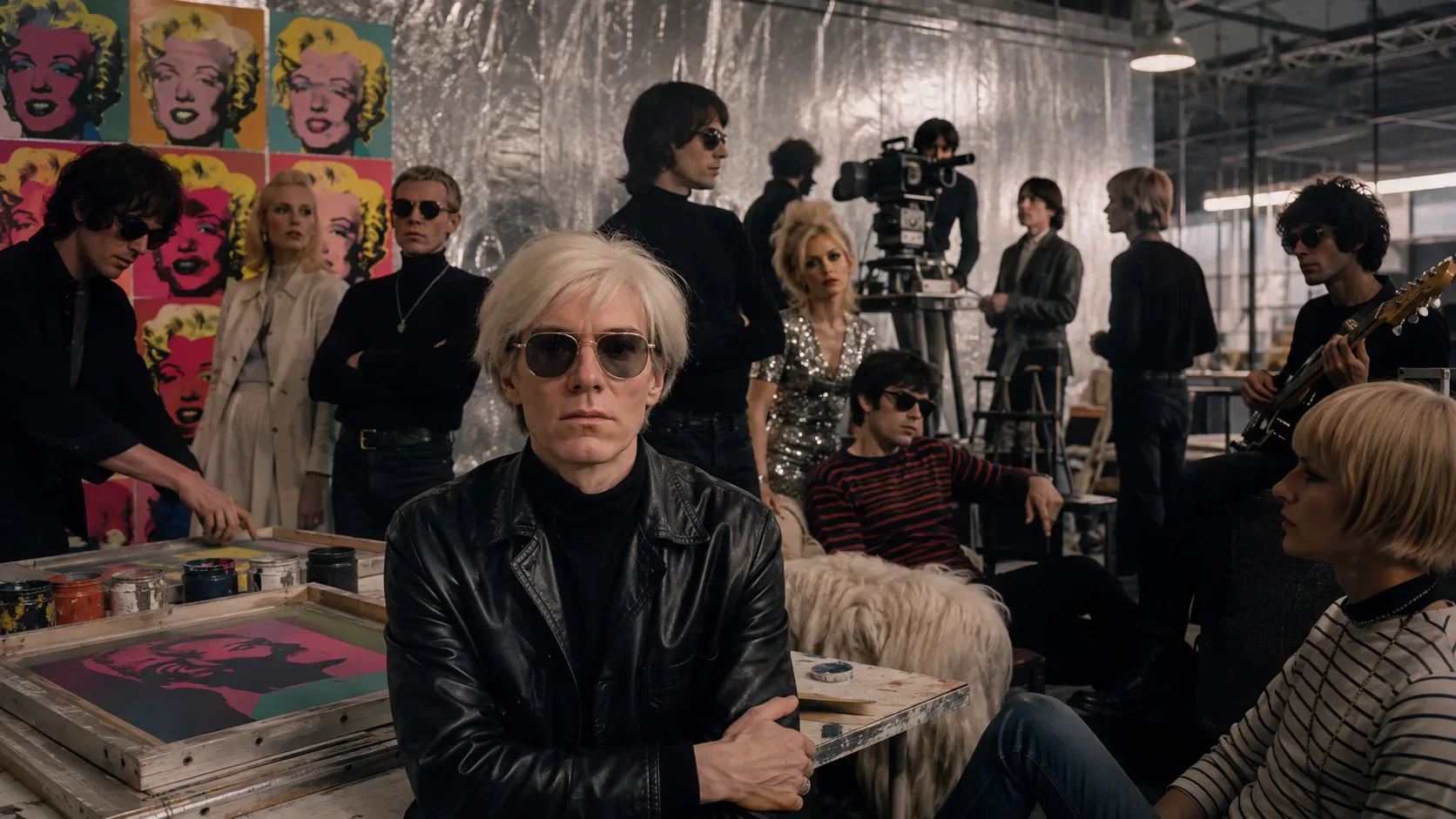
Andy Warhol was born Andrew Warhola on August 6, 1928, in Pittsburgh, United States. The date usually reopens interest in his screen prints, films and portraits of celebrities. But Factory allows us to ask a more productive question than repeating his biography: how much of the work attributed to an artist depends on the people, techniques and infrastructure gathered around him?
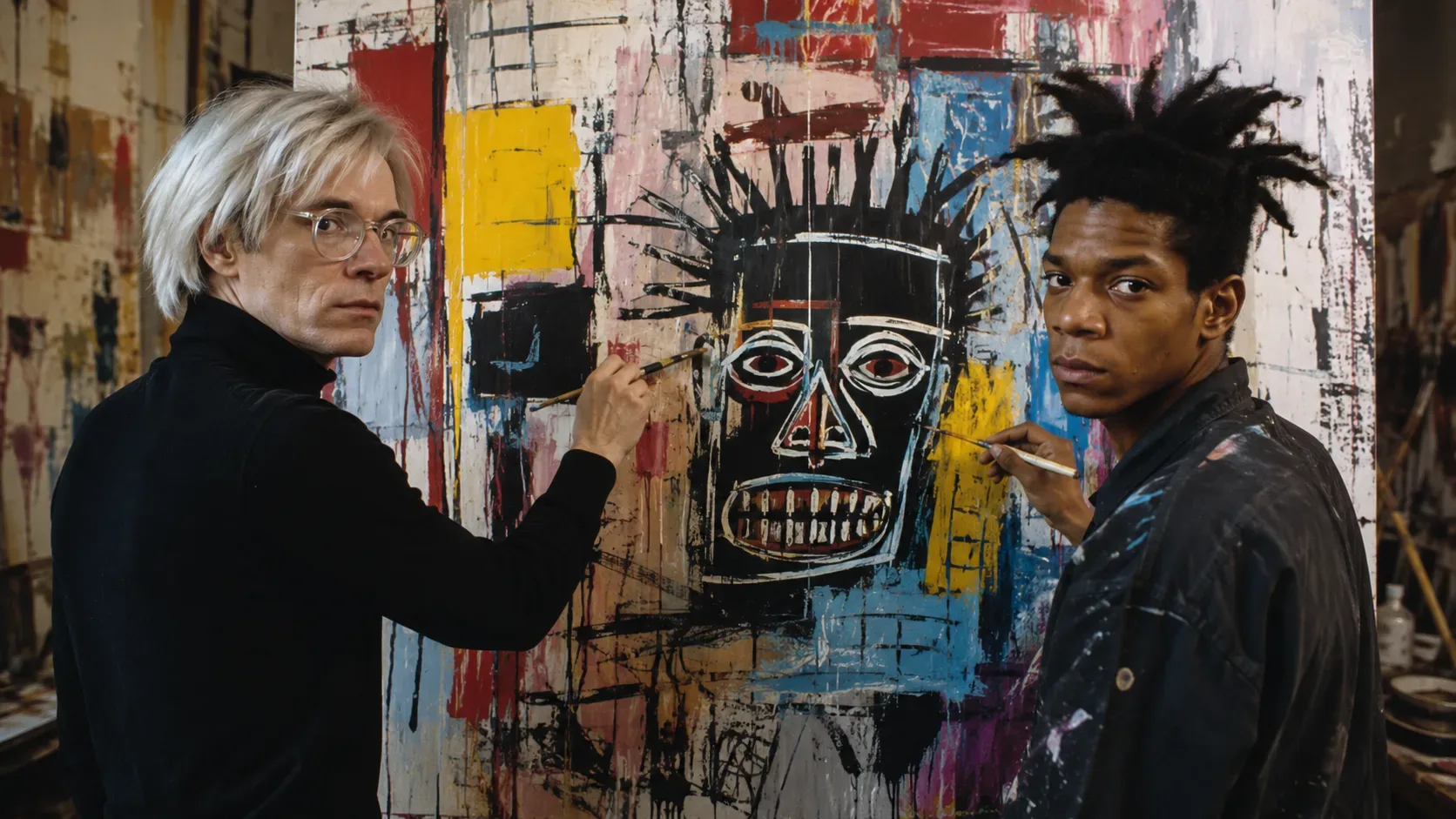
Warhol signed the work; Factory multiplied the system. Assistants pulled up screen printing screens, photographers recorded everyday life, performers provided faces and actions, filmmakers operated cameras, musicians turned projections into shows, and collaborators helped convert recorded conversations into books and magazines. Warhol remained the main selector, director, approver and public name, but the production no longer fit the image of the artist working alone in front of a canvas.
Factory was a studio, but it functioned as infrastructure
Warhol's experiment with shared processes did not begin in Pop art. After completing a pictorial design course at the Carnegie Institute of Technology in 1949, he moved to New York and built a career as a commercial illustrator. Part of this work already depended on photographs, pre-existing images and technical assistance — practices that would continue to be present when he entered the visual arts circuit.
In the early 1960s, Warhol adopted photographic screen printing to produce repeated images with a deliberately mechanical appearance. The technique allowed the work to be divided into stages: choosing an image, preparing the canvas, applying areas of color, printing and deciding which flaws, displacements or variations would remain in the work. The National Gallery of Art notes that Warhol employed assistants to speed up this production and reinforce his dialogue with the industrial economy and serial reproduction.
It was in this context that the name “Factory” gained strength. Sources vary between 1963 and 1964 for the beginning of the first studio, depending on whether they consider the occupation of the loft or the public consolidation of the space. The address of the first Factory was 231 East 47th Street in Manhattan. Billy Name covered the space with silver paint and metallic foil, helping to create the so-called Silver Factory.
The coating was not just decoration. The silver space acted as a backdrop for photographs and films, reflected lighting and offered the Factory a recognizable visual identity. Billy Name also became a resident photographer and documented people, objects and situations that, decades later, still guide the reconstruction of that period. The workplace itself began to produce images and memory.
The Factory also welcomed artists, poets, models, actors, musicians, filmmakers, collectors and the curious. Some were employees or frequent collaborators; others showed up for a project, a shoot or a night. This circulation made it difficult to accurately separate the studio, the cinema set, the social meeting point and the advertising machine. The network was unstable, but this instability provided characters, ideas, contacts and opportunities.
This does not mean that Factory was a horizontal collective. Warhol selected themes, images and colors, decided what would be presented and focused public recognition. Collaboration expanded the process, but credit, control, and commercial value remained unevenly distributed. Each person's contribution needs to be analyzed work by work, rather than being erased or treated as equivalent to Warhol's.
Network map: who did what at Factory
The periods below are approximate. Factory did not have a stable organizational chart, and several people accumulated roles or came and went according to the project.
| Network node | Period of greatest activity | Documented functions | What it added to the system |
|---|---|---|---|
| Andy Warhol | From 1963, in different phases until 1987 | Selection of images and people, direction, approval, production and public presence | He unified heterogeneous works under a recognizable vision and under the name Andy Warhol. |
| Gerard Malanga | 1963–1970 | Assistance in screen printing, acting in films, poetry, dancing in Exploding Plastic Inevitable and initial participation in Interview | It linked the production of images to performance, cinema and publishing. |
| Billy Name | Circa 1964–1970 | Silver ambiance, lighting, space operation, photography and documentation | Transformed the studio into a set and produced a visual archive of the network. |
| Paul Morrissey | Mid-1960s–1974 | Camera, co-direction, film production and project organization | He helped move films from stillness and silence to moving cameras, synchronized sound, and more complex narrative structures. |
| “Superstars” and performers, such as Edie Sedgwick, Ondine, Viva and Joe Dallesandro | Mainly from 1964 to the early 1970s | Acting, improvisation, posing, dancing and social circulation | Their bodies, voices, stories and personas became the subject of films, photographs and events. |
| The Velvet Underground and Nico | Late 1965–1967 | Music, recording and presentations integrated with films, lights and dance | Expanded the Factory to multimedia shows and phonographic production. |
| Editorial and documentary network, with Brigid Berlin, Pat Hackett, Bob Colacello and Fred Hughes | From the late 1960s to the 1980s, according to the contributor | Recordings, conversations, transcription, editing, books and magazines | Extended authorship for writing, archiving and print media. |
The map reveals that “collaborator” does not describe a single activity. Malanga could help print a painting, appear on camera and dance in a show. Billy Name was responsible for the environment and, at the same time, recorded the life that this environment attracted. Morrissey acted in cinema, but also participated in the organization of production. The boundaries between doing, appearing, documenting and disseminating were porous.
How the network interfered with creation
Screen printing separated decision and execution
A traditional painting tends to associate the visible gesture with the artist's hand. Screen printing weakened this correspondence. The image could come from a photograph, the screen could be technically prepared and the printing could involve more than one person. The result still depended on artistic decisions, but these decisions did not need to coincide with the execution of each stage.
Gerard Malanga was hired for his experience with screen printing and worked directly on the production of the images. Research into the Factory indicates that Warhol chose themes, visual sources and colors, followed the process and gave final approval. Thus, authorship operated less as an integral execution and more as a combination of choice, direction and control of the result.
The distinction is important because it avoids two opposite errors. The first is to imagine Warhol alone producing each surface attributed to him. The second is to conclude that his participation was irrelevant because there were assistants. At Factory, conception, technical operation, selection and signature could belong to different people, but they did not have the same power.
Cinema transformed visitors into participants
Between 1964 and 1966, Warhol made approximately 500 filmed portraits known as Screen Tests. Famous and anonymous people who visited the Factory were positioned in front of a 16 millimeter camera. Reels were filmed at normal speed and projected more slowly, creating silent portraits in which small movements took on intensity.
Although linked to Warhol's name, these films depended on a relationship. The camera provided duration and framing, but each person decided how to face the silence, the discomfort and the image itself. Assistants could also operate the equipment. The work emerged from the encounter between an established procedure, an individual presence and the social environment that had brought that person to the studio.
In more complex productions, technical participation became even more evident. MoMA identifies Chuck Wein and Paul Morrissey as collaborators who helped introduce written direction, moving camera, synchronized sound, actors, dialogue, and narrative situations to Factory films. Warhol's name remained central, but the language changed due to the actions of other people.
The cinematic material also continues to reveal the shared nature of the archive. In 2024, MoMA and the Andy Warhol Museum processed dozens of scrolls that had remained undeveloped for some six decades. Among them were films made by cameraman Danny Williams with Warhol, Malanga, Morrissey, Edie Sedgwick and members of the Velvet Underground. The find reinforces that not every image produced in that circle came directly from Warhol's camera.
Music, projection and dance formed a composite work
The relationship with the Velvet Underground began at the end of 1965. Warhol took on the role of producer, got studio time for the group's first album and incorporated the band into performances that combined live music, films, projections, lights and dance.
In Exploding Plastic Inevitable, there was no single object that concentrated the entire experience. The sound came from the band; Nico added another voice and presence; films were projected into space; Gerard Malanga and other performers danced; Lights changed the perception of the stage and the audience. Authorship was made up of coordination between media and people.
Warhol did not need to play an instrument to occupy an authorial position. Its role was to bring the band closer to the network, frame the presentation as part of its project, offer visibility and connect music, cinema and performance. At the same time, the result depended on the compositions, execution and artistic choices of the musicians and performers.
Books and magazines extended the Factory method
The collaboration did not end with painting or cinema. The Andy Warhol Museum reports that Warhol almost always worked with other people in preparing his books. Some works came from recorded conversations, later transcribed, selected and edited. The Philosophy of Andy Warhol, for example, was based on recordings involving Warhol, Brigid Berlin, Fred Hughes, Pat Hackett and Bob Colacello.
After recovering from the attack he suffered on June 3, 1968, Warhol reduced his direct participation behind the camera. The following year, he participated in the creation of Interview, a magazine that brought together cinema, fashion, celebrity and popular culture. Factory began to function increasingly as an editorial and business platform, as well as an artistic studio.
Artist, studio and brand were three different levels
The artist was Andy Warhol as an individual: someone who chose images, recognized people with visual potential, established procedures, accepted or discarded results, and made decisions about circulation. Your previous trajectory, your repertoire and your outlook cannot be replaced by the simple existence of a team.
The studio was the structure that allowed these decisions to be transformed into volume and variety. It brought together technique, equipment, work, characters and encounters. The Factory produced not just paintings, but films, photographs, performances, records, books, magazines and promotional material.
The brand was “Andy Warhol”, the name capable of unifying all of this before the public. The brand made projects made in different media recognizable and helped generate attention, access and commercial value. It could also hide differences in contribution, making the work of assistants, filmmakers, performers or editors perceived as the products of a single mind.
These three layers supported each other and were in tension. Without Warhol, that specific setting probably wouldn't exist. Without Factory, its production would have a different volume, a different speed and fewer means of circulation. Without the strength of the brand, many projects would not have reached the same audience. Individual authorship has not disappeared; became the center of gravity of a collective and asymmetrical production.
What Factory changed about the idea of a solitary genius
Factory did not prove that the artist is expendable. She showed that creating can also mean creating an environment in which people, techniques and media connect.. Warhol's talent included selecting, framing, approving, bringing together collaborators and converting social attention into artistic matter.
This model is closer to the contemporary work of creative directors, cultural producers and studio founders who do not personally execute all stages of a project, but define its direction. The difference is that the signature continues to concentrate a large part of the prestige, even when production is distributed.
So the most useful question is not whether Warhol “did everything” or “did nothing.” To understand a work linked to Factory, it is necessary to identify who proposed the concept, who carried out each stage, who made the final decision, who received credit and which infrastructure allowed the work to circulate.
Warhol remains the name at the center of the map. Factory shows that a center does not exist without connections — and that the story of creation becomes more accurate when it also identifies the nodes that support the network.
To discover other trajectories in which individual authorship intersects with teams, institutions and collaborators, explore the profiles of the blog Gênios em Rede.