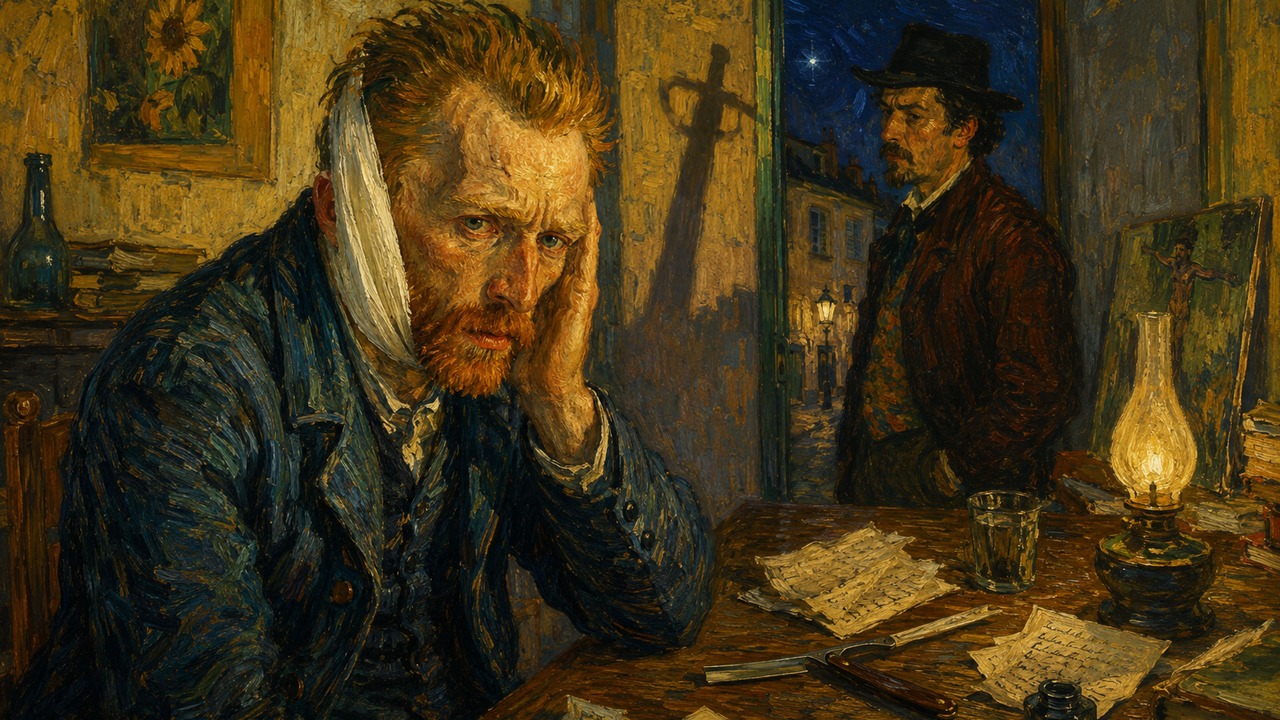
The most responsible answer is less spectacular than the legend: there is no document capable of reliably stating a single reason why Vincent van Gogh injured his own ear. What exists is a well-established sequence. On December 23, 1888, after weeks of tension in the Yellow House, Van Gogh and Paul Gauguin argued. Gauguin left and spent the night in a hotel. Later, Van Gogh suffered a serious crisis that ended with the injury to his ear and the delivery of the cut piece to a woman in a brothel in Arles. The next morning he was taken to the hospital. The break with Gauguin is a central part of the context, but turning it into a single psychological cause goes beyond the evidence.
The confusion grows because three different layers are often mixed together as if they had the same weight: the facts recorded close to the event, the narrative that Gauguin published many years later and a modern hypothesis according to which Gauguin struck Van Gogh with a sword. When these layers are separated, the episode becomes less mysterious, although it does not become fully resolved.
What was happening at Casa Amarela before December 23rd
Van Gogh arrived in Arles in February 1888 and rented the Yellow House with an ambitious project: he wanted to form a community of artists in the south of France who would work together. Gauguin was essential to this plan. He arrived on October 23rd and stayed just over two months.
The coexistence produced important works and real artistic exchange, but also friction. The two disagreed about painting, method, money and domestic routine. The Van Gogh Museum itself summarizes this period by saying that their personalities and ideas soon clashed. At the beginning of December, Gauguin was already considering leaving. Therefore, when the night of December 23rd arrives, the relationship does not suddenly fall apart: the argument occurs at the end of a relationship that had become more difficult.
This helps to understand the weight of Gauguin's departure for Van Gogh. It meant not only the departure of a colleague, but the immediate collapse of the "Ateliê do Sul" project that he imagined for Casa Amarela. Still, context is not proof of motive. We do not have a statement from Van Gogh saying that he injured himself for a specific reason, and any explanation that transforms a set of tensions into a retrospective diagnosis must be treated with caution.
The documented timeline of December 23-25, 1888
December 23: the argument and the injury
The chronology presented today by the Van Gogh Museum records that Van Gogh and Gauguin argued on the night of December 23rd. Gauguin left the Yellow House and checked into a hotel. After that, Van Gogh cut off his left ear, took the fragment wrapped in paper to a brothel and the police were called.
A local newspaper, Le Forum Républicain, published a very close account of the events on December 30th. The news said that, around 11:30 pm the previous Sunday, Van Gogh appeared at an authorized establishment, asked for a woman named "Rachel" and handed her the ear, asking her to keep the object. The text also states that the police found him at home the next morning, practically unresponsive, and that he was taken to the hospital. The newspaper does not explain what happened between the argument with Gauguin and the mutilation. It mainly confirms what happened after the injury.
December 24: hospital and telegram to Theo
In the early hours of December 24, Van Gogh was taken to Arles hospital. Gauguin, who had been out all night, sent a telegram to Theo van Gogh in Paris. This point is important because it establishes a physical separation between the two after the argument: the institutional version of the Van Gogh Museum places Gauguin in the hotel and Van Gogh in the Yellow House when the injury occurs.
December 25: Theo arrives and Gauguin leaves
Theo arrived in Arles on the morning of December 25th and visited his brother in the hospital. Van Gogh was physically weakened and confused. That same night, Theo and Gauguin returned to Paris together. Gauguin never returned to the Casa Amarela. Within days, the artistic community project that Van Gogh had tried to build ended abruptly.
What Gauguin told - and why his account needs caution
The more detailed narrative of the fight is not contemporary with the episode. Gauguin wrote it in Avant et Après in 1903, about fifteen years later. According to him, the relationship had deteriorated, Van Gogh had demonstrated threatening behavior and, on the decisive night, had followed Gauguin with an open razor. Gauguin claims that he turned around, faced Van Gogh and saw him give up and run back home. He then says he looked for a hotel and only found out about the mutilation the following morning.
This account is valuable because it comes from one of the two protagonists and contains details that help to reconstruct the night. But it is not a filming of the facts. It was written much later, when Gauguin already had his own public version of his relationship with Van Gogh and reasons to explain his departure from Arles. More importantly: by his own account, Gauguin did not see the moment the ear was cut off. He tells the previous confrontation and then states what happened at Casa Amarela.
Therefore, the statement "Van Gogh chased Gauguin with a razor" belongs to the category of later testimony, not to that actually observed by independent sources. The Van Gogh Museum also formulates this point carefully: Gauguin "later claimed" to have been chased and threatened with a razor. This choice of words avoids transforming a belated memory into documentary certainty.
So why did Van Gogh cut off his ear?
The documentation allows us to say that the injury occurred during a serious crisis, on the same day that coexistence with Gauguin reached the breaking point. Allow
Also to say that Van Gogh had been experiencing a period of enormous personal and emotional pressure and that, in the following months, he would have new crises. What it doesn't allow is to reduce everything to a simple formula like "he did it because Gauguin was going to leave".
Van Gogh himself, when later writing about his condition, used expressions such as "mental or nervous fever" and admitted that he did not know exactly how to name what had happened. The Van Gogh Museum points out that we don't know exactly what medical condition he had. This is relevant because biographies and popular texts often try to fit the episode into modern diagnoses made from a distance. To understand the night of 1888, it is safer to describe symptoms, circumstances, and documents than to retrospectively attribute a specific illness as a definitive explanation.
Gauguin's departure probably worsened an already fragile situation, and the end of the Casa Amarela project gives historical meaning to the moment. But "probably worsened" is not the same as "caused." The exact reason remains inaccessible.
Where did the theory that Gauguin cut off his ear with a sword come from?
In 2009, historians Hans Kaufmann and Rita Wildegans presented an alternative reconstruction. After years of examining records, letters and reports, they proposed that Van Gogh and Gauguin had confronted each other outside the Yellow House and that Gauguin, who practiced fencing, had struck Van Gogh in the ear with a sword. According to the hypothesis, the two would have maintained a pact of silence: Van Gogh would not denounce his friend and Gauguin would not reveal all the details of the night.
The thesis draws attention because it tries to explain some strange pieces of documentation. Gauguin had fencing equipment in Arles. In January 1889, already recovering from the episode, Van Gogh wrote to Gauguin about returning fencing masks and gloves and made a dark joke, calling those materials "terrible war machines". Kaufmann and Wildegans also reinterpreted other later allusions, words, and drawings as possible signs that there was a secret between the two.
These elements make the hypothesis debatable in the literal sense: there is material to be debated. But they do not amount to direct proof that a Gauguin blade caused the injury.
Why the sword theory remains controversial
The first problem is the absence of direct witnesses to the coup. There is no contemporary testimony saying that anyone saw Gauguin cut off Van Gogh's ear. The thesis depends on circumstantial reconstruction: fencing equipment, ambiguous language in letters, possible symbols and an alternative reading of their behavior.
The second problem is that the hypothesis needs to explain why the closest sources do not record a Gauguin attack. The local newspaper reports on Van Gogh's self-mutilation and trip to the brothel. The chronology adopted by the Van Gogh Museum continues to present the episode as an act by Van Gogh after Gauguin left the house. This does not make every detail of the conventional version indisputable, but it shows where the main weight of
institutional evidence.
The third problem is the source itself used to question the traditional narrative. Gauguin is a late and interested witness, therefore he should not be accepted without criticism. At the same time, rejecting it outright also does not automatically produce evidence in favor of the sword. The weakness of a source does not confirm the competing hypothesis.
Finally, some of the clues cited by defenders of the sword are compatible with less dramatic interpretations. Van Gogh could mock Gauguin's fencing equipment precisely because the relationship between the two had ended in conflict. A phrase about "war machines" may sound suggestive once we know the theory, but it does not identify weapon, blow, location, author or injury dynamics.
What is fact, what is testimony and what is hypothesis
The safest core is short. On December 23, 1888, Van Gogh and Gauguin argued. Gauguin left the Yellow House and spent the night in a hotel. Van Gogh suffered a serious ear injury, took the fragment to a woman in a brothel and was found by police the next morning. On December 24, he was hospitalized and Gauguin called Theo. On December 25, Theo visited his brother; later, he returned to Paris with Gauguin.
On a second level is Gauguin's testimony, published fifteen years later: Van Gogh would have followed him with a razor, retreated before him and returned to the house. It is an important source, but late and without eyewitness testimony of the cut itself.
On a third level is the sword theory: a modern reconstruction according to which Gauguin would have caused the injury during a confrontation and the two would have hidden the fact. It organizes real evidence into an alternative narrative, but remains dependent on inferences and has not presented direct evidence capable of consensually replacing the self-mutilation explanation.
The best answer does not need to choose between legend and sensationalism
The question "why did Van Gogh cut off his ear?" it often invites a simple psychological response or a conspiratorial revelation. The documents support a more sober answer. The crisis occurred at the breaking point of his relationship with Gauguin, when the artistic project of Casa Amarela was falling apart. This helps explain the context, not identify a single reason.
There is also not sufficient basis to state as fact that Gauguin cut off his ear with a sword. Kaufmann and Wildegans' hypothesis is interesting because it forces historians to return to the letters, the reports and the gaps in the case. But it remains controversial precisely because it transforms indirect signals into a sequence of events that no contemporary source records directly.
The Arles episode remains famous because it combines a relatively well-documented chronology with an empty center: no one left a reliable and immediate account of the exact moment of the injury. Separating this void from the information that actually survives is more useful than filling it with retrospective certainty.