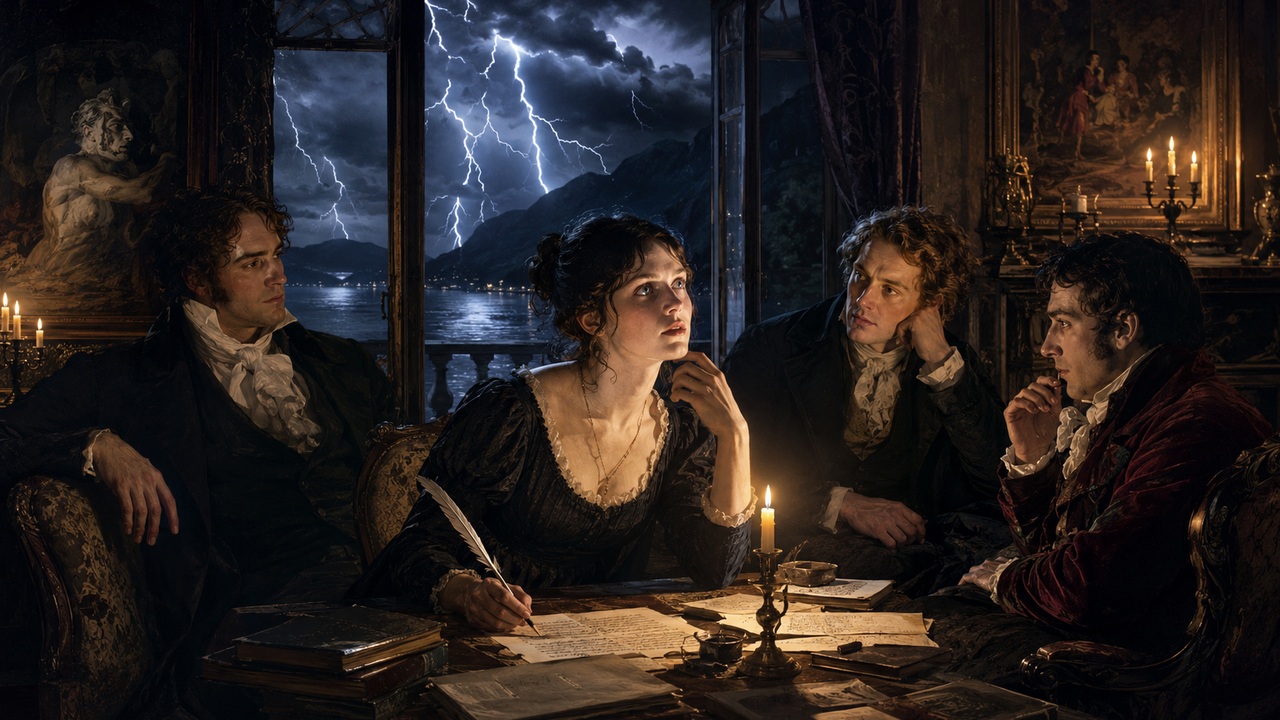
Frankenstein was not born ready in a single stormy night. What happened near Lake Geneva in June 1816 was more interesting: a small circle of writers turned ghost readings, conversations about the origin of life, creative rivalry, and half-baked ideas into projects that would follow very different paths. Mary Shelley left that summer with the core of Frankenstein. Lord Byron left a fragment of supernatural narrative. Percy Bysshe Shelley abandoned his own attempt, but participated intensely in the intellectual milieu and later development of Mary's novel. John Polidori, in turn, would end up converting part of Byron's idea into The Vampyre, a decisive work for the tradition of the aristocratic vampire.
Frankenstein wasn't born overnight
The scene became famous because it seems too perfect not to become a myth: a villa on the edge of a Swiss lake, romantic poets, rain, thunder, candles and a ghost story competition. Almost all of this has a documentary basis. The problem begins when popular memory compresses weeks and months of creation into a single dawn. In 1816, Europe was experiencing the so-called "year without a summer", associated with the climatic consequences of the eruption of Mount Tambora, which occurred in 1815. Mary would later recall a humid and inclement summer, with persistent rain. Storms over Lake Geneva also appear in his records and left their mark on Frankenstein himself. The weather helps explain the atmosphere of the meeting, but it does not act alone as a cause of romance.
Who was really at Villa Diodati
Another detail that is often simplified is hosting. Lord Byron rented Villa Diodati, in Cologny, near Geneva, and stayed there with his young doctor, John William Polidori. Mary Godwin, not yet married to Percy Bysshe Shelley at that time, Percy and Claire Clairmont were staying at Maison Chappuis, a few minutes' walk away. They visited Diodati frequently, especially at night. This matters because the expression "Villa Diodati's group" describes the social and literary circle well, but it does not mean that they all lived under the same roof. Claire was also part of this environment.
In the 1831 introduction to Frankenstein, Mary would recall that four people accepted the challenge of writing ghost stories, without including her among the participants in the contest. The chronology reconstructed by the Shelley-Godwin Archive notes, however, that Claire's participation cannot be so simply dismissed.
The challenge of ghost stories
The exact date on which the competition began is not completely certain. The documents point to mid-June 1816, probably between the 15th and 16th. Mary said in 1831 that the group read ghost stories translated from German to French. This reading is generally associated with the Fantasmagorian collection. Then, according to his recollection, Byron proposed that everyone write a ghost story. The reconstruction is reinforced by Polidori's diary. On June 17 he recorded that the ghost stories had already been started by everyone except him. The next day, he noted that he began his own story after tea. The diary shows a sequence of creative experiences, conversations and readings, not a single perfectly documented instant.
Mary Shelley: from lockdown to "waking dream"
Mary didn't come up with the idea right away. In the 1831 introduction, written fifteen years after the Geneva Summer, she describes the frustration of being asked every morning whether she had yet thought of a story. The turning point came after conversations between Byron and Percy Shelley about the "principle of life", the possibility of reanimating matter and the speculations that circulated around galvanism and experiments attributed to Erasmus Darwin. Mary was careful to record that she was talking about what was said about Darwin, and not what he had necessarily done. This caveat is important: Frankenstein's origin does not depend on a real scientific experiment capable of resurrecting a corpse. What matters is the scientific imagination available at that moment, mixed with the philosophical debate about matter, life and creation. After these conversations, Mary reported having experienced a kind of vision between wakefulness and sleep: she imagined a young scholar kneeling before the being he had assembled, and the creature showing signs of life. The image contained the missing dramatic core. The next day, probably June 17, she announced that she had a story and began writing the scene that would later appear in the novel as the creature's animation. But this beginning was not yet Frankenstein as we know it. The records for July and August show Mary working on "my story." She later turned the short project into a novel. The surviving manuscript allows us to follow this expansion during 1816 and 1817. The work was completed the following year and published anonymously in January 1818.
Byron: the host who blazed the trail for the vampire
Byron had two decisive roles. The first was social: his house became the center of the meeting and, according to Mary, he was the one who launched the ghost story challenge. The second was literary: Byron began a narrative of his own, today known as A Fragment or Fragment of a Novel. The fragment, dated June 17, 1816, follows a narrator traveling with the mysterious Augustus Darvell. There is death, secrecy and promise, but the story ends before fully developing. Byron abandoned the project and the text would only be published in 1819, together with Mazeppa. The fragment is not The Vampyre, but it is the indispensable link to understanding how Diodati's reunion also entered the history of vampire literature. Byron's incomplete idea would be reused in another way by Polidori.
Percy Shelley: more than a witness, less than a co-author
In Mary's memory, Percy also began a story during the competition, based on experiences from his youth, but did not pursue it further. His most lasting contribution occurred on another level. He participated in the philosophical conversations that fueled Mary's imagination, read the project, encouraged her to stop treating it as a short story and develop it at greater length. Manuscripts digitized by the Shelley-Godwin Archive record changes in Percy's hand. This shows real editorial collaboration: corrections, suggestions and interventions in the text preparation process. There is also evidence that he helped with negotiations with the publisher and the submission of the manuscript. None of this turns Percy into the hidden author of Frankenstein. Mary herself acknowledged his influence and, at the same time, stated that she did not owe her husband the invention of the incidents or the main lines of feeling in the novel.. The best description, therefore, is that of a very close interlocutor and editor, whose material participation can be seen in the manuscript, without erasing Mary Shelley's authorship.
Polidori: the link between Diodati and The Vampyre
John Polidori's trajectory is the part that is most lost when the story is told quickly. In Diodati he began a supernatural story, but the documents do not allow us to simply identify this first attempt with The Vampyre. The preserved material about Polidori itself associates his Cologny experience with another project, Ernestus Berchtold. The Vampyre emerged later, from the "foundation" of a story that Byron had planned and started. Polidori publicly explained that the basic elements came from Byron, but that the development was his. The distinction was especially important because, in 1819, the story appeared in the New Monthly Magazine, incorrectly attributed to Lord Byron. Polidori protested. The confusion, however, helped to glue the two stories together forever. The character of Lord Ruthven and the figure of the seductive and aristocratic vampire gained enormous circulation. So the line that comes from Diodati to The Vampyre is not "Polidori wrote his tale that very night." It is a sequence: Byron imagines and begins a fragment; Polidori knows this stuff; then develops its own narrative; the publication misattributes it to Byron; and vampire literature gets a new character model.
Frankenstein and The Vampyre were born on the same night?
In a literal sense, no. Frankenstein has a direct and well-documented relationship with the challenge, with the conversations in mid-June and with the vision narrated by Mary. The Vampyre belongs to the same creative genealogy, but its known form was later developed by Polidori from the ground opened by Byron's fragment. In a cultural sense, however, the association makes sense. The same circle produced two lines of literary descent that would become gigantic: the man-made creature and the aristocratic vampire. The meeting did not deliver two finished works; delivered problems, images, sketches and influence relationships that continued work after the summer ended.
What became a legend
Everyone lived in Villa Diodati
No. Byron and Polidori were in Diodati. Mary, Percy and Claire occupied the nearby Maison Chappuis and frequented the villa. The simplification is understandable because Diodati became the symbolic name of the meeting, but it erases the real geography of the group.
Mary Shelley wrote Frankenstein in one night
No. The core of the story may have emerged suddenly, and Mary probably began writing it in mid-June 1816. The novel, however, grew over many months. His notebooks and chronology show continued work in 1816 and 1817 before the 1818 publication.
Lightning created the monster in Mary's head
The storms were real and entered the novel's imagination, but the most documented explanation is different. Mary related the conception to conversations about the origin of life, reanimation, galvanism, and the vision she had after them. The iconography of the laboratory, electricity, and lightning would later be expanded upon by adaptations and popular culture.
Percy Shelley wrote Frankenstein with Mary
The manuscripts show that Percy interfered in the text and participated in transforming the project into a novel. Calling this an editorial collaboration is correct. Turning him into a secret co-author, however, goes beyond what the evidence supports and contradicts Mary's own explanation of the origin of the central narrative ideas.
Byron wrote The Vampyre
No. The short story is by Polidori. Byron provided some of the narrative terrain through his fragment and plot idea, but Polidori claimed development of the text. The attribution to Byron in the 1819 publication was precisely the reason for a public authorship controversy.
What each person really added to the meeting
Mary Shelley
Mary turned the challenge into a story of her own, found a powerful central image and did something that no one else in the group did at that time: she developed the initial impulse until she converted it into a novel with great moral and narrative architecture. Creation is not limited to the scare of sight. The decisive work was to expand that image to discuss responsibility, abandonment, education, ambition and the limits of human creation.
Lord Byron
Byron provided the stage, the competitive stimulus, and an unfinished narrative that came to life beyond him. Its fragment is small when compared to Frankenstein, but its historical importance grows because it becomes a direct ancestor of Polidori's story and because it records the type of literary experience that circulated in the group.
Percy Bysshe Shelley
Percy was a philosophical interlocutor, competition participant, reader, supporter and editor. Its presence is important precisely because it shows that individual works are also born in networks of conversation. Recognizing this network does not require artificially dividing the authorship of the novel.
John Polidori
Polidori was more than Byron's doctor or a secondary character in the famous night. By transforming Byron's narrative basis into The Vampyre, he created a work with its own trajectory and helped to establish a socially powerful, seductive and dangerous type of vampire that would have long descendants in 19th century fiction and beyond.
Why Villa Diodati still matters
The power of this story lies less in the idea of four geniuses producing masterpieces simultaneously and more in the actual functioning of a creative encounter. One proposes a game. Another leaves a fragment. A young writer takes time to find her story, but recognizes the seed of a novel in a frightening image. A doctor-writer collects materials that were not originally his and transforms them into another work. Conversations, readings, climate, friendship, competition and editing mix together. Villa Diodati became a legend because it offers a perfect scene. The documentation, however, offers something better than the legend: it shows that Frankenstein and The Vampyre's lineage were not instantaneous miracles. They were different results from the same intellectual network, developed at different times, by authors with concrete and traceable contributions. It is precisely this difference between the inspiring moment and the subsequent work that makes the summer of 1816 so extraordinary.