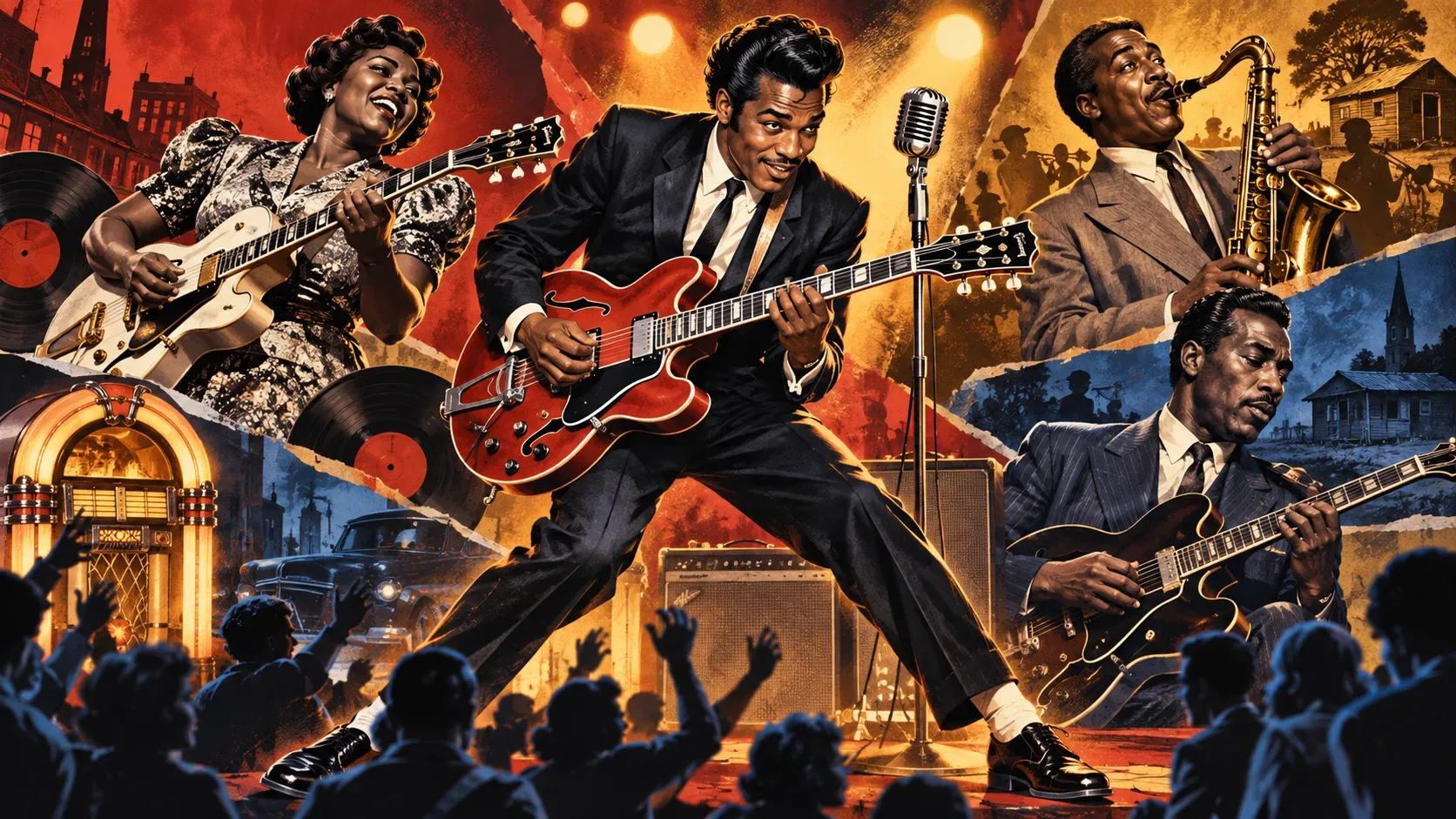
Chuck Berry did not “invent” rock and roll by himself. The most historically accurate answer is that the genre emerged through accumulation: electrified gospel, blues, jump blues, rhythm and blues, country, and other musical languages were already crossing paths before Berry arrived at Chess Records in 1955. Sister Rosetta Tharpe had shown decades earlier how voice, gospel fervor, electric guitar, and stage presence could create an energy that now sounds unmistakably connected to rock. Louis Jordan turned jump blues into hugely popular small-combo entertainment, driven by dance rhythm, humor, and fast-moving stories. T-Bone Walker placed the electric guitar at the center of modern blues, with expressive phrasing and a performance style that treated the instrument as spectacle.
What Berry did was different — and decisive. He condensed several of those currents into short songs, instantly recognizable riffs, lyrics about school, cars, dancing, desire, and youthful mobility, plus a singer-guitarist persona that countless bands would copy. That is why the useful question is not “who was first?” but which part of the mechanism that became rock and roll each artist helped build.
Why rock and roll has no single inventor
Popular genres rarely begin on one date or in one studio. They emerge when practices already circulating through churches, dance halls, radio, clubs, and regional circuits begin to combine, attract a distinct audience, and receive a commercial name. The Smithsonian describes rock and roll as a 1950s derivative of rhythm and blues, shaped by gospel and pop influences and strongly associated with teenage consumption. The Library of Congress likewise describes early rock and roll as a mixture of several African American musical styles with country music and Western swing.
That moves the “inventor” question toward concrete criteria. Who anticipated the electric guitar sound? Who supplied the dance pulse? Who turned the live show into body language? Who wrote for the new teenage audience? Who combined these elements in a form other bands could learn and repeat? The answer changes with the criterion.
Sister Rosetta Tharpe: electric guitar, gospel, and stage energy before the rock label
Sister Rosetta Tharpe first recorded in 1938. According to the Smithsonian, she brought the spiritual intensity of gospel into an electric-guitar-driven language and directly influenced later stars including Chuck Berry, Elvis Presley, Jerry Lee Lewis, and Little Richard. The historical point is not that every Tharpe recording should be labeled “rock,” but that elements later treated as rock innovations were already audible in her work.
Tharpe also disrupts the familiar story in which rock guitar appears only with male performers in the 1950s. Her blend of powerful singing, instrumental virtuosity, and commanding stage presence made the guitar more than accompaniment: it became a visual and rhythmic focus. The Library of Congress preserves her 1944 recording of “Down by the Riverside” in the National Recording Registry, a marker of the lasting importance of that body of work.
What she added: a bridge between gospel, popular performance, and electric guitar; a rhythmic attack that could sound sacred and danceable at once; and a singer-guitarist model that predates rock’s classic boom.
Louis Jordan: jump blues, the small combo, and danceable storytelling
During the 1940s, Louis Jordan and his Tympany Five helped turn jump blues into music with enormous popular reach. The Rock & Roll Hall of Fame notes that Jordan topped the R&B charts for an extraordinary total of 113 weeks and identifies his 1949 “Saturday Night Fish Fry” as a recording often cited among candidates for the “first rock and roll record.”
Jordan matters for more than that priority debate. His formula reduced the scale of the big band to a tighter group, retained swing and dance power, put saxophone and rhythm up front, and used conversational, comic, narrative lyrics. 1950s rock inherited much of that sense of movement and direct communication.
What he added: the propulsion of jump blues, small-combo efficiency, humor, a story told in a few minutes, and the idea that music could be sophisticated, popular, and built for dancing at the same time.
T-Bone Walker: electric guitar as lead voice and spectacle
If Tharpe demonstrated the power of electric guitar in gospel and popular entertainment, T-Bone Walker was central to consolidating a soloistic electric-blues language. The Rock & Roll Hall of Fame describes him as a pioneer in the use of early electric guitars in blues and emphasizes how he made the instrument communicate emotion. His 1940s recordings helped establish the amplified guitar as a protagonist rather than merely harmonic support.
Walker also connected sound and body. His reputation as a showman — using acrobatic movements and treating the guitar as an extension of the performance — anticipated a basic principle of rock: a guitarist did not only have to play; the guitarist could stage the instrument itself. There is no need to claim one exclusive line from Walker to Berry to see the continuity. By the time rock exploded, electric guitar, virtuosity, physical presence, and spectacle already had a history.
What he added: expressive electric phrasing, the lead-guitar role in blues, and a bond between instrumental technique and theatricality that would become central to rock imagery.
What Chuck Berry actually consolidated
Berry entered this process after many ingredients already existed, but he found an extraordinarily portable combination. His official biography records that he arrived at Chess Records in 1955 with a song derived from a country-flavored number then called “Ida May.” Reworked as “Maybellene,” it became a major hit. The crossing of rhythm and blues, blues, and country was no accident: the Library of Congress specifically cites “Maybellene” as an example of Berry bringing country influence into emerging rock and roll.
Berry then refined a grammar. “Roll Over Beethoven” (1956) placed the new music in symbolic confrontation with high culture; “School Day,” “Sweet Little Sixteen,” and “Johnny B. Goode” helped turn school, radio, dancing, cars, ambition, and teenage life into recurring subject matter. Berry’s own official biography emphasizes his ability to articulate the concerns and attitudes of a predominantly young audience.
On guitar, Berry did not invent amplification, the solo, or stage spectacle. His achievement was to give those elements a compact, repeatable vocabulary: guitar figures placed at the front of the song, riffs that worked as signatures, direct dialogue between voice and instrument, and a singer-guitarist posture perfectly suited to the new band format. The Library of Congress, in its note on “Roll Over Beethoven,” says Berry has been described as the figure who came closest to “inventing” rock and roll — not because everything began with him, but because his songwriting, guitar work, and lyrical language formed an exceptional synthesis of the emerging genre.
Comparison: what each artist added to the formula
| Artist | Documentable contribution | What Berry consolidated from that terrain |
|---|---|---|
| Sister Rosetta Tharpe | Electrified gospel, prominent guitar, virtuosity, and stage presence before the classic rock era. | Carried guitar centrality into secular songs aimed at the youth market and the rock circuit. |
| Louis Jordan | Danceable jump blues, small-combo power, humor, popular storytelling, and major 1940s R&B reach. | Converted that narrative efficiency into guitar-centered songs about school, cars, dancing, romance, and mobility. |
| T-Bone Walker | Electric blues with expressive lead guitar and visual performance centered on the instrument. | Helped make the singer-guitarist a rock archetype, with riffs that identified a song from its opening bars. |
| Chuck Berry | Synthesis of R&B, blues, and country; youth-oriented songwriting; riff-based guitar; spectacle; highly repeatable repertoire. | Gave 1950s rock a grammar later bands could learn, copy, adapt, and internationalize. |
Berry was more rock’s great codifying songwriter than rock’s lone “inventor”
This may be the best explanation for his special position. Many predecessors supplied sound, technique, or attitude. Berry connected those dimensions to unusually efficient songwriting. In his best tracks, the listener gets a character, a setting, motion, and conflict in only a few lines, while the guitar works almost like a second voice.
That also helps explain why the Beatles and Rolling Stones found his repertoire so easy to absorb. The importance is not simply that they covered his songs, but that Berry’s songs functioned as a practical manual for how a rock band could sound: guitar up front, direct rhythm, memorable phrases, lyrics built from concrete scenes, and a tight relationship between performance and youth culture.
Why the story does not end with these four names
Sharing credit among Tharpe, Jordan, Walker, and Berry corrects the idea that rock came from one person, but it still does not tell the whole story. Big Mama Thornton, Fats Domino, Bo Diddley, Little Richard, Ike Turner, and many others belong in any serious reconstruction of the period, along with collective traditions of gospel, blues, R&B, country, and dance music. The purpose of this four-artist frame is not to create a new podium; it is to show why the verb “invent” fails when applied to a genre built through circulation and mixture.
Even the definition of the “first rock record” changes with the criterion: guitar distortion, beat, lyrics, audience, instrumentation, intensity, or commercial use of the label. Different candidates can be defended without one erasing the others.
Berry’s centennial brings the question back — without requiring a myth
Chuck Berry was born on October 18, 1926, and would turn 100 on October 18, 2026. The Berry family and Isalee Music launched CHUCK100 as a multi-year celebration culminating on that date, with tributes, new recordings, and other projects built around his legacy.
The centennial is a strong reason to put Berry at the center of the conversation again, as long as the tribute does not erase the network that made his music possible. His greatness becomes clearer, not smaller, in context: Berry did not need to be the first to electrify a guitar, accelerate blues, or turn the stage into spectacle in order to change history. His contribution was to organize many of those forces into a form so convincing that, for millions of listeners and musicians, it came to sound like the definition of rock and roll itself.
So who invented rock and roll?
The short answer is: no one person. Sister Rosetta Tharpe anticipated the force of electric guitar and performance-driven gospel; Louis Jordan brought jump-blues swing, humor, and danceable storytelling to mass audiences; T-Bone Walker turned electric guitar into lead voice and spectacle; and Chuck Berry condensed R&B, blues, and country into songwriting, guitar language, and youth culture that became a model for later rock.
If a formula is more useful than a winner, it is this: Tharpe helped electrify the language, Jordan made it swing, T-Bone put the guitar out front, and Berry turned that inheritance into a rock vocabulary the whole world learned to speak.