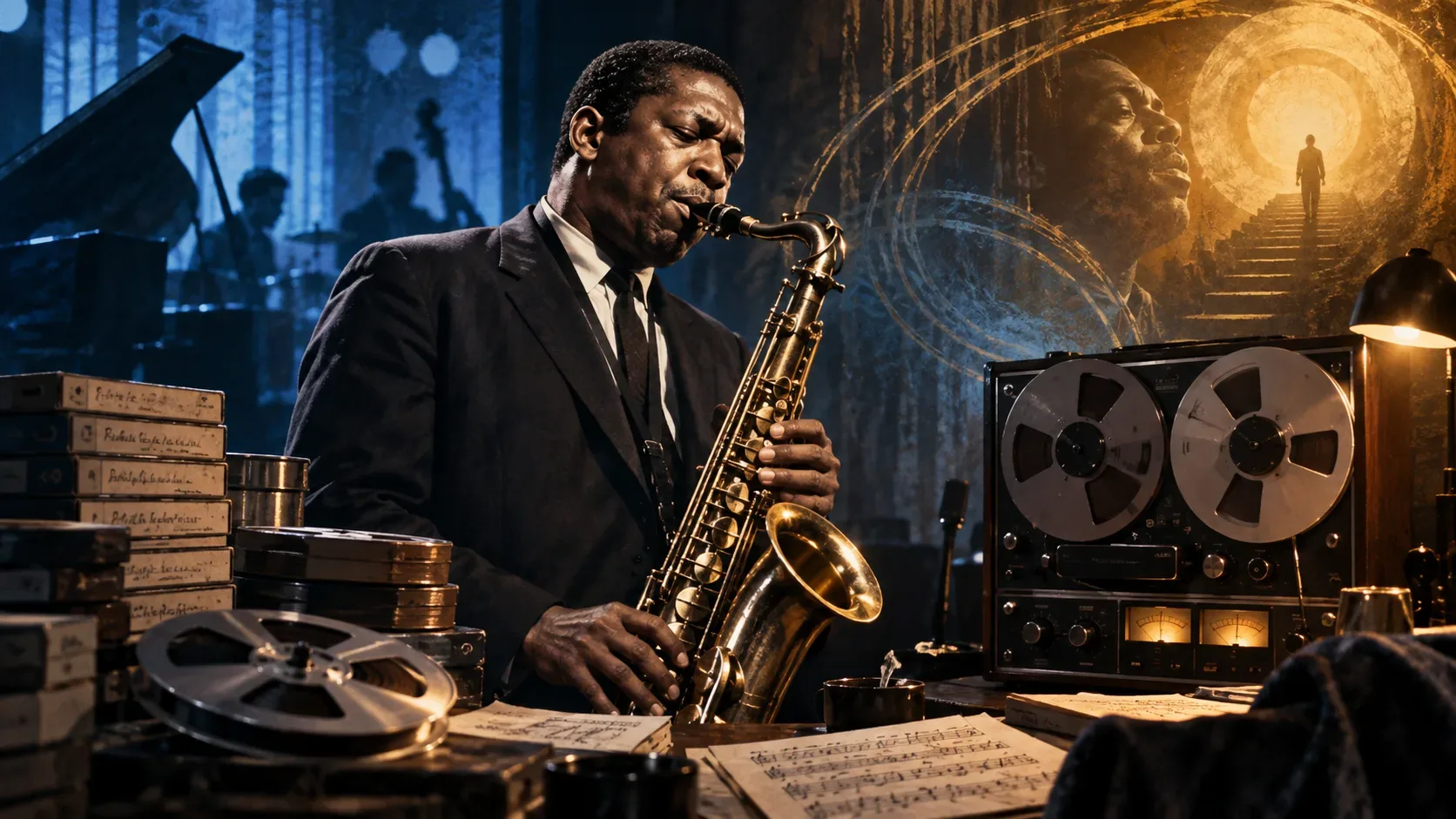
September 23, 2026 marks 100 years since John Coltrane was born. Coltrane’s estate itself is treating 2026 as the year of Coltrane 100, a global celebration of a musician whose artistic direction changed several times in little more than a decade. To hear that transformation, a short sequence of recordings is more useful than starting with a list of “best songs.”
The five tracks below work as listening landmarks. They do not summarize the whole catalog, and they are not a ranking. The point is to follow Coltrane as he moves from hard bop still close to 1950s conventions to extreme harmonic density, then to more open modal forms, to a highly concentrated spiritual synthesis, and finally to the collective freedom of the avant-garde.
| Recording | Moment | What to notice |
|---|---|---|
| “Blue Train” | 1957 | Blues, hard bop and the force of the tenor sax inside a clearly defined form. |
| “Giant Steps” | 1959 | Very fast-moving harmony and improvisation driven by chord changes. |
| “My Favorite Things” | 1960 | Soprano sax, modal repetition and the expansion of a standard into a long performance. |
| “A Love Supreme, Pt. I – Acknowledgement” | 1964 | A simple motif, rhythmic unity and spiritual intent organizing the improvisation. |
| “Ascension” | 1965 | Collective improvisation, a large ensemble and the loosening of earlier harmonic constraints. |
1. “Blue Train”: a personal voice emerges inside hard bop
Coltrane recorded Blue Train in September 1957, during a period when he was still working extensively as a sideman with Miles Davis and Thelonious Monk. Blue Note describes the album as a turning point: it was his only album as a leader for the label, and it already shows a musician finding a highly individual identity without leaving hard bop behind.
On the title track, listen first for the weight of the blues. The theme is clear, the horn section has recognizable functions and the pulse remains firmly anchored. What stands out is Coltrane’s solo: dense lines, an almost continuous forward drive and the sense that he is trying to exhaust the possibilities of each chord before the harmony moves on.
What to listen for: how the tenor sax stays connected to the harmonic design and swing while already sounding more compressed and urgent than its surroundings. This is a strong starting point because the musical “map” is still easy to follow.
2. “Giant Steps”: harmony becomes the main field of tension
Two years later, Coltrane recorded “Giant Steps,” the piece that gave its name to the Atlantic album released in 1960. His Atlantic period, from 1959 to 1961, marked his decisive shift from sideman to bandleader; Rhino/Atlantic itself highlights “Giant Steps” and “My Favorite Things” as central recordings from that phase. The album Giant Steps is also part of the Library of Congress National Recording Registry.
The change from “Blue Train” is immediate. Instead of spending long stretches inside a relatively stable harmonic environment, Coltrane moves through a sequence of tonal centers at great speed. Technique serves a compositional idea: the improviser has to negotiate a highly compressed harmonic architecture.
What to listen for: the almost geometric regularity with which the lines trace the chords. You do not need to identify every key to hear the effect. Notice how the saxophone line seems unable to rest in the same place for very long.
3. “My Favorite Things”: fewer chords, more space and a new timbre
During the October 1960 sessions that produced My Favorite Things, Coltrane found another route. The tune, originally known from the musical The Sound of Music, is stretched into a performance built around repeated modal areas. The switch from tenor to soprano saxophone is equally important; the instrument would become an essential part of his sound.
If “Giant Steps” compresses time with fast harmonic movement, “My Favorite Things” does the opposite: it prolongs relatively simple material and lets improvisation grow over an insistent cycle. The recording shows that Coltrane’s development was not a straight line toward “more chords” or “more difficulty.” He also pursued freedom through reduction — fewer harmonic events, more duration, repetition and timbral exploration.
What to listen for: the soprano’s piercing tone, the circular feel of the accompaniment and the way small melodic cells are repeated, displaced and intensified.
4. “Acknowledgement” from A Love Supreme: technique and spiritual purpose merge
In December 1964, Coltrane entered Rudy Van Gelder’s studio with McCoy Tyner, Jimmy Garrison and Elvin Jones to record A Love Supreme. The suite, released in 1965, was added to the National Recording Registry; its original manuscript is also preserved by the Smithsonian. It is one of the moments when Coltrane’s technical evolution and spiritual intent appear in their most concentrated form.
For a first listen, “Acknowledgement” is the clearest doorway. The bass introduces a short motif that becomes the axis of the piece. The improvisation does not depend on the flood of changes heard in “Giant Steps”; its force comes from repetition, quartet interaction and the continuous transformation of a small amount of material.
What to listen for: how a four-note motif organizes the piece, how drums and piano raise the intensity without breaking its unity, and how the saxophone moves from simple statements toward increasingly fervent speech. The change here is not only musical vocabulary: Coltrane presents the music explicitly as a spiritual search and testimony.
5. “Ascension”: from quartet freedom to collective improvisation
Recorded on June 28, 1965, “Ascension” expands the scale again. The session brought together eleven musicians, including Freddie Hubbard, Pharoah Sanders, Archie Shepp, McCoy Tyner, Jimmy Garrison and Elvin Jones. The official description of the current edition on John Coltrane’s website emphasizes the alternation between densely textured collective improvisation and extended individual solos.
It is a very different listening experience from the previous four. At several points, the familiar guide of “theme, solo and return to theme” no longer matters most. The listener follows sound mass, clashes of timbre, the entrances and exits of soloists and the ensemble’s overall energy. The focus shifts from an individual solving a harmonic problem to a group collectively creating a field of tension.
What to listen for: the transitions between ensemble passages and solos, the way each voice competes for and shares space, and the degree of rhythmic and harmonic freedom. “Ascension” is not a complete rejection of earlier Coltrane; it is an expansion, to the limit, of his search for intensity and freedom.
What changes from one recording to the next
Listening to the five in order makes three transformations especially clear. The first is Coltrane’s relationship with harmony: from defined hard-bop structures, he moves to maximum chord density in “Giant Steps,” then explores modal environments and later accepts much greater degrees of openness. The second is his relationship with form: the solo stops being merely an episode inside a song and increasingly reshapes the duration of the music itself. The third is the role of the ensemble: the group evolves from sophisticated accompaniment into increasingly decisive interaction and, in “Ascension,” into a collective force.
This also helps undo the simplistic idea that Coltrane merely played “faster and faster” or “further and further out.” His path includes extreme harmonic discipline as well as modal simplification, lyricism, repetition, spirituality and the exploration of texture.
How to listen without turning Coltrane into homework
- Listen once without trying to identify music theory. Notice only density, duration, timbre and the feeling of stability or instability.
- On the second listen, choose one element: the bass, the drums, the type of repetition or the way the saxophone moves into and away from a tonal center.
- Always compare with the previous track. The gain comes from contrast: “Giant Steps” is more revealing after “Blue Train”; “My Favorite Things” changes meaning after “Giant Steps.”
- If one recording grabs you, move on to the full album. This sequence is an entry map, not a substitute for the discography.
What these five recordings leave out
Important parts of Coltrane do not fit this selection. The ballad albums, collaborations with Duke Ellington and Johnny Hartman, live work at the Village Vanguard and the final period with musicians such as Pharoah Sanders and Alice Coltrane greatly expand the picture. This sequence prioritizes changes in musical language, not variety of repertoire.
That is why the centennial is less a reason to crown one definitive track than an invitation to hear movement. Between 1957 and 1965, Coltrane did not simply perfect a formula: he changed the problem several times. These five recordings let you hear that process happening.