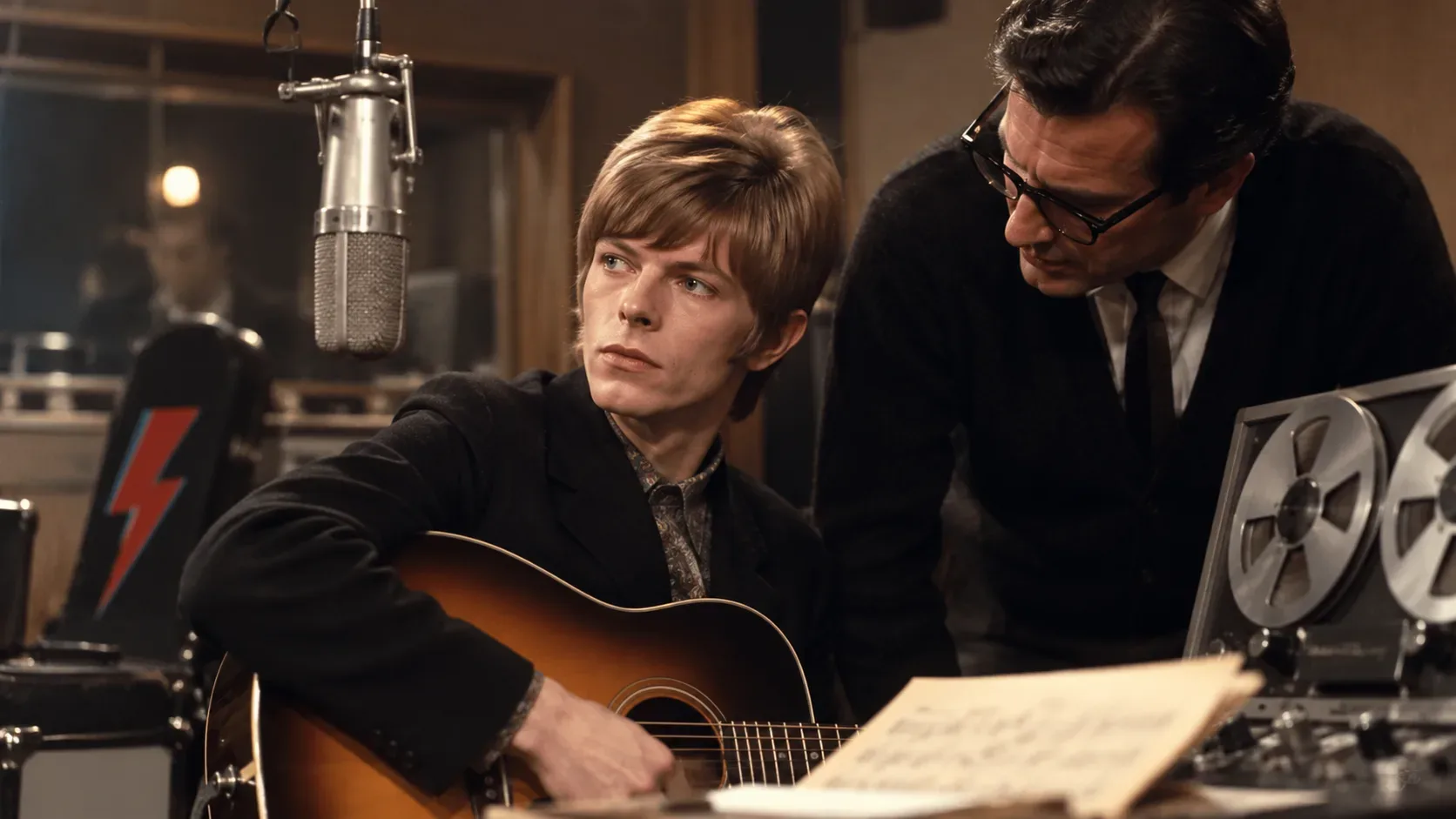
The Shel Talmy Recordings, due for release by Parlophone on September 18, 2026, works best not as a hunt for “early Ziggy clues” or an embryonic version of “Space Oddity.” Its value lies elsewhere: it brings into one frame an 18-year-old David Bowie still billed as Davie Jones, working through bands, demos and professional sessions inside the musical language of London in 1965. It is a portrait of formation — experiments, contemporary repertoire, original songs and studio decisions — before the public identity of “David Bowie” had fully settled.
What arrives on September 18, 2026
The official announcement describes The Shel Talmy Recordings as the most complete collection of recordings Bowie made with producer Shel Talmy in 1965. The CD and digital editions combine released and unreleased material; the official campaign states that those formats contain ten previously unheard tracks, while the LP carries six previously unreleased tracks. The Rhino product listing presents 22 entries in the full set, including masters, demos and alternate takes.
More important than the count is the range of recording situations. The repertoire includes material associated with The Manish Boys, Davie Jones & The Lower Third and demos credited to Davie Jones. That makes it possible to hear the same young artist in different roles: R&B singer, frontman of a band moving closer to mod/beat, and songwriter testing material in a more stripped-down setting.
Why 1965 is a turning point
According to the official David Bowie announcement, Talmy signed David and The Manish Boys in December 1964. By 1965, however, Bowie was already moving on to The Lower Third. Most of the recordings he made with the producer would feature that new group or take the form of solo demos. That rapid movement is exactly what makes the archive valuable: it does not freeze Bowie into a single “first version,” but records a musician trying to discover which band format, repertoire and presentation suited his ambitions.
The context matters too. Talmy had already scored major success with The Kinks and was working with The Who; his preferred studio was IBC in Portland Place. The sessions were engineered by Glyn Johns, before he became a central recording figure for The Rolling Stones, The Who and many others. Jimmy Page appears on the Manish Boys material, while Nicky Hopkins features in The Lower Third sessions. In other words, the young Davie Jones was far from working in isolation. He was part of a network of musicians, engineers and producers helping to define the British sound of the moment.
Three configurations worth hearing separately
- The Manish Boys: place Bowie inside a British R&B framework, with Talmy’s production weight and the presence of session musicians.
- The Lower Third: move the focus closer to beat and mod, with a band more directly tied to Davie Jones’s identity as a frontman.
- Solo demos: remove some of the band polish and expose voice, song structure and compositional choices more clearly.
What to listen for: songwriting, voice and the band relationship
1. Original songs stop being a side detail
Tracks such as “You’ve Got A Habit Of Leaving” and “Baby Loves That Way,” originally issued as a single, matter because they put Bowie’s writing at the center of the discussion. They do not sound like the Bowie of 1969 or 1972 — and that is the more productive way to hear them. Instead of searching for a future signature already fully formed, listen to how he absorbs R&B, beat and British pop formulas and tries to turn them into material of his own.
The fact that Bowie returned to those two songs decades later, re-recording them for the TOY project that was finally released in 2021, shows that 1965 was not simply a discarded archive. The later connection does not make the early recordings “prophetic,” but it confirms that Bowie himself considered some of that repertoire worth revisiting.
2. The voice is still testing possible characters
One of the clearest differences from the Bowie most listeners know from the 1970s is the absence of a single settled vocal persona. Across the 1965 recordings, the performance changes with the repertoire and the lineup. On some tracks, the singing sits firmly inside the vocabulary of R&B and beat; on others, diction and phrasing stand out for their theatricality or for the effort to sound more individual. The historical value lies precisely in that instability: we can hear the construction work, not only the finished result.
3. Alternate takes reveal process, not just product
The presence of alternate versions of “You’ve Got A Habit Of Leaving,” “I Pity The Fool,” “Baby Loves That Way” and “Take My Tip” makes it possible to compare vocal and overdub choices. That moves the collection beyond simple rarity and into the territory of a studio document. The listener can hear that a recording was not necessarily a finished object after the first pass; interpretation and arrangement could be recalibrated within the practices and limitations of a 1965 session.
What Shel Talmy adds to the story
Talmy is more than a famous name in the credits. His presence helps place Bowie inside the British record industry before stardom. The producer had already built a recognizable sound on records by The Kinks and was tied to The Who’s rise. The collection’s own official notes encourage listeners to judge these recordings by what was happening in Britain in 1965, not by the standards of Bowie’s later work.
That avoids a common trap: treating everything an artist made before fame as if it existed only to announce the future. Here, production, instruments, tones and repertoire belong to the present tense of 1965. The gain comes from hearing how Bowie responded to that scene — and where he was already trying to distinguish himself from it.
The name “David Bowie” emerges at the end of this phase
Bowie’s own official site acknowledges that the exact date on which he adopted the stage name is disputed, but places the change in September 1965. The 2026 announcement states the milestone safely: by the end of September 1965, Davie Jones had become David Bowie. The change helped avoid confusion with other performers named Davy/Davie Jones and marked a shift in public presentation, not an instant musical transformation.
That makes the collection especially interesting as a border document. Most of the material belongs to the moment immediately before the name by which he would be known became established. What we hear is not “the birth of a genius” in a single flash, but a sequence of adjustments involving band, image, repertoire and authorship.
What this anticipates — and does not anticipate — about “Space Oddity”
“Space Oddity” would not be released as a single until July 11, 1969, almost four years later and in a different professional context. The familiar recording was produced by Gus Dudgeon; the 1969 album was produced mostly by Tony Visconti. Comparing the two moments is useful precisely because the distance between them is substantial.
| Aspect | 1965 with Shel Talmy | 1969 with “Space Oddity” |
|---|---|---|
| Public identity | Davie Jones transitioning into David Bowie | David Bowie already established as the stage name |
| Dominant format | R&B/beat bands, demos and singles | A more Bowie-centered authorial project and a narrative-driven song |
| Production | Shel Talmy, tied to the sound of the 1965 British scene | “Space Oddity” produced by Gus Dudgeon; album mostly by Tony Visconti |
| Main historical interest | Formation, trial, repertoire and process | Consolidation of an authorial voice recognizable to a wider audience |
There is therefore a line of development we can observe — more original writing, greater control of identity and growing ambition — but not a straight road. Talmy’s recordings do not “contain” Major Tom waiting to emerge. They document experiences that expanded Bowie’s technical and artistic vocabulary before he arrived at a very different language.
How to hear the collection without turning it into prophecy
- Start with the recordings released at the time, such as “You’ve Got A Habit Of Leaving” and “Baby Loves That Way,” to understand what the public actually heard in 1965.
- Move next to the unreleased Lower Third material, listening for changes in energy, repertoire and the role of the vocal.
- Hear the solo demos as a block, because they expose structure, melody and compositional intent more directly.
- Compare the alternate takes to hear studio and performance decisions.
- Only then return to “Space Oddity.” The comparison works better as a contrast in trajectory than as a game of spotting hidden clues.
Why the collection matters now
The Shel Talmy Recordings expands a phase that many Bowie narratives pass over quickly: the musician before his 1967 debut album and long before the popular breakthrough of “Space Oddity.” Its main value is not to reveal a fully formed Bowie at 18, but to provide enough material to study how he tested musical identities inside a competitive and rapidly changing scene.
There is also an important bridge to the way Bowie later remembered 1965. The official announcement notes that 1973’s Pin Ups was conceived as a love letter to the sound of that period and includes four songs originally produced by Shel Talmy for other artists. Seen from that angle, the new collection is not merely catalog archaeology: it illuminates a year that continued to occupy a place in Bowie’s own musical narrative.
Main sources
Release details, formats, participants and session context come from the official David Bowie announcement and Rhino/Parlophone. The “Space Oddity” chronology is based on the official 50th-anniversary retrospective. Bowie’s own site also notes that the exact date of the 1965 name change remains debated, so this article does not present one specific day as settled historical consensus.