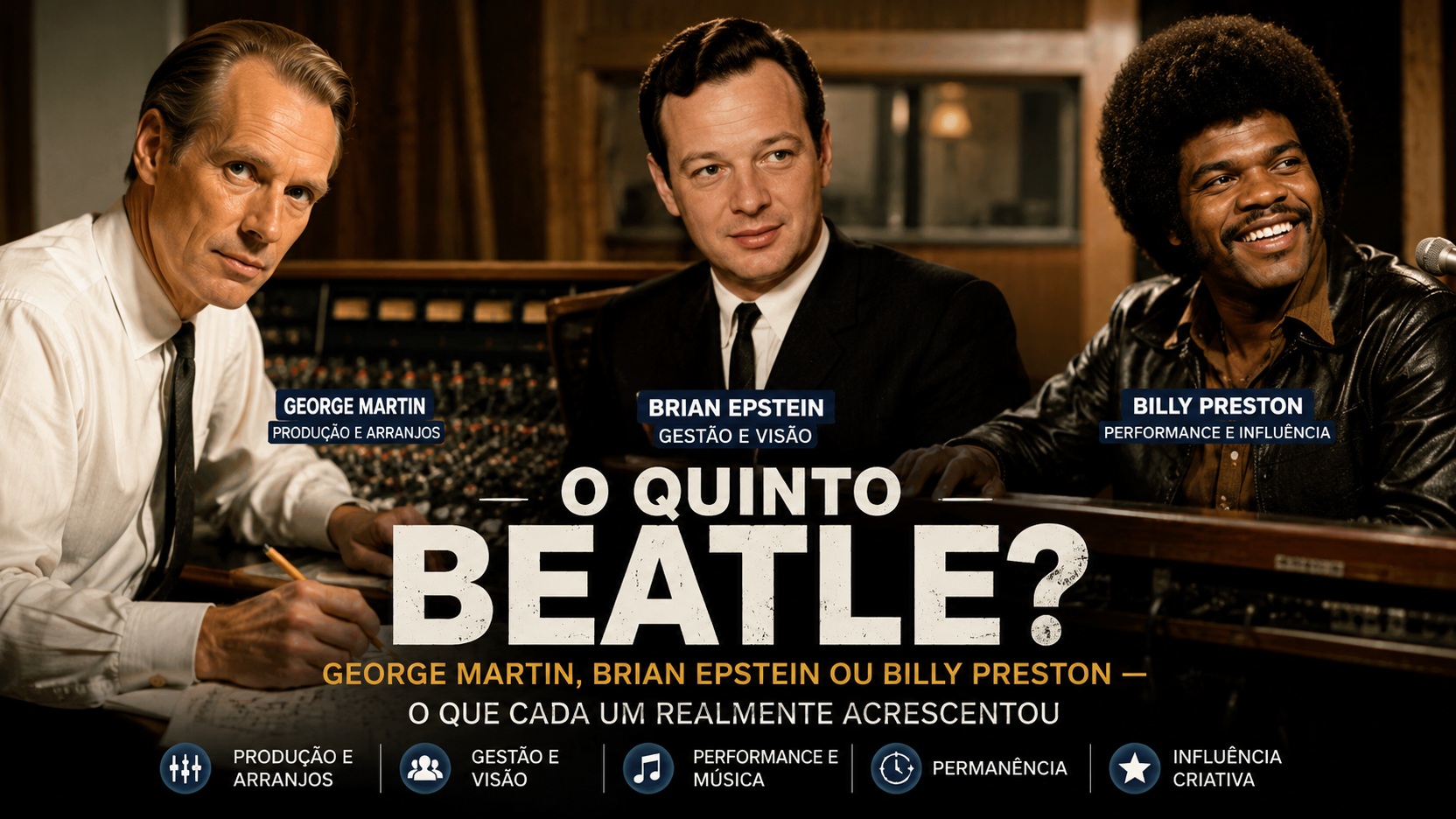
There is no official fifth Beatle. The nickname works as a question about influence: who, outside of John Lennon, Paul McCartney, George Harrison and Ringo Starr, was decisive for what the group became? When George Martin, Brian Epstein and Billy Preston are placed in the same dispute without criteria, the comparison becomes misleading, because they served in very different roles. Martin was the studio and arrangement partner; Epstein organized his career, opened doors and built the professional machine around the group; Preston entered music as an instrumentalist and even shared credit on a single with the Beatles. Therefore, the answer changes depending on what is meant by "fifth Beatle".
There is no official fifth Beatle
The title never corresponded to a formal fifth place in the band. It came to be used for people who had exceptional closeness or impact on the quartet, which explains why such different names appear in the discussion. A businessman can be the "fifth Beatle" due to his weight in his career; a producer, for creative participation; a guest musician, for his effective presence on the recordings. The expression, therefore, says less about a unique identity and more about the chosen criterion.
This distinction avoids a common error: transforming contributions of different natures into a single ranking. The producer didn't do the businessman's job; the businessman did not write the arrangements; the guest keyboardist did not follow the entire career. The most useful comparison is to ask what each added, for how long, and to what part of the Beatles phenomenon.
George Martin: the studio's fifth Beatle
George Martin is the strongest name when the criterion is the musical construction of the records. The Beatles' official chronology records that the group signed a contract with EMI and auditioned with Martin in June 1962. From then on, he became the main producer of the group's catalog and participated in a working relationship that spanned almost the entirety of the Beatles' recording career.
Production and arrangement
Martin's difference was not just pressing the record button. He had musical training, experience with orchestration and mastered the possibilities of the studio. In "Yesterday", for example, the idea of adding a string quartet came from him, and Paul McCartney worked alongside him on the arrangement. On "Eleanor Rigby", Martin wrote the arrangement for two string quartets. In "In My Life", the producer also contributed directly to the recording with the well-known instrumental piano bridge.
These examples show why their influence is described as creative, but it is important to keep the proportion correct. The songs, the voices, the central instruments and the artistic identity belonged to the group. Martin worked as an idea translator, music editor, arranger and technical partner. In some tracks his intervention was decisive; in others, much smaller. The merit lies precisely in the continuity of this partnership and the ability to adapt the production work to the band's accelerated evolution.
Permanence and creative influence
Among the three candidates in this comparison, Martin combines two characteristics that are difficult to bring together: long stay and direct musical participation. He was linked to the Beatles from the beginning of the EMI phase until the final years, including as a producer on the recordings of "Abbey Road" and on the project that led to "Let It Be".. This continuity means that its influence appears not in an isolated phase, but in the group's transition from a stage band to a band that started to use the studio as part of the composition and sound creation process.
In 2016, after Martin's death, Paul McCartney wrote on the Beatles' official website that if anyone deserved the title of fifth Beatle, it was George. The phrase does not transform the producer into a formal member, but it helps to understand why his name has become the most recurrent answer when the debate is specifically musical.
Brian Epstein: the fifth Beatle of his career
Brian Epstein makes a different claim. He was not the architect of the arrangements and did not play on the records, but he helped transform a local Liverpool band into a professional venture capable of reaching major record labels, television and international markets. The official Beatles timeline records that
he met the group at a performance at the Cavern Club in November 1961. A few months later, he was already looking for a recording contract for them.
From the Cavern Club to the contract with EMI
The band's own official archive describes Epstein taking recordings and tapes from company to company in London, after rejections that included the famous Decca audition. It was this effort that, through a tortuous path, put the material in front of George Martin on Parlophone, an EMI label. Epstein's importance comes through clearly at this point: he didn't create the Beatles' music, but he built access for the music to reach the people who could record, distribute and promote it.
The Rock & Roll Hall of Fame, which inducted Epstein in 2014, highlights his marketing skills and his insistence on continuing to bet on the group despite rejections. This helps explain why his role cannot be reduced to booking shows. He was involved in the public presentation, negotiation, positioning and commercial defense of the band at a time when the British market still viewed a group from Liverpool with suspicion.
Management, image and access
Epstein also interfered in the way the Beatles presented themselves professionally. In the official "Anthology" material, John Lennon recalls that Brian put the group in more tailored suits and shirts. The aim was not to change the music, but to make the band more acceptable to theaters, television, record companies and an industry that operated with very different performance codes than the clubs of Hamburg and Liverpool.
In this criterion, Epstein is practically unbeatable among the three names. His creative influence on the recordings was indirect, but his influence on the existence of his career was structural. He remained their manager until his death in August 1967. When he disappeared, the band lost the figure who for years had centralized much of the external organization, just when the Beatles were stopping touring and entering a more complex phase of business and their own projects.
Billy Preston: the fifth Beatle to actually play with them
Billy Preston has a literal advantage that Martin and Epstein don't: He joined the Beatles' sound as a guest musician at one of the most documented and tense moments in the group's history. In January 1969, during the sessions that led to the "Get Back" project and later the "Let It Be" album, Preston began playing keyboards with John, Paul, George and Ringo at Apple Studio.
The impact on the 1969 sessions
The official material about "Get Back" records that Preston was invited to play with the band and that his presence brought musical energy and lightness to the sessions. His instrument does not appear as a decoration: the electric piano and the organ became part of the arrangement of several performances. He was also at the Apple Corps rooftop concert on January 30, 1969, the Beatles' last public performance as a group.
Preston remained close musically that year. The official page for "Something" records his participation at the piano in the recording of George Harrison's song for "Abbey Road". This expands their contribution beyond the "Let It Be" project, although it remains a collaboration focused on the band's final months, rather than a seven or eight year partnership.
The credit "The Beatles with Billy Preston"
The strongest argument in favor of Preston is on the album label itself. The single "Get Back", released in 1969 with "Don't Let Me Down" on the other side, was credited to "The Beatles with Billy Preston". The band's official documentation highlights this shared credit. For a supporting musician, it was an unusual and highly visible recognition.
Still, the credit does not mean that Preston has formally become the fifth member. He was a very high-level guest collaborator. Your case is strong when the question is who most literally played as if they were in the band on a Beatles recording and concert. It is weakest when the criteria are permanence, career management or influence over the entire catalogue.
What happens when we change the criteria
Production and arrangement
If the question is who added the most to the recorded sound throughout his career, George Martin is the central name. His work brought together production, arrangements, studio decisions and mediation between Beatles ideas and technical resources. Preston had real influence on specific recordings, but not to the same length. Epstein almost doesn't fit into this criteria, because his role was business.
Management
If the focus is career, positioning, contracts, access and public image, Brian Epstein is the answer. It was he who took the risk of representing the group before its national success, persisted in the face of rejections and helped create the professional structure that allowed the Beatles to leave the local circuit and reach the London recording industry.
Performance
If the criteria is to play effectively with the Beatles on released recordings and in public performance, Billy Preston has the most straightforward case. He appears on keyboards, participated in the rooftop show and received name credit alongside the band on "Get Back". Martin also played instruments on Beatles recordings, but his main identity within the group's history is that of producer and arranger, not as a stage member.
Permanence
Always, Martin and Epstein have a clear advantage over Preston. Epstein entered the group's history in 1961 and remained until 1967. Martin followed EMI's recording phase from 1962 and continued to be present in the final years. Preston had a much shorter stint, focused on 1969. This does not reduce the quality of his contribution, but it changes the weight of the argument when length is one of the criteria.
Creative influence
Creative influence also needs to be separated into types. Martin directly interfered in the format of recordings, arrangements and musical solutions throughout many albums. Preston added his own instrumental voice in specific sessions and helped change the musical dynamics of that period. Epstein exerted an indirect creative influence: by protecting space for the band and building its projection, he created conditions for the creativity of the four to reach a scale that would hardly be the same without professional management.
So who was the fifth Beatle?
The most accurate answer is conditional. If "fifth Beatle" means permanent musical partner in the studio, George Martin has the strongest claim. If it means the person who made the group's professional and international career possible, Brian Epstein is the essential name. If you mean the outsider musician who most literally joined the ensemble on recordings and received credit alongside him, Billy Preston occupies a unique position.
For this reason, choosing just one name without stating the criteria impoverishes the story. The three added things that the others couldn't replace. Epstein helped the Beatles get to the place where they could be heard; Martin helped transform the quartet's ideas into increasingly sophisticated records; Preston entered at the final moment and added such a clear instrumental presence that his name appeared in the single's own credit. The nickname is the same, but the reasons are different.
It's also worth one last caution: calling any of them the fifth Beatle should not erase the boundaries of authorship and function. Martin did not write the Beatles' work, Epstein was not a musician in the group and Preston did not participate in the entire trajectory. The historical value of each becomes clearer when the comparison abandons the search for an absolute winner and begins to observe contribution, duration and context.