Beethoven did not keep composing because he “heard everything through vibrations.” The documented explanation is more interesting: his hearing loss was progressive, he retained residual hearing for years and tried to amplify it with mechanical devices, while the core of composition also depended on musical memory, auditory imagery, mastery of notation, and an extraordinarily intensive process of sketching and revision. When external hearing had become severely limited, those tools were still available to him.
His deafness did not happen all at once
The letters of 1801 are essential because they show Beethoven in the middle of the process, not after it. On June 29 of that year, writing to his physician and friend Franz Gerhard Wegeler, he reported that his hearing had been worsening for about three years, accompanied by tinnitus, difficulty hearing high notes, and problems understanding speech. The Beethoven-Haus preserves and comments on this letter. Two days later, in a letter to Carl Amenda, he again discussed his hearing loss and asked for secrecy; that document is also in the Beethoven-Haus digital archive.
This removes a common simplification: Beethoven did not wake up “completely deaf” and suddenly begin composing without hearing. There was a long transition. In the early nineteenth century he could still hear part of what he played and what happened around him, although with distortions and limitations. The Beethoven-Haus summarizes that by around 1814–1815 he was already virtually deaf in his right ear; according to an account by his pupil Carl Czerny cited by the institution, by around 1817 he could no longer hear music in a functional way.
What changed was the sound input — not all of his musical knowledge
Composing is not simply listening to an instrument and writing down what sounds good. For a musician with Beethoven's training, a score was a deeply internalized language. Intervals, chords, voices, forms, rhythms, and harmonic relationships could be conceived, written, compared, and transformed on paper. Modern research on musical imagery helps explain why trained musicians can represent music mentally without continuous external sound; in Beethoven's case, however, we do not need to imagine a mysterious mechanism. The surviving material itself shows how he worked.
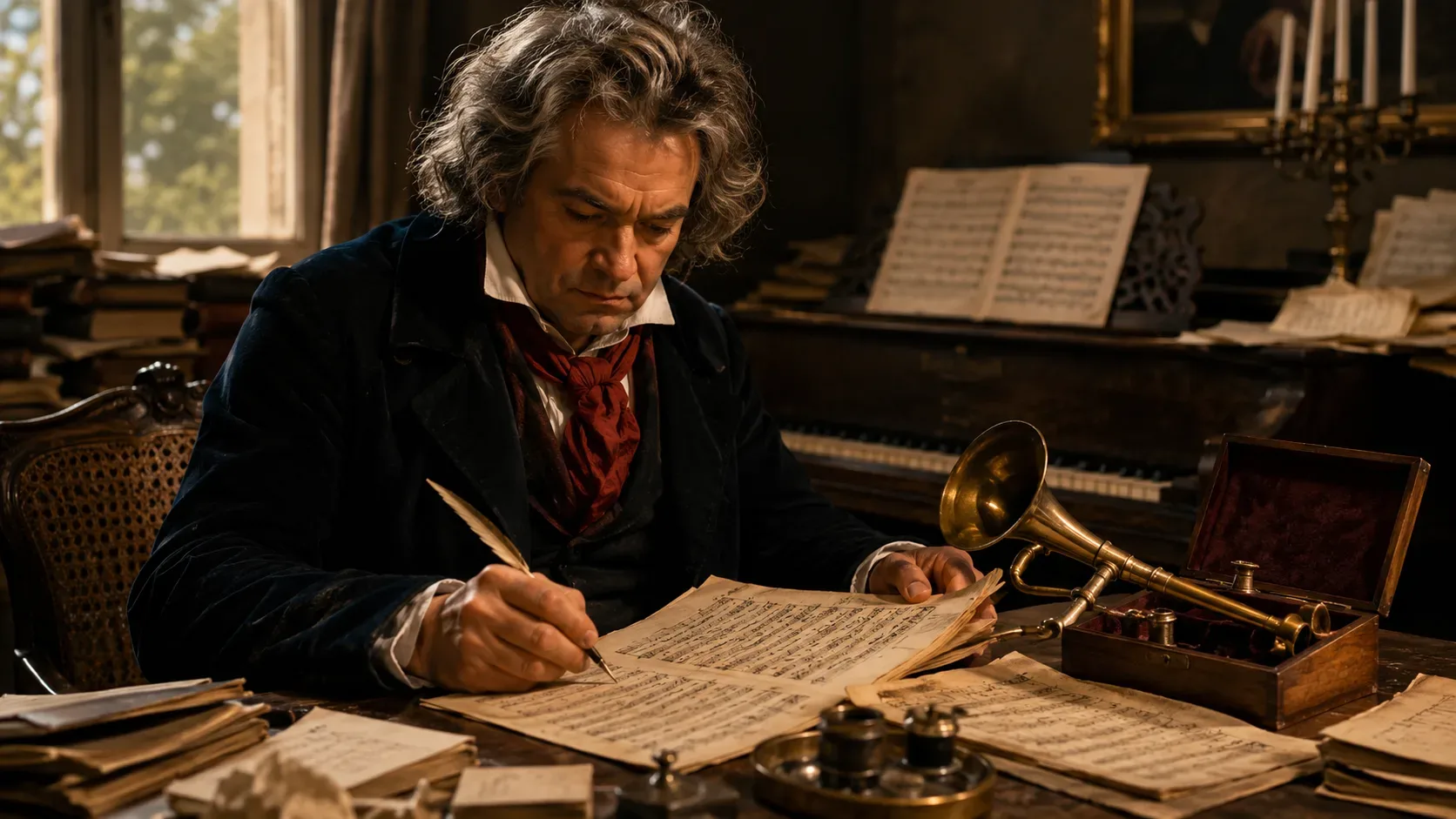
The Beethoven-Haus records several thousand preserved sketch leaves and about 70 sketchbooklets, as well as separate sheets — more surviving sketch material than for any other composer. The institution notes that Beethoven wrote down ideas, drafts, and concepts for nearly all of his works. He used larger books at his desk and small pocket sketchbooks outside the home. In other words, his composition was a construction process: an idea could be recorded, reorganized, tested on paper, revisited days or months later, and subjected to many revisions.
The sketches show how he could compose without constant acoustic feedback
This method is the central piece of the answer. Rather than imagining Beethoven writing an entire symphony “in his head” in one pass, the manuscripts show fragmented, iterative work. Short motives appear in many versions; passages are expanded, cut, transposed, or combined; formal plans change. The Beethoven-Haus describes the sketches as a privileged source for tracing the genesis of his works and his working method.
This pattern continued in the late works, precisely when his hearing impairment was extreme. One example is the Ninth Symphony, premiered in 1824. In 2024, marking the 200th anniversary of the premiere, the Beethoven-Haus again displayed manuscripts and documents connected with the work, including sketch leaves. There are also leaves combining sketches for the Ninth with material for String Quartet Op. 127. Deafness therefore did not erase the compositional mechanism: Beethoven could still formulate musical structures and refine them through notation and revision.
Hearing devices helped, but they did not “solve” deafness
Beethoven tried to preserve as much residual hearing as possible. In 1813, mechanic and inventor Johann Nepomuk Mälzel produced several ear trumpets for him. Four models are preserved by the Beethoven-Haus; the institution explains that different shapes were intended to amplify different resonant ranges and notes that it is difficult to determine how effective they actually were. One example can be viewed in the museum's digital archive.
There are signs of temporary benefit. The Beethoven-Haus material on the progression of his deafness cites an 1815 diary entry in which Beethoven praises the “Mälzel machine.” The same source includes a later visitor's report of a device like a large bell or resonating box associated with the piano, designed to concentrate sound around the composer. These aids tried to amplify what remained of his hearing; they did not restore normal hearing.
What about the story that he bit a rod to feel vibrations?
The idea that Beethoven touched or bit a wooden rod connected to the piano appears in modern medical and biographical literature as a possible form of vibration transmission. A review of his hearing aids indexed in PubMed mentions this hypothesis. But it is not the strongest evidence, nor is it necessary to explain how he continued to compose.
The surviving objects and documents provide a more secure chain of evidence: ear trumpets, attempts to amplify the piano, letters about hearing loss, conversation books, and thousands of musical sketches. Tactile vibration may have been a supplementary aid at certain moments; turning it into the main explanation reduces a much broader cognitive and technical process to a single anecdote.
The conversation books show what deafness affected most directly
From 1818 onward, Beethoven used conversation books to communicate with visitors. In general, the other person wrote a question or comment and Beethoven answered verbally. One of the earliest surviving books can be consulted at the Beethoven-Haus. These notebooks show how hearing loss most directly impaired everyday communication and the immediate reception of external sound.
This distinction helps explain why his activity as a public pianist deteriorated before his ability to compose. The Beethoven-Haus notes that he withdrew from public concert life as a pianist around 1814. Ensemble playing, coordinating with other performers, and controlling dynamics and balance in real time depend heavily on acoustic feedback. Composition, by contrast, could continue through paper, knowledge, memory, and revision.
The Heiligenstadt Testament shows that continuing to compose was also a decision
In October 1802, Beethoven wrote to his brothers the document known as the Heiligenstadt Testament. In it, he described the suffering caused by his deafness and said that art had kept him from leaving life before producing what he felt capable of creating. The document is catalogued by the Beethoven-Haus.
This does not technically explain every measure, but it clarifies the context: continuing to compose was not a miracle that occurred despite sudden deafness. It resulted from decades of musical training, a working system based on notation and sketches, repeated attempts to exploit residual hearing, and a conscious artistic decision to keep creating even as hearing and communication became progressively more difficult.
In short: how did Beethoven keep composing?
- His hearing loss was gradual. For years he retained some hearing and tried to amplify it.
- He had a deeply internalized musical language. He did not need to hear every decision externally in order to represent notes, harmonies, and forms.
- He wrote and revised obsessively. Thousands of surviving sketches show a method based on trial, transformation, and refinement.
- He used devices for whatever hearing remained. Ear trumpets and piano amplification devices helped in limited and temporary ways.
- Conversation books replaced part of spoken communication. They show that deafness strongly affected social interaction without stopping musical writing.
- “Feeling vibrations” is not the whole explanation. It may have been an occasional aid, but the documentation points to a much broader set of cognitive, technical, and material resources.
The most striking point, then, is not that Beethoven found a physical trick to “hear” again. It is that he already possessed, inside and outside his head, a compositional system robust enough to keep working when the external auditory channel became increasingly unreliable.