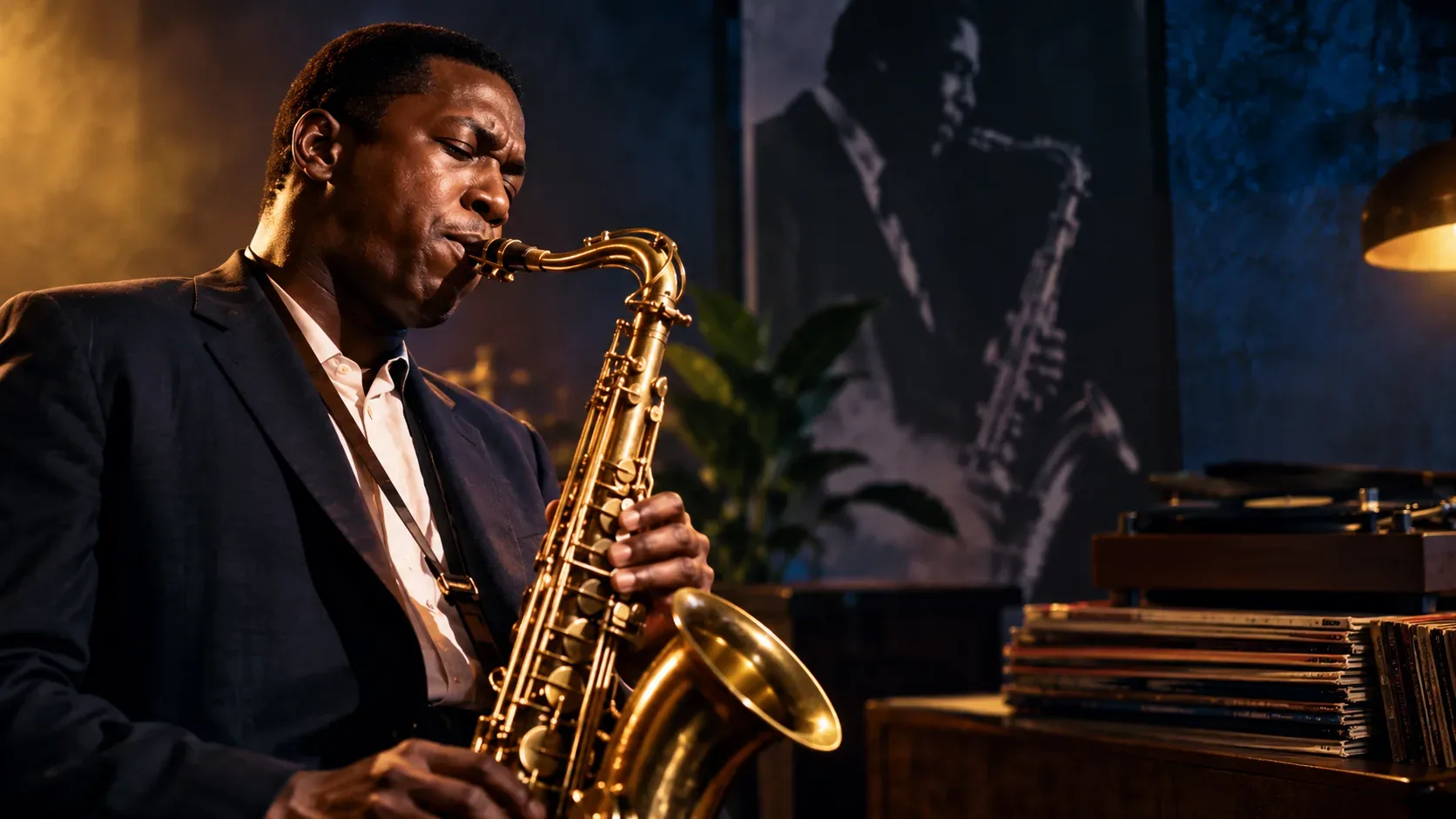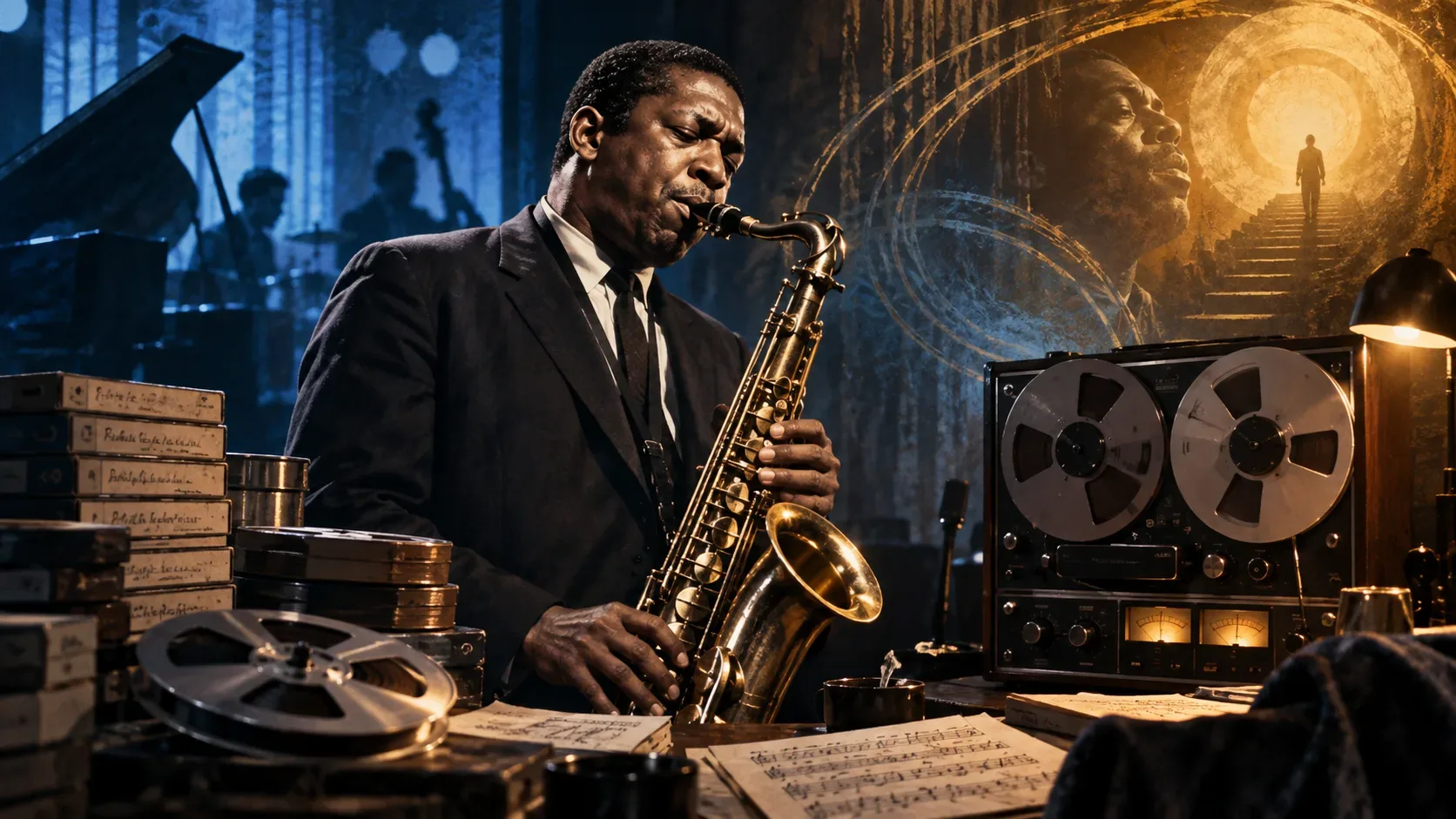
The Tiberi Tapes matter because they place a microphone where John Coltrane’s transformation was happening night after night: on club bandstands, not only in recording studios. Made by Frank Tiberi in New York and Philadelphia in the early 1960s, they preserve dozens of performances from a period when Coltrane was still working with material associated with Giant Steps and My Favorite Things while expanding duration, timbre, group interaction, and improvisational freedom. The archive therefore helps us hear the road to A Love Supreme as a continuous process rather than a sudden change in December 1964.
What the Tiberi Tapes are — and why the recording context matters
Frank Tiberi, a saxophonist and educator, followed Coltrane performances in New York and Philadelphia clubs with a portable reel-to-reel recorder. Historical notes connected to the project say the collection grew to more than 80 reels and more than 60 hours of music. Tiberi was not assembling a commercial album: he recorded the music to study, transcribe, and understand what Coltrane was doing on stage. That origin explains both the documentary value and the limitations of the material.
The archive should not be read as a sequence of planned, perfectly catalogued sessions. Some tape boxes had dates and venues; others did not. The first official release, the LP The Tiberi Tapes: A Preview of the Mythic Recordings, makes that uncertainty visible. It contains “Giant Steps” and “Satellite,” but states that the recording was probably made at the Showboat in Philadelphia in the early 1960s. Steve Davis on bass and Pete LaRoca on drums are also listed as probable, while McCoy Tyner is credited on piano and Coltrane on tenor saxophone and, at the end of “Satellite,” soprano.
Why the interval between My Favorite Things and A Love Supreme is crucial
“My Favorite Things” was recorded on October 21, 1960, with Coltrane on soprano saxophone, McCoy Tyner on piano, Steve Davis on bass, and Elvin Jones on drums. The recording is a landmark because it shows Coltrane turning a familiar song into a broad field for repetition, variation, and extended improvisation. A Love Supreme, by contrast, was recorded on December 9, 1964, at Van Gelder Studio by the quartet with Tyner, Jimmy Garrison, and Jones, and organized as a four-part suite with an explicitly devotional purpose.
Only a little more than four years separate those points, but musically the distance is enormous. This is exactly where the Tiberi tapes become valuable: they document performances outside studio control, on different nights, with repertoire that could be stretched and reshaped in front of an audience. Instead of giving us only a “before” and “after,” the archive lets us look for intermediate stages.
| Milestone | What is documented | What it helps us hear |
|---|---|---|
| My Favorite Things (1960) | Studio recording of the title track on Oct. 21, 1960 | Soprano saxophone, repetition, and the expansion of a familiar song |
| Tiberi Tapes (early 1960s) | Private club recordings in New York and Philadelphia, with uneven cataloguing | How repertoire, solos, and group interaction changed in live performance |
| A Love Supreme (1964) | Suite recorded on Dec. 9, 1964 by the classic quartet | Integrated form, spiritual language, and a mature collective identity |
The first preview already changes how “Giant Steps” can be heard
The preview LP released for Record Store Day on April 18, 2026 contains two performances: “Giant Steps” and “Satellite.” That matters because “Giant Steps” often stands in the Coltrane narrative for the peak of his highly concentrated harmonic research at the end of the 1950s. Finding it again in an early-1960s club document is a reminder that Coltrane did not simply discard one language when he discovered another. He kept bringing earlier material to the bandstand, testing new proportions, pacing, and improvisational routes.
The historical value is not that one performance can be declared the “origin” of A Love Supreme. It is that the performance supports a cumulative view of Coltrane’s development. Dense harmony, modal exploration, repetition, extended form, changing tone color, and close listening among band members could coexist. The bandstand functioned as a laboratory.
The tapes help us hear the quartet as a process, not a frozen lineup
Another advantage of the archive is that it resists the idea that the so-called “classic quartet” appeared fully formed. The preview probably documents a lineup that predates the final stabilization with Jimmy Garrison on bass, while already including McCoy Tyner and, according to the release credits, musicians associated with the group’s earlier period. That makes it possible to track not only Coltrane’s development but also how different partners changed the rhythmic and harmonic space around him.
By the time A Love Supreme was recorded, Tyner, Garrison, and Elvin Jones had developed a remarkably strong collective identity with Coltrane. The Tiberi Tapes are especially useful when they allow that mature result to be compared with earlier nights in which repertoire, personnel, and performance length were still in motion.
What is safe to conclude — and what still requires caution
- Safe: Tiberi created a private archive of Coltrane club performances in New York and Philadelphia in the early 1960s; the collection is much larger than the material previously issued and was used for decades as a study resource.
- Safe: the official 2026 preview contains “Giant Steps” and “Satellite” and explicitly acknowledges uncertainty about the exact venue and part of the personnel.
- A plausible historical reading: the recordings help reconstruct Coltrane’s development through live versions, showing continuity between lines of research that discographies often divide into separate “periods.”
- Not safe: dating every tape or assigning every musician without confirmation. The available documentation itself contains gaps.
- Also not safe: treating every recording as a direct rehearsal for A Love Supreme. They illuminate the path but do not replace evidence about compositional intent.
What about the full centennial release?
Coltrane’s centenary falls on September 23, 2026 and is part of the global COLTRANE 100 program. The release calendar for the Tiberi Tapes has shifted during the campaign. The official Explore Coltrane 100 page still labels the full project “Coming Fall 2026” and offers sign-up access, while earlier promotional copy referred to September. A Guardian report published September 11, however, gives November 6 as the Impulse! release date. As of September 13, the safest formulation is therefore: the preview is already out, and the expanded project is scheduled for the Northern Hemisphere fall.
How the archive can change the history without forcing a rewrite
The Tiberi Tapes do not make the studio albums less important; they do the opposite. They add what a discography usually hides: repetition, experimentation, uneven nights, personnel changes, and decisions that become visible only when a piece is played repeatedly in front of people. That kind of documentation is especially important for Coltrane, whose work changed quickly and whose language was shaped by intensive practice and constant performance.
The historical gain is to hear 1960–64 as a working zone. My Favorite Things demonstrates a new breadth of form and tone color; A Love Supreme condenses that search into a suite of extraordinary musical and spiritual coherence. In between, Tiberi’s tapes preserve part of the everyday process through which the transformation took place. Their greatest value, then, is not the revelation of one secret, but the chance to hear Coltrane’s evolution while it was still happening.
Sources for following the project
- Coltrane 100 — official page for the Tiberi Tapes and centennial projects
- Record Store Day — preview LP details, tracks, credits, and cataloguing caveats
- Everything Jazz — historical introduction and an excerpt from Ashley Kahn’s liner notes
- Smithsonian Folkways — recording details for “My Favorite Things”
- Smithsonian — context and recording date for A Love Supreme