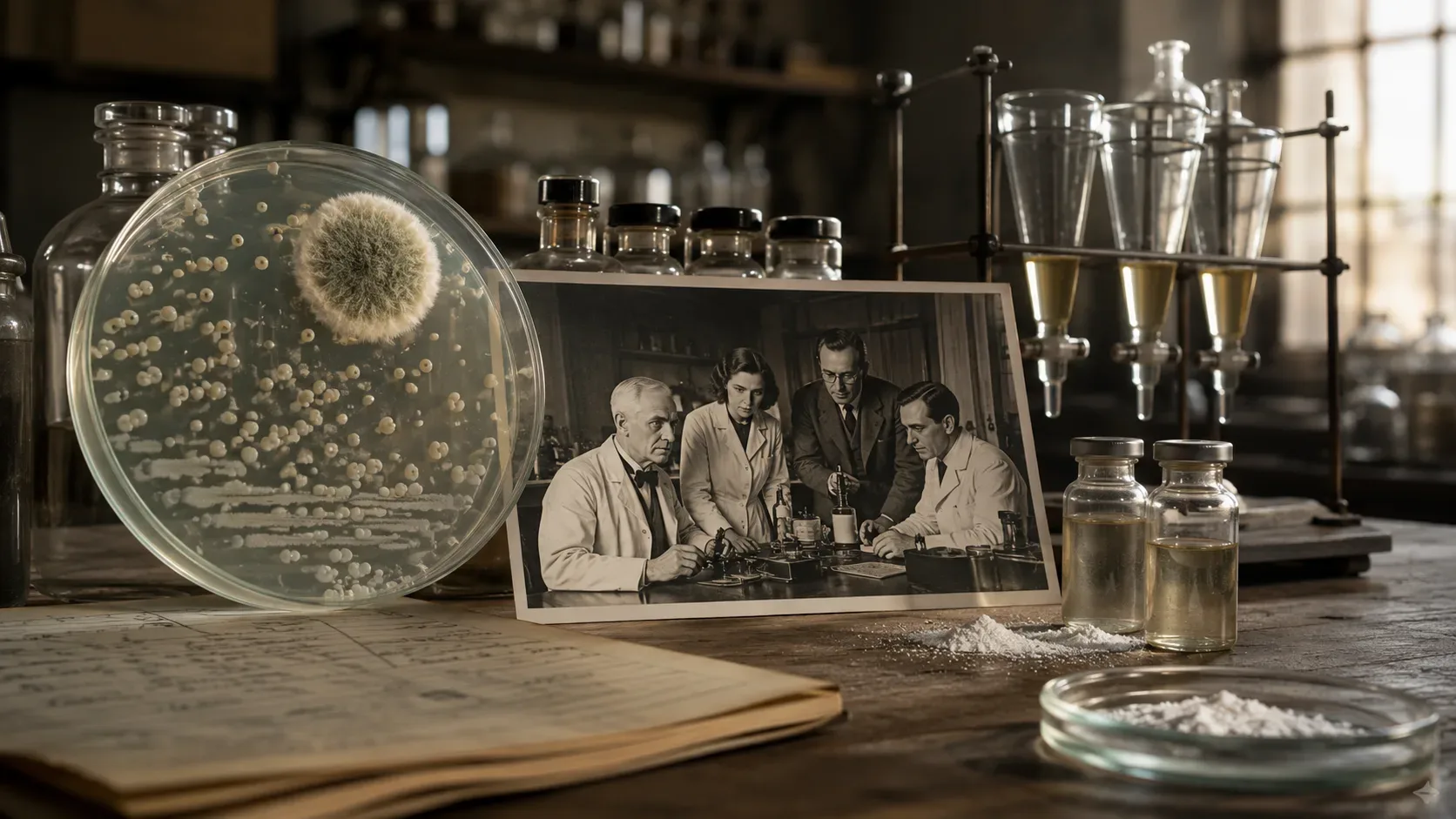
In September 1928, Alexander Fleming was examining staphylococcal cultures in his laboratory at St. Mary’s Hospital in London when he noticed something unusual. One of the plates had been contaminated by a fungus and, around it, the bacterial colonies had disappeared or stopped growing. Fleming had not created a medicine at that time. He had identified a phenomenon worth investigating.
The moldy plate scene has become one of the best-known stories in science. The problem is that his popular version often jumps directly from Fleming's observation to penicillin ready to save patients. Between these two moments there was more than a decade of chemistry, microbiology, animal experimentation, clinical research, laboratory improvisation, public financing and industrial engineering.
Fleming was born on August 6, 1881, in Scotland. On August 6, 2026, it will be 145 years since his birth. The date offers an opportunity not to diminish his contribution, but to tell it with greater precision:Fleming discovered the antibacterial effect and gave its name to penicillin; Turning it into treatment required the work of many other people.
The moldy board was the beginning, not the end product
Fleming was studying bacteria of the genus Staphylococcus when he noticed a clear area around the contaminating fungus. He cultivated the microorganism separately and concluded that the fungus released a substance capable of inhibiting or destroying certain bacteria. He called this substance penicillin.
In 1929, he published the article “On the Antibacterial Action of Cultures of a Penicillium, with Special Reference to Their Use in the Isolation of B. influenzae”. The work described the action against different bacteria and presented penicillin as a useful tool for the laboratory. It also mentioned a possible application in the treatment of infections caused by sensitive microorganisms. Therefore, it is inaccurate to say that Fleming did not perceive any medical potential. What he failed to do was produce a stable, purified preparation in sufficient quantity to demonstrate its value as a systemic treatment.
His assistants Stuart Craddock and Frederick Ridley tried to isolate the active ingredient. They only obtained crude and unstable solutions. Other researchers, including biochemist Harold Raistrick, also faced difficulties. The substance lost activity during the extraction procedures and did not seem suitable for regular production. Gradually, penicillin came to be seen mainly as a useful curiosity for bacteriologists.
Fleming's contribution was, nevertheless, decisive. Contamination does not automatically turn into a scientific discovery. It was necessary to recognize that the pattern around the fungus was significant, cultivate the microorganism, compare its effects, test different bacteria, name the substance and publish the results.
Myth versus evidence
| Simplified version | What the evidence shows |
|---|---|
| Fleming single-handedly invented penicillin as a medicine. | Fleming identified and described the substance. The transformation into a medicine occurred later, with the Oxford team, clinical researchers, public laboratories and companies. |
| It was just an accidental discovery. | The contamination was accidental, but realizing its importance and investigating it required bacteriological knowledge and experimental work. |
| Fleming saw no medical use. | Your article mentioned a possible therapeutic application, although the practical focus was on laboratory use and it did not produce a viable treatment. |
| Once penicillin worked in animals, all it took was manufacturing it. | The increase in scale required new strains of the fungus, better culture media, fermentation tanks, extraction techniques and coordination between government, universities and industry. |
From discovery to medicine: timeline from 1928 to 1945
| Year | Step | What happened |
| 1928 | Discovery | Fleming observed that a contaminating fungus prevented the growth of bacteria in a culture dish. |
| 1929 | Publication | The bacteriologist described the action of penicillin, its limitations and possible uses in a scientific article. |
| 1939 | Resumption in Oxford | Ernst Chain, Howard Florey and colleagues began an experimental program to extract, stabilize and test the substance. |
| 1940 | Animal testing | Penicillin preparations protected mice exposed to a lethal bacterial infection, offering the first decisive demonstration of action in the body. |
| 1941 | Patient treatment | The team began systematic treatments in Oxford and published clinical results, but remained limited by the scarcity of the substance. |
| 1941–1944 | Scale production | Researchers from the United States Department of Agriculture and pharmaceutical companies have developed more productive culture media, strains, and industrial processes. |
| 1944 | Military availability | Production increased enough to supply Allied forces in major World War II operations. |
| 1945 | Recognition | Fleming, Chain and Florey shared the Nobel Prize in Physiology or Medicine for the discovery of penicillin and its curative effect. |
Oxford solved the problem that the board couldn't solve
Chain and Florey resumed almost stopped research
In the late 1930s, biochemist Ernst Boris Chain and pathologist Howard Walter Florey studied substances produced by microorganisms. Penicillin attracted attention precisely because of its action against staphylococci and the chemical difficulties that had prevented its development.
The program began in a structured way in 1939, at the Sir William Dunn School of Pathology, at the University of Oxford. It wasn't just a question of repeating Fleming's experiment. The team needed to figure out how to grow the fungus in a predictable way, measure the substance's potency, separate it from the culture liquid, reduce impurities, check its toxicity, and test whether it would work inside a living organism.
Norman Heatley built the bridge between the bench and the tests
Norman Heatley was one of the most important and least remembered members of the project. He developed a sensitive method for measuring the activity of penicillin and helped create extraction procedures in which the substance was passed between solvents and water without losing all of its activity. He also designed equipment and containers that allowed him to grow more fungus in the available space.
Edward Abraham worked on purification and later determination of chemical structure. Arthur Gordon Sanders operated extraction equipment. Margaret Jennings participated in toxicity assessments. The team brought together different skills because no single method would solve the entire problem.
Production was still extremely inefficient. The laboratory used improvised containers and then specially designed ceramic vessels. Six women were hired to take care of the crops and ongoing production. Known as the “Penicillin Girls,” they were Ruth Callow, Claire Inayat, Betty Cooke, Peggy Gardner, Megan Lancaster and Patricia McKegney.
The mice showed that the substance could treat an infection
In 1940, the team finally accumulated enough penicillin for an animal protection test. In the best-known experiment, eight mice were given a lethal dose of streptococci. The four treated with penicillin survived; the four untreated died. The result indicated that the substance did not just act on a plaque: it could fight an infection within the body.
The study was published in the journal The Lancet on August 24, 1940. Authorship included Chain, Florey, Heatley, Jennings, Sanders and other members, reflecting the collective nature of the work.
The human test revealed both power and scarcity
In January 1941, the team performed a test injection to assess the safety of the preparation. The systematic treatment of Albert Alexander, a 43-year-old police officer with a serious infection, began on February 12. His condition improved, but the small supply of penicillin ran out before the infection was eliminated. Even recovering part of the substance excreted in the urine, the team was unable to maintain the treatment, and Alexander died weeks later.
The case is often called the “first penicillin treatment,” but the more accurate formulation is the Oxford program's first systemic and systematic treatment. Previous local experiments and applications have not provided the same clinical demonstration.
Other patients were treated as new quantities became available. Charles Fletcher conducted the treatments at Radcliffe Infirmary under Florey's supervision. Mary Ethel Florey coordinated part of the clinical trials carried out in civilian and military hospitals. Results published in 1941 established the effectiveness of penicillin against infections that, until then, could be fatal.
The scientific problem had changed. It was no longer necessary to just ask whether penicillin worked. It was necessary to figure out how to produce thousands and then millions of doses.
Producing at scale was another discovery
British industry was mobilized by the Second World War and did not have the immediate capacity to create a new production process. In 1941, Florey and Heatley traveled to the United States to seek support. They arrived at the Northern Regional Research Laboratory, a Department of Agriculture laboratory in Peoria, Illinois, which had experience with fermentation and the use of agricultural byproducts.
In Peoria, Andrew Moyer and other researchers increased yields using lactose and corn steep liquor, a nutrient-rich liquid from corn processing. The laboratory also looked for strains of the fungus that produced more penicillin. One of the best was found in a deteriorated melon purchased at a local market — an episode associated with employee Mary Hunt.
The American contribution did not come from a single person or company. The work brought together the Department of Agriculture laboratory, government coordination bodies and companies such as Merck, Squibb, Lilly, Pfizer, Abbott and Lederle. Some knowledge was shared to speed up production during the war, while each institution also developed its own equipment and procedures.
Fermentation in deep tanks made it possible to cultivate the fungus in much larger volumes, but created difficulties with aeration, temperature, foam, sterility and extraction. On March 1, 1944, Pfizer opened a factory in Brooklyn with 14 tanks of approximately 7,500 gallons each. The facility became a major supplier of the drug, but was part of a broader industrial network.
By 1944, production had grown enough for penicillin to accompany Allied troops on the European campaign. The move from the laboratory to the factory was not an automatic step: it was an advance in industrial microbiology and chemical engineering as indispensable as the tests carried out in Oxford.
Collaborators who don’t fit into the “lone genius” version
The complete narrative includes people who performed different and equally necessary jobs:
- Alexander Fleming observed the phenomenon, identified its antibacterial action, named penicillin and published the first results.
- Stuart Craddock and Frederick Ridley participated in the initial attempts at isolation.
- Ernst Chain and Howard Florey organized and directed the program that demonstrated therapeutic potential.
- Norman Heatley developed fundamental assays, extraction techniques and equipment.
- Edward Abraham, Margaret Jennings and Arthur Gordon Sanders worked on the purification, toxicity and operation of the process.
- Charles Fletcher and Mary Ethel Florey participated in the transition to clinical trials.
- The “Penicillin Girls” kept the experimental production going in Oxford.
- Andrew Moyer, Kenneth Raper, Mary Hunt and Peoria colleagues helped increase yields and find more productive strains.
- Scientists, engineers and workers from different companies transformed the experimental process into industrial production.
Dorothy Crowfoot Hodgkin is also part of this story. In 1945, his analysis by X-ray crystallography confirmed the molecular structure of penicillin, resolving an important chemical dispute and paving the way for later antibiotic research.
Why the Nobel went to Fleming, Chain and Florey
The 1945 Nobel Prize in Physiology or Medicine was shared between Alexander Fleming, Ernst Boris Chain and Howard Walter Florey “for the discovery of penicillin and its curative effect on various infectious diseases”. The award presentation itself described the story as an example of different scientific methods working towards a common purpose.
The award recognized three central figures, but does not constitute a complete list of those who made the medicine possible. Heatley, Abraham, Jennings, Fletcher, Ethel Florey, the Oxford workers, the Peoria researchers and the industrial engineers were left out of the formal awards.
This does not mean that the credit given to Fleming is undue. Without his observation, his experiments and his publication, the Oxford team might not have found that starting point. The mistake is in making it a starting point for the entire trip.
After all, who “made” penicillin?
The answer depends on the verb used.
Fleming discovered that the fungus produced an antibacterial substance and established the first knowledge about it.
The Oxford team developed methods to extract, concentrate, evaluate and test penicillin as a treatment.
Doctors and clinical researchers have demonstrated its effects on patients and identified practical limitations.
Public laboratories and companies produced at scale, creating culture media, strains, tanks and purification processes capable of delivering the medicine in large quantities.
The Nobel Prize recognized three protagonists, while documented history reveals a much larger network.
The most faithful formulation, therefore, is not that Fleming “wasn’t important” nor that he “invented everything himself”. It is this:Fleming saw and investigated the phenomenon; Turning his observation into medicine required years, an international team and industrial production.
The most useful legacy of this story
The story of penicillin is often used to celebrate serendipity. Its deepest lesson, however, is in collaboration.
A contaminated plate produced a clue. Bacteriology turned the clue into a discovery. Biochemistry produced testable preparations. Experimentation showed that they acted on living organisms. Clinical medicine demonstrated that they could treat patients. Industrial microbiology and engineering have created a product available at scale.
Great scientific advances may have moments of individual insight, but they rarely end there. Methods are needed to confirm the observation, teams to solve different problems, institutions willing to finance the work and production systems capable of bringing the results to people.
Explore the full timeline and subscribe to the Science Stories series to follow other discoveries that were born less from an instant of genius than from persistent networks of collaboration.