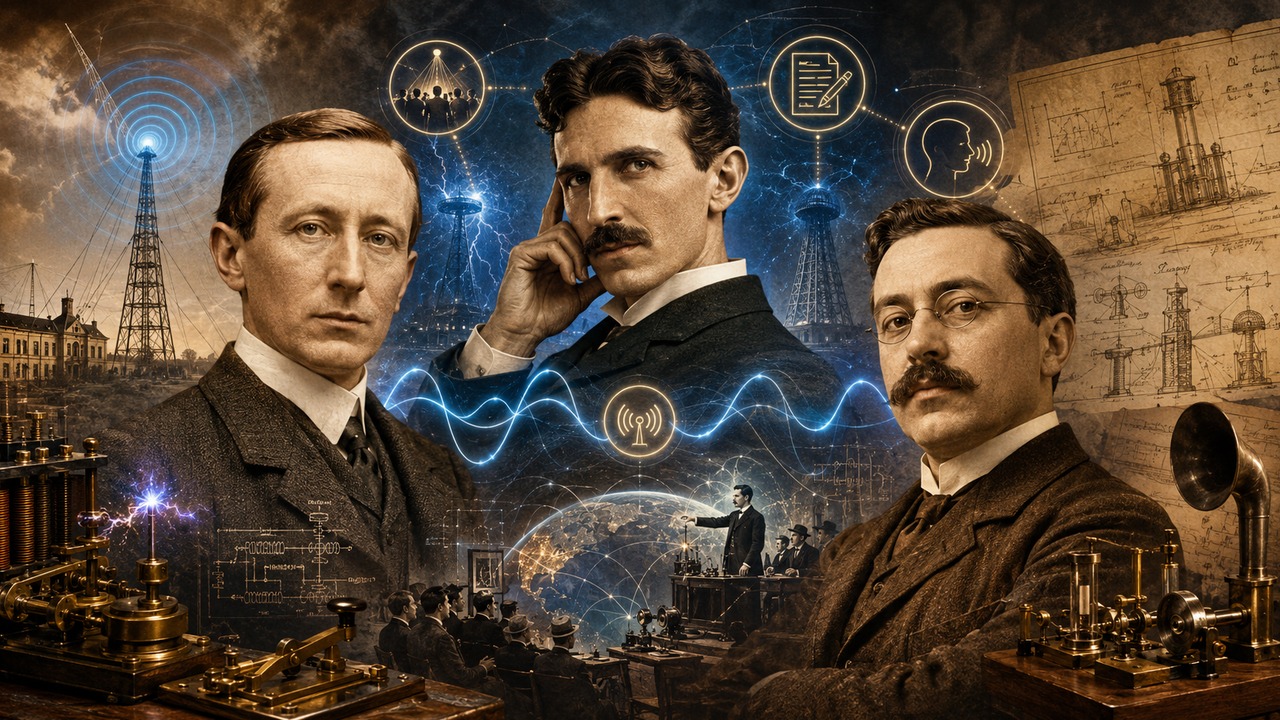
The short answer is no: Hedy Lamarr did not invent Wi-Fi in the historical or technical sense in which we use that expression today. What she and composer George Antheil created was a patented radio communication system in which transmitter and receiver would change frequencies synchronously. The idea had a specific military objective: to make it more difficult to detect and block the signal used to control a torpedo.
Connecting to Wi-Fi, however, is not invented. Decades later, the first version of the IEEE 802.11 standard included frequency-hopping spread spectrum, or FHSS, as one of its physical layer options. It is this link that is often compressed into the phrase "Hedy Lamarr invented Wi-Fi." The phrase draws attention, but it erases the difference between inventing an earlier technique and creating a network technology that would emerge much later.
What patent 2,292,387 actually describes
United States Patent No. 2,292,387, titled "Secret Communication System", was filed on June 10, 1941 and granted on August 11, 1942. The document identifies as inventors Hedy Kiesler Markey, the name used by Lamarr at that time, and George Antheil.
The patent text does not mention Wi-Fi, internet, personal computers or local networks. It describes a secret communication system using carrier waves at different frequencies, especially designed for the remote control of devices such as torpedoes. The central logic was to make the transmitter and receiver switch together from one frequency to another, so that an adversary without access to the sequence would not know on which frequency the next command would be sent.
The proposed mechanism to keep both sides synchronized is one of the most striking parts of the document. The patent suggests the use of two synchronized registers similar to the perforated rolls of pianolas. As a conventional roll could have 88 lines of perforations, the system could select up to 88 different carrier frequencies. The number 88, therefore, is not a later legend: it appears in the legend itself
technical description of the patent.
Today this idea is normally associated with the concept of frequency hopping. In simple terms, instead of continually remaining on a single radio channel, the system changes frequencies according to a sequence known to both sides of the communication. This can make transmission more resistant to narrow interference and jamming attempts concentrated on a fixed frequency.
What was Lamarr's contribution and what was Antheil's contribution
It is tempting to divide the invention into two perfect sentences, attributing the idea of radio and torpedoes to Lamarr and the entire mechanical part to Antheil. Documentation requires more care. The patent is joint, written in the first person plural, and does not separate each claim by inventor.
Subsequent institutional reports help to reconstruct the process. The National Inventors Hall of Fame records that the two developed the frequency hopping communication system together. It also associates Antheil, a composer familiar with pianolas and synchronized mechanical systems, with the solution based on 88 positions inspired by the keys of a piano.
The safest formulation, therefore, is to treat Lamarr and Antheil as co-inventors. It is possible to explain that each person's experience and ideas contributed in different ways, but there is no need to turn a documented partnership into a dispute over percentages of authorship that the patent does not provide.
Frequency hopping is not the same thing as Wi-Fi
FHSS is a transmission technique. Wi-Fi is a family of wireless local area network technologies based on IEEE 802.11 standards. This category difference resolves much of the confusion.
A radio technique can appear within a pattern without being the entire pattern. IEEE 802.11 defines much more than how the carrier changes frequency: it specifies medium access rules, communication formats and different physical layer options, which have changed over time.
The evolution of 802.11 itself shows why it makes no sense to reduce Wi-Fi to frequency hopping. The original 1997 standard provided for three physical options: a radio with FHSS, another radio with direct-sequence spread spectrum, or DSSS, and an infrared option. Shortly after, 802.11b adopted DSSS and CCK to achieve higher speeds, while 802.11a used OFDM. Later generations continued to evolve with other modulation techniques and multiple antennas.
So even when we recognize that FHSS was in the first version of 802.11, Wi-Fi cannot be defined as "Lamarr's invention put into a router". There is a technological kinship, not an identity.
Where the patent meets the first IEEE 802.11
The strongest documentary bridge is in the 1997 standard. The official IEEE page for IEEE 802.11-1997 reports that two physical radio units operated in the 2.4 to 2.5 GHz band: one using frequency-hopping spread spectrum and the other using direct-sequence spread spectrum.
This FHSS presence is important because it shows that Lamarr and Antheil's association with the history of wireless communications does not depend solely on retrospective tributes. The idea of switching frequencies in a coordinated manner became a recognized technique and reappeared in real systems many decades after the patent.
At the same time, the 1997 document also prevents excessive logical leaps. FHSS was one option among many. The Wi-Fi that became popular in the market quickly followed other physical paths, especially DSSS, CCK and OFDM. The historical link exists, but it does not authorize us to say that the entire 802.11 standard was born from that patent.
"Hedy Lamarr invented Wi-Fi"
As a literal statement, no. Wi-Fi is based on the IEEE 802.11 family of standards, developed decades later through a collective process of standardization and engineering. Lamarr and Antheil's patent predates this work and describes a technique that later appeared as one of the options for the first 802.11.
A more accurate phrase would be: Hedy Lamarr and George Antheil co-invented a synchronized frequency-hopping communications system that became an important antecedent of techniques used in wireless communications, including a first-generation IEEE 802.11 option.
"Hedy Lamarr invented Bluetooth"
No either. Bluetooth is a technology developed separately decades later. The connection exists because classic Bluetooth uses frequency hopping. The current Bluetooth BR/EDR specification describes physical channels based on pseudo-random sequences of radio hops and, in connection mode, supports up to 1,600 hops per second over a set of channels.
This makes the comparison technically interesting: there is an idea of family in common, the coordinated change of frequency between the participants. But sharing a principle does not mean sharing authorship. Lamarr and Antheil's system, the Bluetooth architecture and its protocols are distinct projects, created in different contexts, times and implementations.
"Hedy Lamarr invented GPS"
No. The Navstar GPS program was approved for development by the United States government in 1973, more than three decades after Lamarr and Antheil's patent, and grew out of its own pipeline of satellite navigation and military engineering projects.
There's a reason Lamarr's name sometimes appears next to GPS: satellite navigation systems also use spread spectrum techniques and codes to distinguish signals and measure distances. This, however, is a broad list of radio communication principles, not evidence that GPS is derived from patent 2,292,387 or was invented by Lamarr.
"Without Hedy Lamarr there would be no Wi-Fi"
This phrase is even more difficult to sustain because it turns history into a counterfactual that is impossible to demonstrate. Radio and spread spectrum technologies have been developed by many researchers and organizations along partially independent lines. The fact that a patent is an important antecedent does not prove that all subsequent evolution would depend exclusively on it.
Historical recognition does not need an absolute statement. Lamarr and Antheil's contribution remains relevant even when we strip away the exaggeration: in 1941 they formalized and patented an ingenious solution for synchronizing frequency changes between transmitter and receiver, with a focus on reducing the vulnerability of a control link to interception and jamming.
Why the “invented Wi-Fi” myth has spread
The story combines elements that work very well in short titles: a Hollywood star, a secret invention, war, mechanical music and technology that now exists in practically every home. When all of this is compressed into one sentence, "invented Wi-Fi" seems like a simple translation of "made an important contribution to wireless technologies."
The problem is that simplification exchanges a chain of influence for direct authorship. It also erases George Antheil, who appears as a co-inventor in the patent, and hides the fact that Wi-Fi was born from a complex standard, built by many participants and based on various physical techniques throughout its evolution.
There is also a language effect. Modern terms are used retroactively to explain ancient inventions. This helps the reader to create a mental bridge, but it can become an anachronism when the analogy starts to be presented as a historical identity.
What the documents allow us to say with confidence
Hedy Lamarr and George Antheil are co-inventors of patent 2,292,387 for a "covert communication system". The document describes transmitter and receiver changing frequencies synchronously and proposes pianola-type rollers to coordinate the sequence, with the possibility of 88 frequencies.
Decades later, the original IEEE 802.11 included FHSS as one of its radio options. This is a real link between the patent and the early history of wireless local area networks. The IEEE itself treats Lamarr's work as part of the path that helped pave the way for modern wireless communications.
What the documents do not support is the literal statement that Hedy Lamarr single-handedly invented Wi-Fi, Bluetooth or GPS. To neither diminish their contribution nor artificially increase it, the best description is more specific: Lamarr and Antheil together created a pioneering synchronized frequency hopping solution, and this solution belongs to the technical history that preceded and influenced later wireless systems.