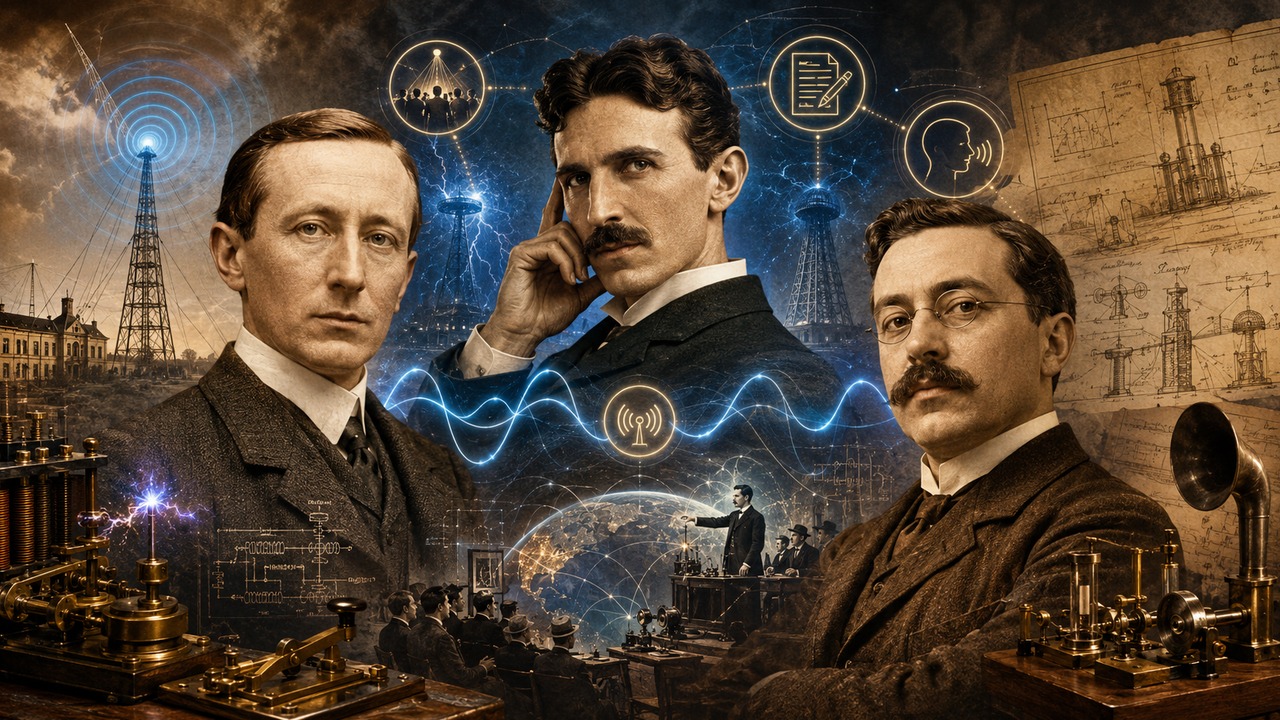
The question “who invented radio?” it seems to beg for a name, but the documents tell a layered story. Radio did not emerge from a single ready-made and complete device. Before broadcasting with voice and music existed, it was necessary to demonstrate electromagnetic waves, build transmitters and receivers, develop tuning, send signals over distances, transmit speech and transform experiments into usable services.
That's why Marconi, Tesla and Roberto Landell de Moura can appear as “inventors of radio” in different sources without all of them talking about exactly the same achievement. When Heinrich Hertz and Reginald Fessenden enter, the dispute becomes even clearer: each name stands out under a specific criterion.
The short answer: there is no single winner for all criteria
If “inventing radio” means physically demonstrating the waves that would make wireless communication possible, Heinrich Hertz is a decisive figure. If it means transforming Hertzian waves into practical, long-range and commercially exploited wireless telegraphy, Guglielmo Marconi occupies the center of the story. If the focus is on technical priority in circuits and tuning that later appeared in Marconi's patents, Nikola Tesla is unavoidable. If the criterion is wireless voice transmission and Brazilian documentation of a public demonstration in 1900, Roberto Landell de Moura gains enormous importance. And, in North American historical tradition, Reginald Fessenden appears as a pioneer of radiotelephony and the transmission of voice and music.
The error begins when one of these criteria is transformed into a universal definition of “radio”.
Before Marconi, Tesla and Landell: Hertz proved that waves existed
Between 1886 and 1888, Heinrich Hertz experimentally produced and detected electromagnetic waves, verifying predictions from James Clerk Maxwell's theory. The IEEE-recognized milestone highlights that Hertz observed properties such as reflection, refraction and polarization and demonstrated fundamentals of high-frequency technology.
That doesn't make Hertz the inventor of a radio service. His role was more fundamental: he showed that electromagnetic waves could be generated and detected in a controlled way. From then on, other researchers were able to try to convert them into a means of signaling and communication.
If the criteria is practical, long-distance wireless telegraphy, Marconi has the strongest claim
Guglielmo Marconi's trajectory is the one that best explains why his name became synonymous with the birth of radio. The Guglielmo Marconi Foundation records that in 1895 he experimented with a wireless telegraphy system. The following year he went to England, sought patent protection and began to publicly present the system. In 1897, he helped create the Wireless Telegraph and Signal Company, which would later incorporate his name.
Advancement was not restricted to the laboratory. Marconi progressively extended transmission distances, made links across the English Channel and, in December 1901, received signals sent from Poldhu in Cornwall, across the Atlantic in Newfoundland. In 1907, his company inaugurated a regular public radiotelegraph service between Europe and America.
In 1909, Marconi shared the Nobel Prize for Physics with Karl Ferdinand Braun. The motivation for the award was their contribution to the development of wireless telegraphy. The wording is important: the Nobel Prize did not declare Marconi “the only inventor of radio”; recognized a decisive contribution to a specific technology, wireless telegraphy.
Thus, when the criteria are practical radiotelegraphy system, range expansion, industrial organization and service implementation, Marconi is the best documented name among the three protagonists of the question.
If the criterion is technical priority in circuits and tuning, Tesla enters the center of the dispute
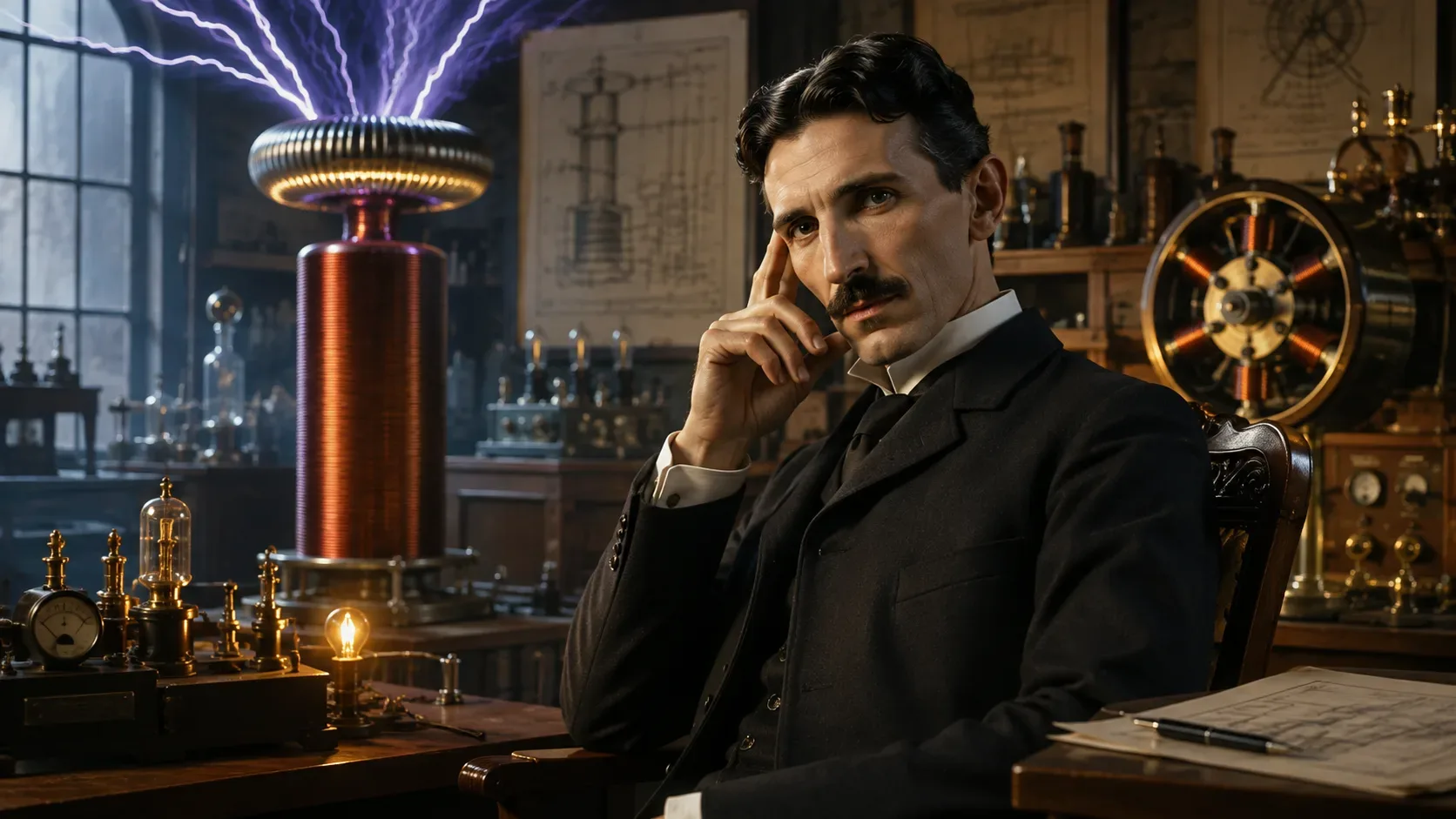
Nikola Tesla was already working with wireless energy and signal transmission in the 1890s. In 1898, he received North American patent 613,809 to remotely control ship or vehicle mechanisms. The document described a circuit sensitive to the influence of electrical waves produced at a distance, a concrete application of wireless command.
Most important for the dispute with Marconi are patents 645,576 and 649,621, granted in 1900 based on applications linked to work begun in 1897. They dealt with systems and apparatus for transmitting electrical energy and described transmission and reception arrangements with coupled and tuned circuits.
Decades later, these works would appear in the famous Marconi Wireless Telegraph Co. v. United States, decided by the United States Supreme Court in 1943. The Court considered that Tesla had anticipated technical features of a later patent by Marconi on a system of four tuned circuits. It also evaluated previous contributions from Oliver Lodge and John Stone Stone.
This is very different from saying that the Supreme Court “declared Tesla the inventor of the radio.” The case discussed validity and infringement of specific patent claims. The ruling itself stated that Marconi's reputation for achieving successful radio transmission rested on his original patent, which was not on trial at that point. The ruling limits certain Marconi patent claims; does not transfer the entire invention of radio to Tesla.
Tesla therefore has a strong claim when the criterion is priority on certain principles of tuning, coupling and control by electrical waves. This does not automatically equate to priority in implementing a public radiotelegraphy system or voice transmission.
If the criterion is wireless voice, Landell de Moura changes the conversation
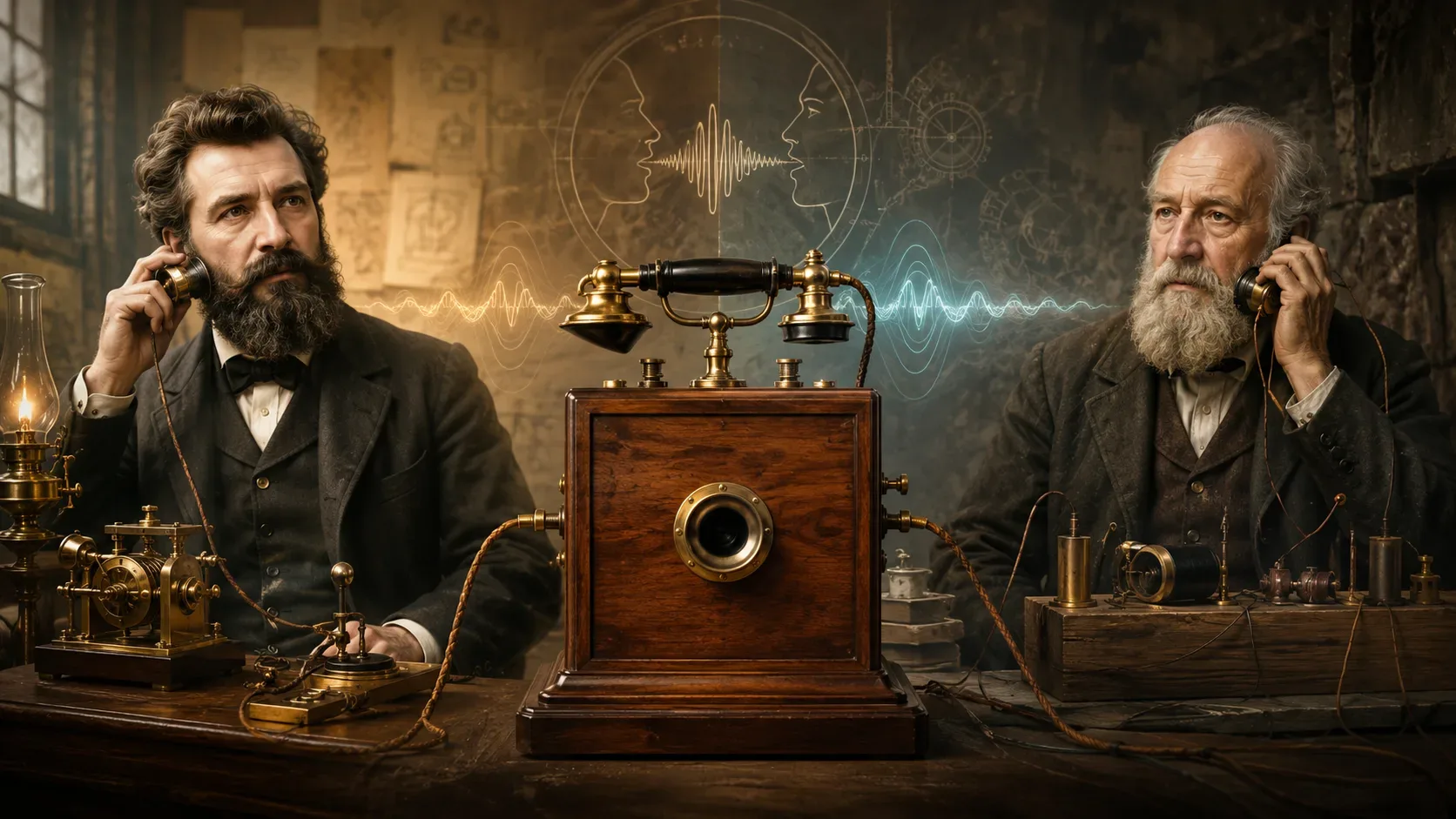
Roberto Landell de Moura occupies a unique position because his experiments sought something different from the Morse code radiotelegraphy that made Marconi famous: the wireless transmission of sound and speech.
Agência FAPESP records a demonstration carried out in São Paulo on June 3, 1900. The report retrieves news from Jornal do Commercio on June 10 of that year, according to which Landell carried out experiments with devices of his invention and included among the witnesses the British representative Percy Charles Parmenter Lupton and his family. The publication treats the episode as a successful demonstration of wireless long-distance sound transmission.
Research published in 2023 in the magazine Khronos, from USP, argues that Landell was the protagonist of at least two of the oldest voice transmissions over radio waves and brings together references from newspapers from 1899 and 1900, as well as later documents. This set of documents is relevant because it shows that Landell is not just a figure retrospectively added to history: there was public circulation of news about his experiments at the turn of the century.
Still, it is important to separate what is firmly documented from what remains disputed. There are narratives that push back Landell's experiences to earlier years, but the June 1900 demonstration is a much more solid documentary point for a public assertion of priority. The more an allegation depends on poorly documented earlier dates, the greater caution must be exercised.
Landell's patents show that this was not just an isolated experiment
In the United States, Landell obtained three patents directly related to wireless communication in 1904. Patent 771,917, entitled Wave Transmitter, describes the transmission of information from one point to another without wires and associates sound vibrations with electrical or light oscillations. Patent 775,337, Wireless Telephone, declares the objective of transmitting and receiving information corresponding to articulated speech without the help of wires. Patent 775,846, Wireless Telegraph, describes a wireless telegraphy system with electrical waves and the possibility of graphic, harmonic or phonetic signals.
These documents make it difficult to reduce Landell to a local curiosity. He worked systematically on wireless telephony and telegraphy and sought patent protection in the United States.
But a patent is not a certificate of “first inventor of radio” in the broadest sense. Patents protect delimited claims and depend on what has been presented, examined and considered new within a specific legal system. Marconi, Tesla and Landell had patents on different objects, on different dates and in different countries. Comparing just the number or date of a patent without comparing what it claims can produce wrong conclusions.
Fessenden shows why even the “first voice on radio” criterion depends on the sources considered
The United States National Park Service attributes a radio voice transmission to Reginald Fessenden on December 23, 1900, between two towers about a mile apart, and later records voice and music transmissions in 1906. In North American narrative, Fessenden is often presented as the “father of voice radio.”
The problem is that Brazilian documentation about Landell records a previous public demonstration, in June 1900. Thus, two historical traditions can use the expression “first voice transmission by radio” supported by different sets of documents.
This cannot be solved by automatically choosing the most famous font. It is necessary to ask what each experiment transmitted, by what physical means, under what conditions, with what witnesses, with what contemporary documentation and with what technical continuity. The existence of an official North American source that calls Fessenden the first does not erase Landell's documentation; and Landell's documentation does not make it unnecessary to examine the exact nature of his apparatus and demonstrations.
Public demonstration, patent and implementation are different criteria
A public demonstration answers the question “did it work in front of witnesses?” A patent answers “what technical characteristics were claimed and legally recognized?”. A commercial service responds “was the system repeatable, scalable and useful outside the laboratory?” These tests may produce different protagonists.
Landell is particularly strong in the criterion of early demonstration of wireless sound in Brazil and in the later patent registration of wireless telephony and telegraphy. Tesla is strong in prioritizing certain circuit architectures and principles, in addition to electrical wave remote control. Marconi is exceptionally strong in practical integration, range enhancement, business organization and radiotelegraph service at scale. Fessenden is central to the consolidation of radiotelephony and voice and music transmission experiments.
None of these facts requires erasing the others.
What the 1943 Supreme Court Really Changed
The 1943 decision is probably the most imprecisely used document in this dispute. It's important, but for a narrower reason than what usually circulates in internet summaries.
The Supreme Court examined Marconi Wireless Telegraph Company's patents in a lawsuit against the United States government. In analyzing patent 763,772, the Court concluded that certain broad claims were not inventive in light of previous work by other researchers. The text directly discusses Tesla, Lodge, and Stone, and states that Tesla had anticipated elements of the four-tuned-circuit arrangement later claimed by Marconi.
At the same time, the decision noted that Marconi's reputation for the first successful radio transmission related to his original patent, not the later patent that was being invalidated at that part of the process. Therefore, using the case as if it were a declaratory judgment about “who invented the radio” distorts the legal scope of the trial.
The correct conclusion is more interesting: even the patent of an established inventor could contain improvements whose technical elements already appeared in previous works. This reinforces the idea that radio was built by overlapping contributions.
So who invented radio?
If the question requires a single name without defining the criteria, the answer will inevitably be incomplete. Marconi is the best answer to the consolidation of practical, long-distance, commercially deployed wireless telegraphy. Tesla has relevant priority in principles and circuits that entered the patent dispute and in wireless control applications. Landell de Moura has serious documentation of early experiments with wireless voice and sound and specific patents for wireless telephony and telegraphy. Hertz provided the experimental basis for electromagnetic waves. Fessenden developed and demonstrated radiotelephony in a historic line that led to the transmission of voice and music.
The more precise question, therefore, is not “who won the radio race?”, but “which stage of technology are we trying to assign?”. When the criterion comes before the name, the apparent
contradiction between sources decreases. Radio stops seeming like a sudden invention of a single genius and starts to be seen for what it really was: a technology built in stages, with contributions that crossed, competed and were recognized in different ways in different countries and patent systems.