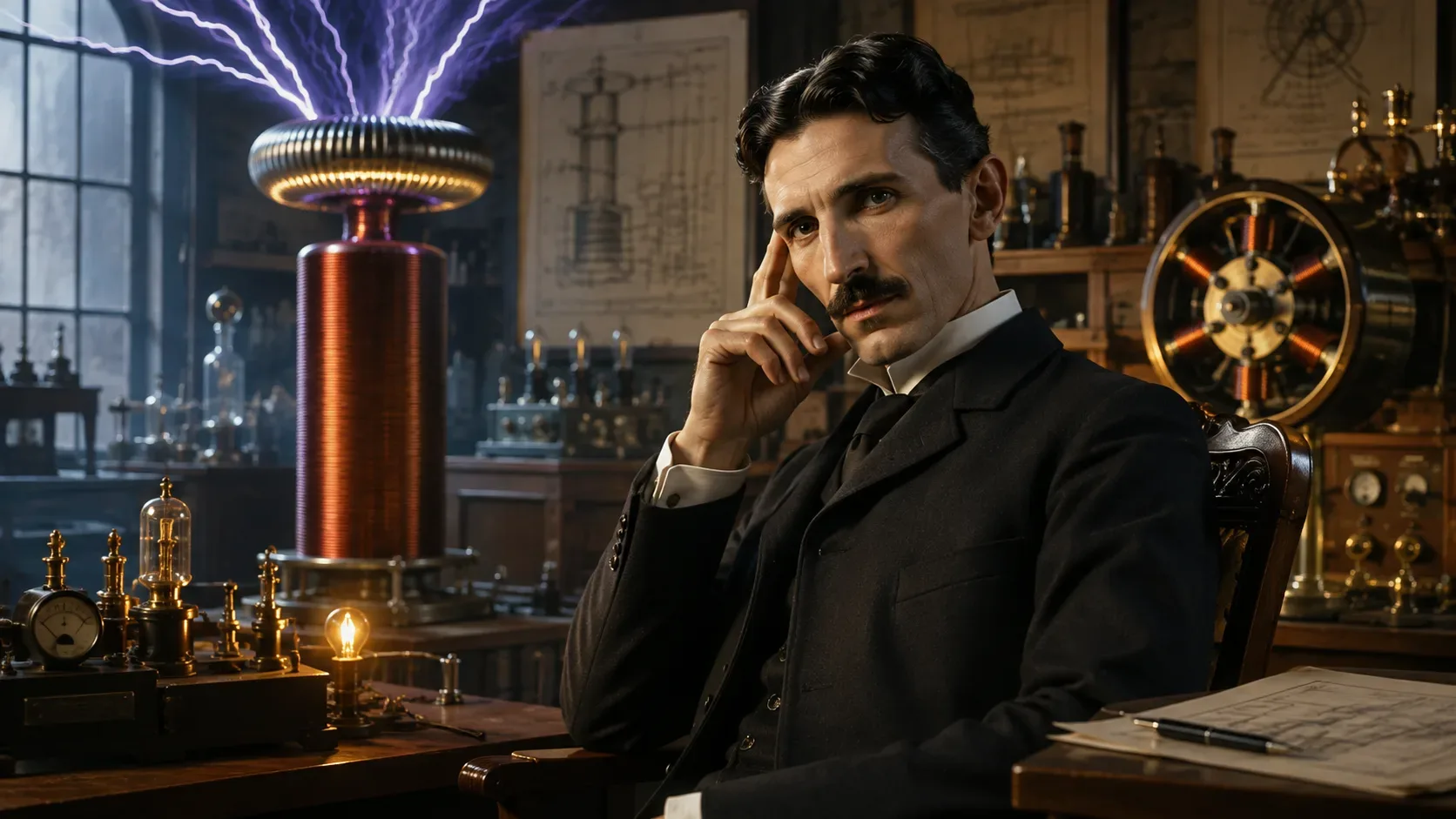
Nikola Tesla was a Serbian-American engineer and inventor whose work helped transform electricity into an infrastructure capable of powering cities and moving machines. Born on July 10, 1856, in Smiljan, then part of the Austrian Empire and now a territory of Croatia, he died on January 7, 1943, aged 86, in New York. Between one date and another, he became famous, made money, lost commercial opportunities, presented visionary projects and ended his life in much more modest conditions than those he had enjoyed at the height of his career.
His most important contribution was the development of polyphase alternating current motors and systems. Tesla also carried out relevant work with high frequency, lighting, wireless transmission, remote control and automation. However, the historical figure ended up surrounded by exaggerations: he did not invent electricity, he did not single-handedly create radio and he did not leave evidence of a machine capable of providing unlimited energy for free.
Understanding your life requires separating three dimensions: proven inventions, projects that did not reach practical application and stories expanded upon by admirers, films and popular publications.
Childhood, training and first jobs
Nikola Tesla was the son of Milutin Tesla, a priest of the Serbian Orthodox Church, and Georgina “Đuka” Mandić Tesla. Although his mother had no formal technical training, Tesla later attributed her great ability to build utensils and solve practical problems.
He attended schools in the region of present-day Croatia and studied engineering at the Austrian Polytechnic Institute in Graz. He also attended classes in Prague, but did not complete a university course or receive an engineering degree. Before emigrating, he worked with telephone and electrical equipment in Budapest and Paris.
On June 6, 1884, Tesla landed in New York on the ship City of Richmond. Shortly afterwards, he began working at Edison Machine Works, a company linked to Thomas Edison. The visit was brief, but important: Tesla got to know the North American electrical sector from the inside and realized the commercial limitations of the direct current systems used at that time. The Nikola Tesla Museum preserves both the record of his arrival and the certificate of American citizenship, issued on July 30, 1891.
Tesla and Edison disagreed about engineering, compensation, and the future of electrical distribution. Still, the image of two inventors personally waging war for decades is an oversimplified one. Tesla worked for a short time for an Edison company. The subsequent dispute occurred mainly between competing companies, investors and technological systems.
The invention that established his reputation
The big obstacle for alternating current at the beginning of electrification was developing efficient and reliable motors. Tesla worked on a solution based on phase-shifting currents, capable of creating a rotating magnetic field inside the engine.
On May 1, 1888, some of his main records related to electromagnetic engines and distribution systems were published in the United States. In these projects, independent circuits received alternating currents in different phases, producing progressive movement of the magnetic field.
The result was the induction motor: a machine that could operate without the system of brushes and commutators used in many earlier motors. The solution reduced mechanical wear and helped make an integrated system for generation, transmission and industrial use of alternating current viable. The Smithsonian preserves examples of engines built by Westinghouse based on this principle.
Industrialist George Westinghouse realized the commercial potential of the technology. In July 1888, his company acquired the rights to Tesla's patents, and the inventor spent time working as a consultant in Pittsburgh. Tesla provided an essential part of the system; Westinghouse engineers, transformer manufacturers, generator builders, and other inventors participated in transforming these concepts into a commercial electrical grid.
Tesla invented alternating current?
No. Alternating currents, generators and transformers were already studied and used before Tesla. His decisive contribution was to develop and patent components of a polyphase system, especially motors capable of efficiently converting alternating electrical energy into movement.
Saying that Tesla “invented alternating current” erases the work of other researchers and engineers. To say that it only had a secondary role would also be incorrect: its induction motor and its polyphase patents were fundamental to the commercial expansion of this model.
The War of Currents
At the end of the 19th century, companies fought over which system would supply the growing electrical grid in the United States. Direct current, associated with Edison's companies, worked well in local networks, but faced economic difficulties in transmitting energy over long distances under the technical conditions of the time.
Alternating current made it possible to increase the voltage for transmission and reduce it close to consumers through transformers. Westinghouse defended this model and used patents from several inventors, including Tesla's.
The so-called War of the Currents was, therefore, an industrial, financial, regulatory and advertising dispute. Edison and his allies publicly explored the risks of high voltage, while Westinghouse sought to demonstrate that alternating current could be operated safely. Tesla became the main technical symbol of the winning side, but the commercial battle was led mainly by companies.
A landmark moment occurred at the 1893 Chicago World's Fair, lit by Westinghouse alternating current equipment. The fair demonstrated the system's capabilities on a large scale and reinforced its public acceptance.
The next step was the use of Niagara Falls. Westinghouse received contracts to supply generators, and the polyphase system associated with Tesla's patents became part of the project. The plant began producing power in 1895, and Buffalo began receiving electricity from the falls on November 15, 1896.
Nikola Tesla's main inventions and contributions
Polyphase system and induction motor
This was Tesla's contribution with the greatest economic and social impact. Induction motors have become essential in factories, pumps, fans, tools and countless equipment.
The principle of the rotating magnetic field was also independently researched by the Italian physicist Galileo Ferraris. This demonstrates that major technological transformations rarely depend on a single person. Tesla, however, obtained influential patents and worked with Westinghouse to bring the system to market.
Tesla coil
The Tesla coil is a resonant transformer capable of producing high voltage and high frequency alternating currents. Patents related to the device were granted in 1891. Tesla used these coils in experiments with electrical discharges, lighting and wireless transmission.
Today, versions of the equipment are employed primarily in educational demonstrations, specialized research, and scientific entertainment. The coil is not a generator of free energy: it receives energy from a source and transforms it into electrical signals of different characteristics.
Lighting and high frequency currents
Tesla performed demonstrations in which discharge tubes were illuminated without direct wire connection. It also investigated high-frequency effects and lighting possibilities that were not yet commercially mature.
These works contributed to the study of discharges in gases and resonant circuits. This does not mean that Tesla single-handedly invented fluorescent lamps, neon lighting, or all the technologies that later utilized similar phenomena.
Remote control and automation
In 1898, Tesla presented a small boat controlled by radio signals at Madison Square Garden. The invention was registered in US patent 613,809, relating to the control of mechanisms on vessels or vehicles.
The boat could receive commands to change direction and activate its mechanisms. Tesla called the technology teleautomaton and imagined applications in automation, transportation and warfare. The experiment is recognized as one of the first practical examples of wireless remote control and as a conceptual precursor to robotics.
Radio and wireless communication
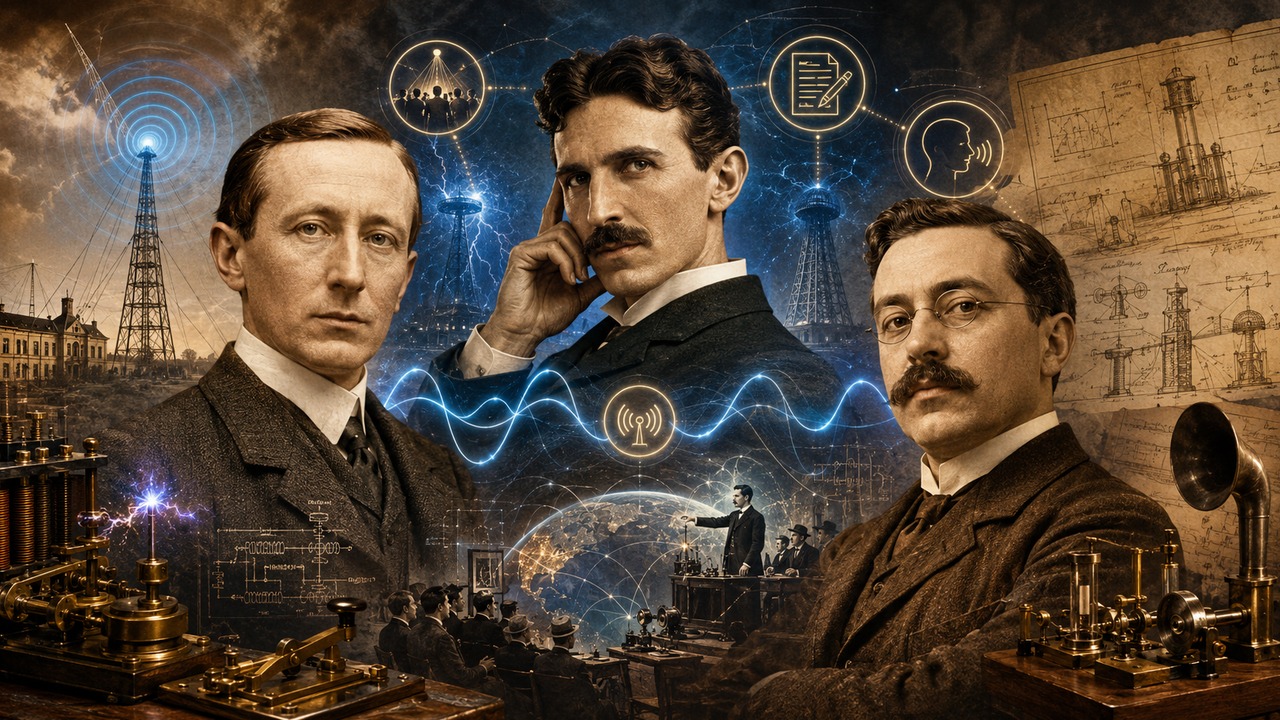
Tesla developed tuned circuits, transmitters and receivers related to communication using electromagnetic waves. He also presented projects that combined antennas, resonant circuits and grounding.
However, radio emerged from the accumulated work of researchers such as Heinrich Hertz, Édouard Branly, Oliver Lodge, Alexander Popov, Guglielmo Marconi, John Stone Stone and Tesla. There is no solid historical basis for attributing all invention to a single person.
Tesla turbine and other mechanical projects
Tesla patented a bladeless turbine that used smooth discs and the viscous effect of the fluid. The idea was elegant and continues to be studied in specific contexts, but it has not replaced conventional turbines in large-scale industrial applications.
He also worked on mechanical oscillators, pumps, meters, transportation devices, and aeronautical designs. His last North American patent, granted in 1928, described an air transport device, but the inventor did not build an operational prototype.
Wardenclyffe: the project that changed its trajectory
In 1899, Tesla set up a laboratory in Colorado Springs to study high-voltage discharges, resonance, and wireless transmission. The results convinced him that he could build a worldwide network to transmit messages, telephony, images and, according to his most ambitious proposals, electrical energy.
In 1901, banker J. P. Morgan invested in a station project in Shoreham, Long Island. The facility, later known as Wardenclyffe, included a laboratory designed by architect Stanford White and a large transmitter tower.
The initial objective presented to investors was linked to transatlantic communications. During development, Tesla expanded the scope and sought more resources to build a much more powerful transmitter.
In December 1901, Marconi announced the reception of a signal sent from England to Newfoundland. His solution was simpler and cheaper than Tesla's proposal. Morgan turned down new contributions, material costs rose, and Tesla was unable to gather sufficient financing. Work lost pace and was practically at a standstill in 1905. The tower was demolished in 1917.
Would Wardenclyffe provide free energy?
There is no evidence that Wardenclyffe was close to producing unlimited energy or eliminating the need for power plants. Tesla wanted to transmit electricity wirelessly; the energy would still have to be generated by some source.
There is also no evidence that Morgan terminated the project specifically because he could not install meters and charge for electricity. The documented explanation involves increased costs, change in scope, technical risks, Marconi competition and inability to attract new investments.
The main controversies and myths about Tesla
Tesla versus Edison
Tesla worked for an Edison company and left after disagreements. In his autobiography, he said that an administrator promised him a large reward if he improved certain machines, but then treated the promise as a joke.
The story was later retold placing Edison himself at the center of the episode. Because independent documentation is limited and versions vary, it should be presented as Tesla's account, not word-for-word proven dialogue.
The later technological competition wasn’t just “Tesla versus Edison” either. The main confrontation occurred between the Edison and Westinghouse business systems, with dozens of engineers and investors involved.
Was Tesla the true inventor of radio?
The United States Supreme Court decided, on June 21, 1943, a patent case from the Marconi Wireless Telegraph Company. The court found certain claims in a Marconi patent invalid because they had been anticipated by previous work. The decision discussed contributions from Oliver Lodge, John Stone Stone and Nikola Tesla.
This did not mean that the Supreme Court declared Tesla the sole inventor of the radio. The ruling dealt with the validity and infringement of specific patent claims, not the granting of exclusive historical title.
Tesla was one of the pioneers of wireless communication, but radio resulted from an international sequence of discoveries, demonstrations and commercial systems.
Tesla gave up a fortune?
The contract with Westinghouse provided for payments for the exploitation of its patents, including remuneration associated with the power of the engines sold. When the company faced financial difficulties, Tesla agreed to drop the royalty clause.
The decision certainly reduced his future earnings. However, estimates that he would have abandoned billions of dollars are retrospective and speculative calculations. They usually assume that the contract would remain valid for decades, without renegotiations, limits, patent expiration or business changes.
The “death ray”
In the 1930s, Tesla released the concept of a defensive system that he called Teleforce. The press often described it as a “death ray.” The proposal involved the acceleration of particles, but there is no proof that Tesla built an operational weapon with the announced capabilities.
After his death, documents and objects were sealed by the North American body responsible for the custody of foreign properties. Tesla, despite the name of the organization, was a citizen of the United States. The FBI claims it did not search his belongings or keep his projects, contradicting a conspiracy theory repeated for decades.
Eccentricity is not a diagnosis
Tesla developed strict routines, avoided physical contact in some situations and showed a strong concern for cleanliness. He also became known for feeding and caring for pigeons in New York.
These behaviors have led modern authors to suggest different psychological diagnoses. However, it is not possible to clinically evaluate a person who has been dead for decades based only on reports, interviews and habits. Responsible editorial treatment is to describe them without turning retrospective speculation into diagnosis.
How Nikola Tesla lived until the end of his life
After Wardenclyffe's failure, Tesla continued looking for investors, registering patents, providing consultancy and giving interviews. However, it did not achieve the commercial success it had with its alternating current patents.
He lived for years in New York hotels, changing addresses when he racked up bills or faced conflicts with management. In the final period, he received financial support associated with Westinghouse, which paid for his accommodation.
For the last ten years of his life, he occupied room 3327 at the New Yorker Hotel. The Nikola Tesla Museum preserves objects from this room, including furniture, suitcases, cabinets and a safe.
Tesla never married or had children. He spent long periods alone, walked around the city and fed pigeons. In interviews, he described an especially intense bond with an injured white dove that he cared for.. The story became a symbol of his loneliness, although many popular versions add interpretations not supported by the sources.
Despite financial difficulties, he was not completely forgotten during his lifetime. He received tributes, honorary diplomas and visits from journalists. On his birthdays, he released predictions and projects, some technically plausible and others increasingly speculative. The contrast between the importance of his previous work and the lack of results from his latest projects reinforced his image as a visionary and isolated inventor.
Tesla died in his room at the Hotel New Yorker on January 7, 1943. The certificate preserved by the Nikola Tesla Museum records the funeral on January 12. His body was later cremated on March 25, 1943. The ashes were taken to Belgrade and are today preserved in the Nikola Tesla Museum.
His documents, correspondence, calculations, drawings and personal objects were sent to Belgrade in 1951. The Nikola Tesla Museum was created in 1952 and opened to the public on October 20, 1955. Its archive brings together more than 160 thousand documentary records.
Essential Chronology of Nikola Tesla
| Data | Event |
|---|---|
| July 10, 1856 | Born in Smiljan, then part of the Austrian Empire |
| June 6, 1884 | Arrives in New York |
| 1888 | Publishes fundamental patents for polyphase motors and systems |
| July 1888 | Westinghouse acquires rights to its alternating current patents |
| July 30, 1891 | Becomes a US citizen |
| 1891 | Registers patents related to the Tesla coil |
| 1893 | Take part in demonstrations at the Chicago World's Fair |
| 1895–1896 | The alternating current system is applied in the Niagara Falls project |
| 1898 | Demonstrates radio controlled boat |
| 1899 | Performs experiments in Colorado Springs |
| 1901 | Wardenclyffe project begins with funding from J. P. Morgan |
| 1905 | The Wardenclyffe project is paralyzed due to lack of resources |
| 1917 | Wardenclyffe's tower is demolished |
| 1928 | Receives its last North American patent |
| January 7, 1943 | Dies at the Hotel New Yorker, in New York |
Tesla's legacy without exaggeration
Nikola Tesla was not a misunderstood magician who single-handedly invented all modern technologies. Nor was he a dreamer without practical results.
His work with induction motors, polyphase systems and high-frequency currents had concrete consequences. His remote control demonstrations anticipated automation, and his wireless experiments participated in the historic construction of telecommunications.
At the same time, their failures show that a visionary idea is not enough. A technology also needs to be verifiable, financially sustainable, adaptable to existing infrastructure, and capable of outperforming competing solutions.
In 1960, the General Conference on Weights and Measures adopted tesla, symbol T, as the name of the International System unit for magnetic flux density. The tribute aptly summarizes his legacy: Tesla became a permanent presence in science not because of legends, but because of his proven contributions to the study and application of electromagnetism.