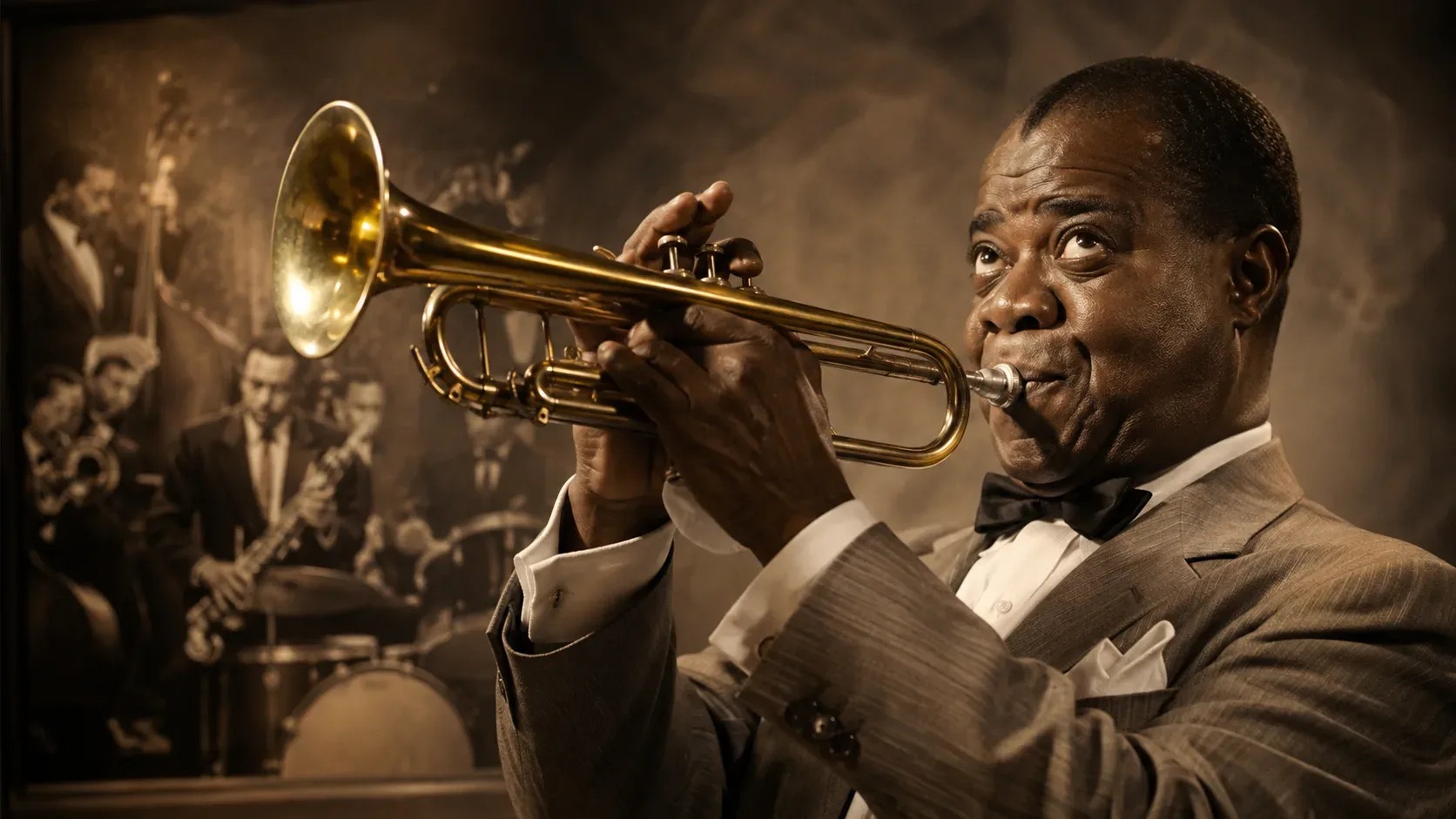
On August 4, 2026, it will be 125 years since the birth of Louis Armstrong. The calculation seems simple: 2026 minus 1901. For Armstrong himself, however, it would have produced another result.
For much of his life, the trumpeter believed he was born on July 4, 1900, the date of United States independence. He celebrated his birthday that day, filled out documents with that information and reached the end of his life without there being any evidence that he knew the date now accepted by biographers, museums and cultural institutions: August 4, 1901.
The correction came only years after his death, when music researcher Tad Jones found a baptism record in a New Orleans church. The episode produces a good biographical curiosity, but its interest goes beyond that. The story reveals how a public life is constructed, how archives correct versions repeated over decades and, above all, how not even an artist as singular as Armstrong formed himself.
The man who helped change the sound of the 20th century didn't correctly know his own birthday. He also wouldn't have reached the place he occupies in history without teachers, mentors, partners, composers and musicians who worked alongside him.
Louis Armstrong's birthday existed on two dates
The Louis Armstrong House Museum calls July 4 the musician's “traditional” birthday. It was the date recognized by Armstrong himself and his mother, Mary “Mayann” Albert. According to the museum, he already used it in documents when he was still a teenager. Therefore, books, reports and reference works continued to record July 4, 1900 for decades.
The other date appeared in the late 1980s. While researching Armstrong's early years for a project by writer and critic Gary Giddins, Tad Jones followed a lead related to the musician's baptism. At the Church of the Sacred Heart of Jesus, in New Orleans, he received a copy of a record that identified Armstrong's parents and reported his birth on August 4, 1901. The discovery was widely publicized after the publication of Satchmo, a book by Giddins released in 1988.
It is important to correctly name the evidence: it was a baptismal registration or certificate, not a civil birth certificate. The Louis Armstrong House Museum states that the document convincingly indicates the date of August 4, 1901, now adopted in his official biography and by institutions such as the Smithsonian.
The correction, therefore, does not delete the other date. One belongs to the historical chronology supported by the archive; the other belongs to the story lived by Armstrong himself. The museum still celebrates both.
Why did the wrong date last so long?
There is no proven explanation for the origin of the divergence.
The 4th of July version could seem especially appropriate for a personality who would later be presented as a cultural symbol of the United States. But turning this coincidence into a cause would be speculation. What is known is that Armstrong believed in it, his mother confirmed it and documents completed throughout his youth helped to consolidate it.
Researchers consider it possible that he changed the year to appear older when he began working professionally as a teenage musician. This hypothesis would help explain the transition from 1901 to 1900, but does not completely resolve the change from August to July. The Louis Armstrong House Museum itself presents this possibility with caution, without treating it as a demonstrated fact.
The longevity of the error also shows the strength of the autobiographical information. When a person repeats the same date for years, provides it to institutions and incorporates it into their own celebrations, the version begins to circulate as fact. Only deliberate documentary research managed to interrupt this chain.
Jones did not find the record in a digital database or in a file already associated with Armstrong. As he later reported, it only took a few minutes inside the church to locate a document that had been kept for around 88 years. The difficulty was not in deciphering the proof, but in knowing where to look.
The formation of Louis Armstrong was a collective work
The anniversary story provides a good narrative thread, but it shouldn't reduce Armstrong to a calendar curiosity. 125 years after his birth, the most revealing question is another: who helped transform the boy from New Orleans into the musician who reorganized the role of the soloist in jazz?
Three names help answer: Peter Davis, Joe “King” Oliver and Lil Hardin Armstrong. They occupied different positions — teacher, mentor, partner, composer and strategist — at decisive stages in the artist's formation.
Peter Davis and the first structured musical instruction
At the turn of 1912 to 1913, Armstrong was arrested after firing a gun into the air during New Year's celebrations. He was sent to the Colored Waif’s Home for Boys, the historic name of a segregated juvenile institution in New Orleans.
It was there, under the guidance of musical director Peter Davis, that he received more structured cornet instruction, learned to read music, joined the institution's band and, later, became its leader. Armstrong remained there for approximately a year and a half, leaving in 1914.
This episode is often presented as the moment when Armstrong found his way. The formulation requires care: the importance of Davis and the band does not transform the hospitalization into a benign experience nor does it justify the punitive and racially segregated system that produced it.
The decisive gain came from the musical education offered by Peter Davis. He helped Armstrong move from informal experience—singing in the streets, listening to musicians in neighborhoods, and experimenting with instruments—to the discipline of ensemble, reading, and regular performance.
King Oliver and his entry into the professional world
After leaving the institution, Armstrong found in Joe “King” Oliver an informal teacher, artistic role model and almost fatherly figure. One of New Orleans' most respected cornetists, Oliver offered instrumental guidance to the young musician and helped him break into the city's professional circuits. Armstrong called him “Papa Joe.”
When Oliver moved to Chicago in 1918, Armstrong took over the position he had left in Kid Ory's band. Four years later, Oliver sent out a call for his former student to join the Creole Jazz Band at Lincoln Gardens in Chicago.
From July 1922, the two started playing together. His two-horn dialogues became one of the hallmarks of the group, which recorded in 1923. Armstrong found more than exposure there: he gained experience within one of the fundamental formations of Chicago jazz and learned, on stage and in the studio, how his sound could work in relation to another great instrumentalist.
Oliver opened the door. Later, Armstrong would need to decide when to cross it alone.
Lil Hardin Armstrong was much more than “Louis’s wife”
Pianist Lillian “Lil” Hardin was already part of King Oliver's band when Armstrong arrived in Chicago. He had musical training, professional experience and a clear perception that the new cornetist was capable of leading his own career.
Lil and Louis were married in February 1924. She encouraged him to leave Oliver's shadow, improve his professional performance, and accept opportunities in which he could appear as a soloist. Therefore, describing her as just Armstrong's second wife diminishes her role: Lil was a pianist, composer, arranger, band leader and a kind of informal administrator of her husband's career.
His contribution also appears in the music. She played on Hot Five recordings, participated in key Hot Five and Hot Seven sessions, and wrote or documented compositions linked to that repertoire. The collections of the Library of Congress preserve copyright deposits that help demonstrate her role as an author and organizer, not just as an accompanist.
It was Lil who pushed Armstrong to think in terms of artistic autonomy. After a stint with Fletcher Henderson's orchestra in New York, he returned to Chicago and began, in 1925, recording under his own name. The movement that consolidated the great soloist therefore had an intellectual, musical and strategic partner.
A timeline of Armstrong's formation
| Data | Moment |
|---|---|
| August 4, 1901 | Birth in New Orleans, according to the baptism record located later. |
| 1913–1914 | Musical instruction with Peter Davis and participation in the youth institution's band. |
| From 1914 | King Oliver becomes an informal teacher, mentor and professional reference. |
| 1918 | Armstrong takes the place left by Oliver in Kid Ory's band. |
| 1922 | Moves to Chicago to join King Oliver's Creole Jazz Band. |
| 1923 | Participates in his first recordings with Oliver's group. |
| 1924 | Marries Lil Hardin and joins Fletcher Henderson's orchestra in New York. |
| 1925 | Returns to Chicago and begins recording the Hot Five under his own name. |
The chronology brings together data from the Louis Armstrong House Museum, the Library of Congress and institutions dedicated to the preservation of jazz.
How Armstrong transformed what he was given
Recognizing the training network does not diminish Armstrong's originality. On the contrary: it allows us to observe what he did with the knowledge that circulated in New Orleans, on the boats of the Mississippi, in the bands of Chicago and in the recording studios.
Armstrong expanded the space of the individual improviser within music that, in its earliest recorded formats, was heavily based on collective interaction. His rhythmic security, his melodic lines and the architecture of his solos helped to place the improviser at the center of the performance. For this reason, many scholars describe him as the first great jazz soloist.
His influence was not limited to the trumpet. Armstrong treated the sung melody with freedom similar to that of an instrumentalist: he moved accents, introduced variations and used the voice as a material for improvisation. His recording of “Heebie Jeebies” in 1926 played an important role in popularizing scat singing.
None of this appeared in a vacuum. Jazz developed in African-American communities in New Orleans, in dialogue with different musical traditions, and spread through networks of musicians, entertainment venues, travel, migration and recordings. Armstrong worked in a segregated society, in which black artists created decisive cultural forms without controlling, under equal conditions, the means of dissemination and recognition.
The image of the isolated genius is insufficient. Armstrong's talent was extraordinary; the infrastructure that allowed it to develop it was collective.
What the two dates say about Louis Armstrong
The existence of two anniversaries does not mean that all versions have the same factual value. For historical chronology, the best available evidence supports August 4, 1901. To understand how Armstrong lived and told his own story, however, July 4, 1900 remains relevant.
A date shows when he was born. The other shows what he believed in, what he said about himself and how he was celebrated by family, friends, musicians and admirers.
At 125 years since his birth, the documentary correction also works as a reminder that biographies are not definitive blocks. They change when new files are found, when people previously treated as supporting actors receive due recognition and when a trajectory is no longer narrated solely as a sequence of individual achievements.
Louis Armstrong did not correctly know the date of his own birth. But the path that took him from the streets of New Orleans to international stages can be reconstructed with ever greater precision — as long as history makes room for Peter Davis, King Oliver, Lil Hardin Armstrong and the musical communities that sustained their formation.
Follow the series of trajectories and explore another biography, such as those of Nikola Tesla, John Venn or Neil Armstrong. Each known life can still contain a story that traditional summaries have failed to tell.