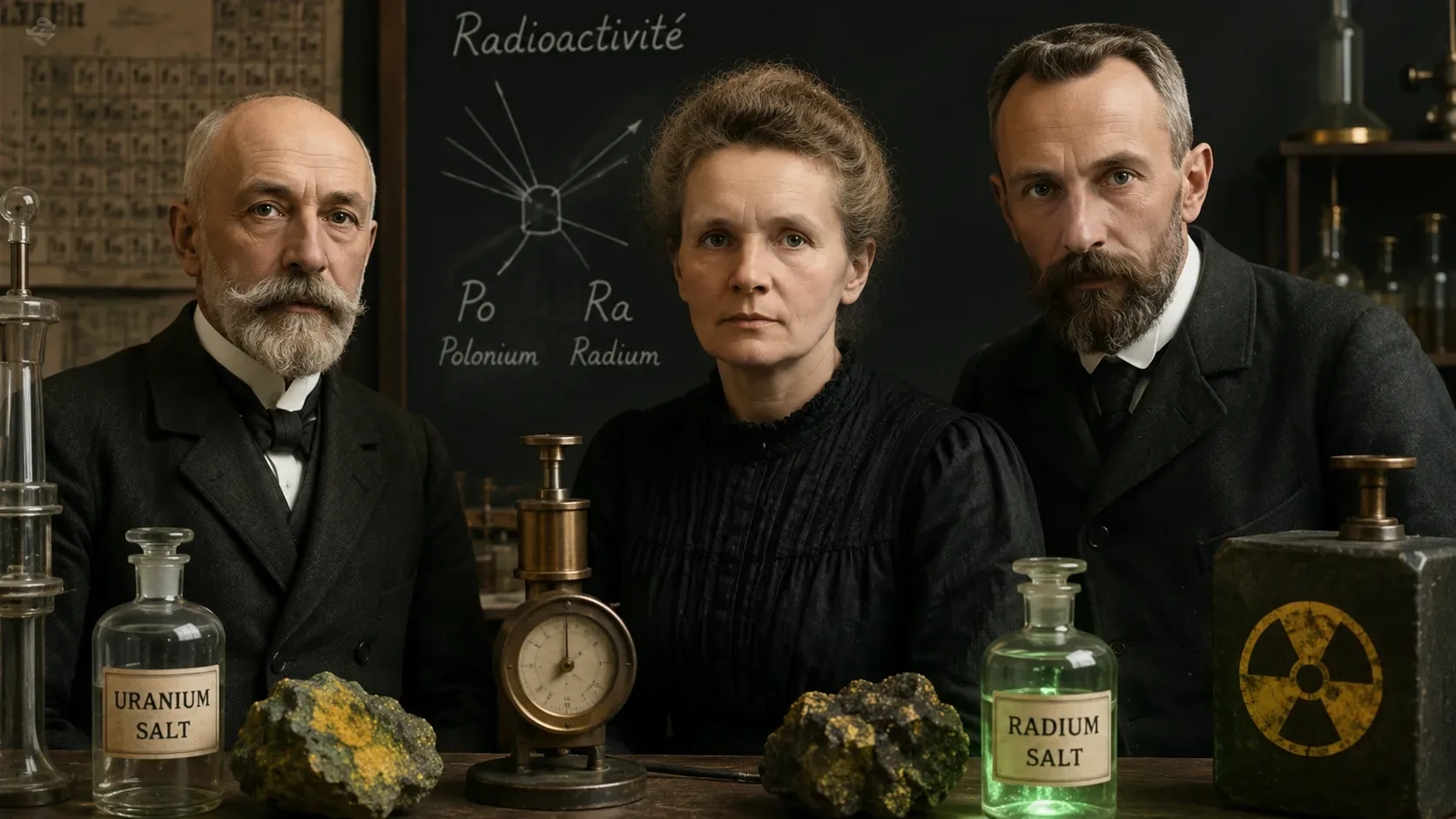
No, at least not in the sense of being the first person to observe the phenomenon. Henri Becquerel identified in 1896 that uranium compounds emitted penetrating radiation spontaneously, without needing to be excited by light. Marie Curie turned that finding into a systematic research program: she measured the phenomenon, showed that it also appeared in thorium, treated the emission as a property linked to the atom itself, and introduced the term radioactivity. Then, working with Pierre Curie, she used that property as a kind of tracer to reach two new elements, polonium and radium.
The most accurate way to divide the credit is therefore this: Becquerel discovered the spontaneous radioactivity of uranium; Marie Curie expanded, conceptualized, and named the phenomenon; Marie and Pierre Curie discovered polonium and radium and deepened the study of radioactive substances. The wording of the 1903 Nobel Prize in Physics itself makes this distinction.
Why the phrase “Marie Curie discovered radioactivity” is imprecise
The phrase is common because Marie Curie became the historical figure most strongly associated with radioactivity. But it blends together different stages of scientific discovery. Before Marie began her thesis on the subject, Becquerel had already shown that uranium emitted rays capable of exposing photographic plates and ionizing air.
What Marie did from 1897 onward was decisive precisely because she did not merely repeat the observation. She created a quantitative way to study the emission, compared substances, tested minerals, formulated the idea that intensity was tied to the amount of radioactive element, and treated the phenomenon as an atomic property rather than an effect of a particular molecule, light, or an external chemical reaction.
This difference between observing first and building a field of investigation is why short answers online can look contradictory: many use “discovered radioactivity” as shorthand for “was central to creating the science of radioactivity.” Historically, those two claims are not equivalent.
What Henri Becquerel discovered in 1896
After Wilhelm Röntgen's discovery of X-rays, Becquerel was investigating whether phosphorescent materials could produce similar radiation after receiving light. In his tests, he placed uranium salts on photographic plates wrapped in black paper.
The decisive point came when plates stored in the dark were still strongly exposed. Becquerel concluded that the emission did not depend on prior exposure to light. Later experiments showed that the effect was linked to uranium itself, including in materials that were not phosphorescent.
This is the finding that the 1903 Nobel Prize in Physics described as the “discovery of spontaneous radioactivity.” Becquerel received half of the prize; the other half was divided between Pierre and Marie Curie for their joint research on the radiation phenomena he had discovered.
What Marie Curie added to Becquerel's phenomenon
Marie Curie chose the so-called “Becquerel rays” as her research subject and adopted a quantitative approach. Instead of relying only on photographic plates, she measured the extremely weak electric currents produced when the radiation ionized air. To do this, she used a system based on the electrometer and piezoelectric quartz developed by Pierre Curie and his brother Jacques.
That precision allowed several important conclusions:
- The emission could be measured comparatively. This made it possible to test minerals and compounds rather than simply record whether a plate darkened.
- Thorium also showed the phenomenon. Marie reached this conclusion in 1898, almost simultaneously and independently of the German physicist Gerhard Carl Schmidt.
- Activity depended on the amount of uranium or thorium, not on the chemical form of the compound. For Marie, this pointed to a property of the atom itself.
- Some ores were far too active for the amount of uranium or thorium they contained. That anomaly opened the path to searching for unknown elements.
Marie began using the term radioactivity for this property. In her 1911 Nobel lecture, she explained that she had called elements emitting this kind of radiation radioactive and that the name radioactivity came to designate the new property of matter. The Nobel historical account places the first use of the term by the Curies in their July 1898 paper on polonium.
Why Pierre Curie was more than a “helper”
Pierre Curie was already an established physicist, with work in crystallography, magnetism, and piezoelectricity. The measuring apparatus derived from the work of Pierre and Jacques Curie was crucial because it converted ionization caused by radiation into highly sensitive electrical measurements.
When Marie's results suggested that certain ores contained something much more active than uranium, Pierre temporarily set aside his own line of research to work with her. The investigation then combined two fronts: chemical separation of ore fractions and physical measurement of the activity of each fraction. Laboratory notebooks preserved by the Musée Curie contain notes by both researchers from this process.
So describing Pierre as merely a support figure distorts the collaboration. Marie initiated the program, formulated central hypotheses, and led much of the chemical treatment; Pierre contributed metrology, experimental physics, and the joint work that made it possible to track minute amounts of radioactive material through repeated separations.
How polonium and radium were discovered in 1898
The clue came from pitchblende, a uranium ore whose activity was greater than could be explained by the uranium it contained. If the known components did not account for the measurement, Marie proposed that the ore must contain at least one unknown substance that was far more radioactive.
By fractionating the ore and repeatedly measuring activity, Marie and Pierre observed a fraction chemically associated with bismuth that became increasingly active. In July 1898 they announced evidence for a new element and proposed the name polonium, in honor of Marie's native Poland.
Months later, they found another extremely strong activity following barium fractions. On December 26, 1898, a note proposing the name radium was presented to the French Academy of Sciences. That paper was signed by Pierre Curie, Marie Curie, and Gustave Bémont, a detail often lost in popular summaries, although historical tradition and Nobel citations credit the discovery of the two elements to the work of Marie and Pierre Curie.
“Discovering an element” is not the same as isolating it pure
In 1898 the Curies did not yet have a vial of pure polonium or a bar of metallic radium. The discovery was inferred from a combination of chemical behavior and extraordinary radioactivity: as the ore was separated, the activity became concentrated in particular fractions as if an unknown element were present there.
Fully demonstrating the existence of radium required years of processing large quantities of pitchblende residues, purification, and determination of chemical properties. Marie Curie later obtained very pure radium compounds, determined its atomic weight with increasing precision, and in 1910 isolated radium in metallic form with André Debierne. The 1911 Nobel Prize in Chemistry recognized Marie for the discovery of radium and polonium, the isolation of radium, and the study of the nature and compounds of that element.
This chronology prevents another common mistake: imagining that the 1898 discovery was a single moment when the element appeared ready-made and separated. In practice, it was a chain of evidence strengthened over years.
So what did each of them actually discover?
| Person | Main contribution | What is not accurate to say |
|---|---|---|
| Henri Becquerel | In 1896 he identified the spontaneous emission associated with uranium, the phenomenon later called radioactivity. | He did not discover polonium or radium. |
| Marie Curie | She systematized measurements, independently showed the radioactivity of thorium, formulated radioactivity as an atomic property, introduced the term radioactivity, and launched the search that led to new elements. | She was not the first person to observe uranium's spontaneous emission. |
| Pierre Curie | He joined Marie's research, supplied decisive expertise in physical measurement, and worked with her on identifying polonium and radium and studying radiation. | He was not merely a laboratory assistant. |
| Marie and Pierre Curie | In 1898 they discovered evidence for the new elements polonium and radium through chemical separation guided by activity measurements. | The initial discovery did not mean the elements had already been isolated in pure form. |
The Nobel wording itself separates the credit
The division of the 1903 Nobel Prize in Physics is one of the clearest sources for resolving the question. The prize awarded Becquerel half for the discovery of spontaneous radioactivity and gave the other half jointly to Pierre and Marie Curie for their research on the radiation phenomena discovered by Becquerel.
The 1911 Nobel Prize in Chemistry recognized another layer of the story: Marie Curie received the prize for her services to chemistry through the discovery of the elements radium and polonium, the isolation of radium, and the study of its nature and compounds.
So simply saying “Marie Curie discovered radioactivity” erases Becquerel; saying that she “only continued Becquerel's work” erases the conceptual, methodological, and chemical transformation produced by Marie and by her collaboration with Pierre. The accurate history is a sequence of connected discoveries.
A short answer to remember
Becquerel discovered in 1896 that uranium emitted radiation spontaneously. Marie Curie turned that phenomenon into a subject of systematic measurement, linked it to an atomic property, introduced the term radioactivity, and recognized that unusually active ores pointed to unknown elements. Marie and Pierre Curie, working together, announced polonium and radium in 1898.
This division does not diminish any of the three. On the contrary, it shows how science advanced in stages — from Becquerel's observation, to Marie's interpretation and method, to the Curies' collaboration that revealed new elements.