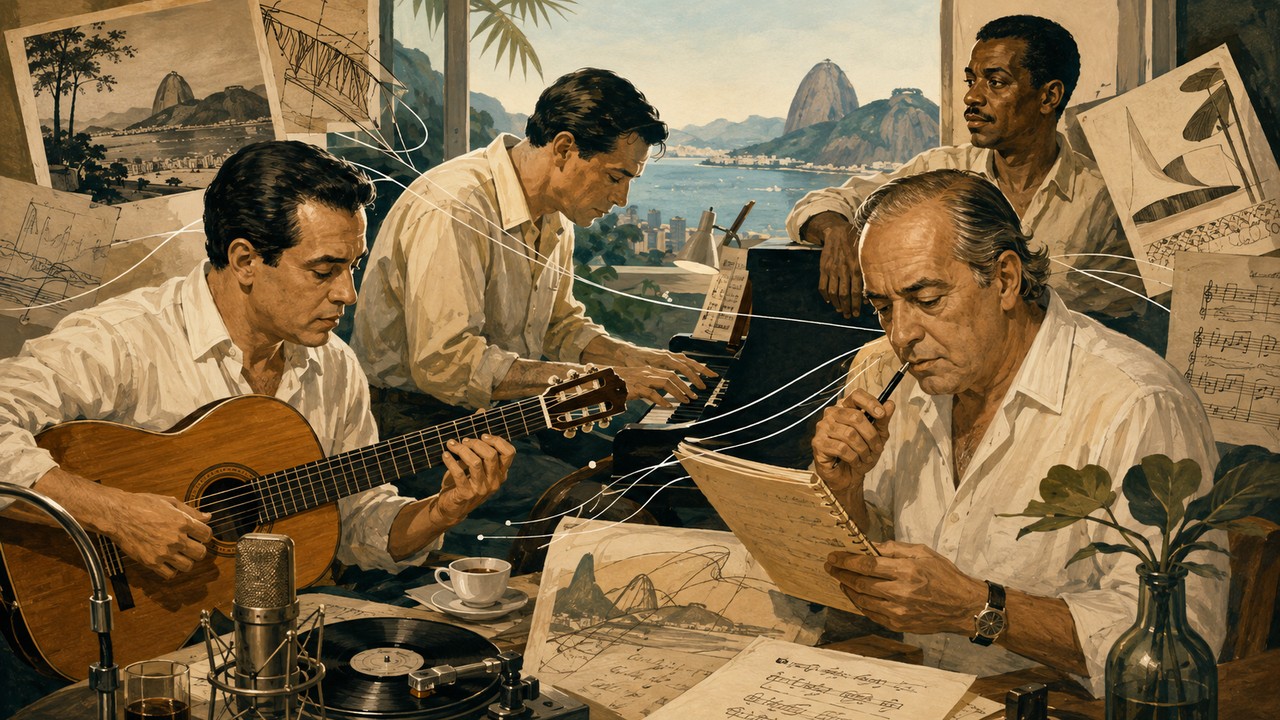
The most accurate answer is that bossa nova was not created by a single person. If the question is who transformed a set of previous trends into an immediately recognizable language, João Gilberto occupies the center of the answer. But the form that was consolidated in 1958 also depended on the compositions and arrangements of Tom Jobim, the lyrics of Vinicius de Moraes, precursors such as Johnny Alf and a network of interpreters, musicians, composers and circulation spaces that were already modernizing Brazilian song.
The short answer: João Gilberto is central, but he is not the whole story
João Gilberto did something that no explanation about the origins of bossa nova can overcome: he organized guitar, voice, silence and pulse into a new system of interpretation. Its beat became the most recognizable sound signal of the genre. It wasn't just a different side dish. It was a way to shift accents, control dynamics and make the voice talk to the guitar without having to compete with a large orchestra.
This, however, does not mean that he invented each ingredient alone. Bossa nova was born from a combination. Tom Jobim provided repertoire, harmonic thinking and arrangement work on decisive pieces. Vinicius de Moraes provided lyrics to an essential part of this repertoire and helped form the partnership that would lead to Chega de Saudade. Johnny Alf had already explored, years before, sophisticated harmonies, restrained singing and a modern relationship between Brazilian music and jazz. And samba itself, with its long history, provided the rhythmic grammar that João Gilberto reorganized.
Therefore, the question changes when you separate creation into functions. Who crystallized the beat and the interpretation? João Gilberto. Who wrote the music for Chega de Saudade and participated in the harmonic architecture and arrangements of the new sound? Tom Jobim. Who wrote the lyrics and helped build the partnership’s poetic repertoire? Vinicius. Who anticipated harmonic, vocal and pianistic traits at the beginning of the 1950s? Johnny Alf. Who allowed all of this to become a record, a repertoire and a movement? A much larger network.
Before 1958, Brazilian music was already changing
Bossa nova did not emerge in a vacuum. In the 1940s and 1950s, samba, samba-canção, radio, nightclubs, vocal ensembles and the growing circulation of jazz were already producing changes in the way of harmonizing, singing and accompanying songs. The result of 1958 was a condensation of previous processes, not an absolute beginning.
It is also important not to tell this story as if bossa nova had separated itself from samba. Carioca samba was originally formed and cultivated in black communities in Rio de Janeiro and generated many subsequent developments. Bossa nova is among these developments. Its novelty does not erase this genealogy: it reorganizes rhythmic materials and forms of playing that already belonged to the Brazilian tradition.
Musical studies on João Gilberto's beat show precisely this continuity. The thumb on the staff can be understood as a translation, for the guitar, of the bass function of the surdo; the syncopated attacks of the chords dialogue with designs of the tambourine. The innovation lies in the way these elements were compressed, displaced and
combined with another harmonic conception and extremely controlled singing.
Johnny Alf: precursor does not mean supporting
Johnny Alf is one of the reasons why the answer “João Gilberto invented everything” is insufficient. At the beginning of the 1950s, Alf was already presenting Brazilian music with sophisticated harmony, modern phrasing and lighter singing on piano and voice. Works such as Rapaz de Bem and Ilusão à Toa are constantly remembered as pieces that paved the way for the aesthetic that would later be called bossa nova.
Calling him a precursor is more rigorous than declaring, without reservations, that he recorded the “first bossa nova”. The label was not yet consolidated and the language that would become recognizable from 1958 onwards did not yet exist in its complete form. What exists is an audible continuity: some choices that would later seem new were already being tried by Alf in another context.
Its concrete role is mainly in harmonic and interpretative modernization. The piano doesn't just function as support for a sentimental melody; he creates spaces, shifts chords and dialogues with the voice. The song avoids some of the dramatic excess associated with certain aspects of samba-canção. This combination impressed younger musicians and places Alf in the genealogy of bossa nova, even if he is not responsible for the guitar beat that defined the genre.
The centrality of Johnny Alf also corrects a memory excessively concentrated on the apartments in the South Zone and on protagonists who later gained international prominence. The formation of the new sound goes through nightclubs, pianists, singers, black musicians and professional circuits that precede the group that would become publicly identified with bossa nova.
João Gilberto: the point at which antecedents become a language
If Johnny Alf helps explain what came before, João Gilberto helps explain why 1958 seems like a turning point. He didn't just combine influences: he established a way of playing and singing with its own unity.
On the beat, the right hand separates functions. The thumb maintains a more regular bass base, while the other fingers strike chords in syncopated positions. The effect preserves the pulse of samba, but removes weight and creates a sensation of constant internal movement. The voice, in turn, does not need to mechanically follow the guitar's accents. João delays, anticipates and lengthens phrases in a controlled way, creating independence between singing and accompaniment.
This relationship is decisive because it explains why bossa nova is not just “samba played bass” nor “samba with jazz chords”. João's method modifies the organization of time. Sound economy stops being a simple absence of volume and becomes part of the interpretative composition.
Bim Bom, composed by João himself, is useful to understand this. The language did not depend exclusively on Tom and Vinicius' songs. João could apply it to his own material or to old sambas, transforming different repertoires through the same interpretative principle. This ability to rearrange songs is one of the reasons why your
contribution is deeper than that of a simple interpreter of Chega de Saudade.
Tom Jobim: composition, harmony and studio architecture
Tom Jobim arrived in 1958 already involved with composition, piano, arrangement and working on a record label. His partnership with Vinicius de Moraes began decisively in 1956, when the two created the music of Orfeu da Conceição. This meeting generated a repertoire that brought Jobim's harmonic refinement closer to Vinicius's poetic writing and prepared the ground for collaboration in the following years.
Tom's role in the origins of bossa nova should not be confused with João's. The guitar beat is associated with João Gilberto; Jobim's contribution appears above all in the composition, harmony, orchestration and in the way of organizing the musical environment so that the novelty could work on record.
Chega de Saudade is the best example of this division of labor. The music is by Tom and the lyrics are by Vinicius. When João performs it, he does not “write” the song, but radically changes the experience of listening to it. The composition offers modulations, tension and resolution; João's interpretation reorganizes the pulse and the relationship between melody, harmony and rhythm. It is precisely the sum of these layers that makes the recording historical.
Jobim was also important for understanding the value of the economy. Instead of filling every space, his arrangements could let the guitar and voice breathe. This choice of texture helped transform an accompaniment innovation into a phonographic language capable of being repeated, recorded, and recognized.
Vinicius de Moraes: the lyrics are not a detail of the invention
Vinicius usually appears in the history of bossa nova as “the poet”, which is true, but incomplete. After his partnership with Tom in Orfeu da Conceição, he began to work increasingly intensely as a popular song lyricist. Their collaboration created a repertoire into which poetry, everyday speech, musical form and melody could fit together with enormous precision.
In Chega de Saudade, Vinicius writes lyrics that move from absence to loving exuberance. The song begins with a lack and ends with an excess of hugs and kisses. This change matches Jobim's musical architecture and gains another dimension in João Gilberto's restrained interpretation. The apparent calm of the voice does not eliminate the emotion; it concentrates it.
This point helps to understand why bossa nova cannot be reduced to an instrumental innovation. The new aesthetic involved a way of saying words. More conversational lyrics, urban images, humor, metalanguage and a precise relationship between syllable and melody would become important hallmarks of the repertoire associated with the movement. Vinicius was one of those responsible for giving literary density to this transformation.
1958: the year the pieces fell into place
Elizeth Cardoso's album Canção do amor loja, by Elizeth Cardoso, is an essential point of passage. Recorded at the beginning of 1958 and released that year on the Festa label, it brought together songs by Tom Jobim and Vinicius de Moraes. In Chega de Saudade e Outra Vez, João Gilberto's guitar appears with the beat that would soon be identified with bossa nova.
This recording is important because it offers the first phonographic documentation of the beat in a larger project. Elizeth's voice still belongs to another interpretative tradition, more expansive than João's. The clash between the established singer and the new accompaniment makes the album almost an audible laboratory of the transition.
Shortly afterwards, on July 10, 1958, João recorded his own version of Chega de Saudade. Here, the transformation is complete because voice and guitar begin to follow the same aesthetic project. It is no longer a new beat accompanying a previous song; it is an integrated language.
Therefore, two apparently competing statements can be true at the same time. Too Much Love Song is a decisive prologue and registers the beat before. The recording of João de Chega de Saudade is the moment in which the new system appears more completely and begins to have the strength to define a style.
Elizeth Cardoso and the recording: without the record, the story would be different
Elizeth Cardoso is not generally placed on the list of “inventors” of bossa nova, and with good reason: she did not create João’s beat nor did she compose Chega de Saudade. Even so, his participation was historically decisive. It was on his LP that the combination between Tom and Vinicius' songs and João's guitar gained commercial registration before the Bahian's solo version.
The difference between inventing an idea and circulating it matters. Popular music depends on performance, recording, production, distribution and repetition. An innovation that remains only in rehearsal or in small circles has a different impact than one that becomes available on record. Song of Too Much Love transformed an experience into a sound document; João's recording later turned this document into a model.
The network that turned a music solution into motion
No genre is born just because a person finds a good technical solution. Other musicians need to recognize, imitate, adapt, compose and create an audience for this solution. Bossa nova took shape when João's language found composers and interpreters capable of expanding it.
Names like João Donato, Carlos Lyra, Roberto Menescal, Newton Mendonça, Sylvia Telles, Nara Leão, Os Cariocas and Ronaldo Bôscoli belong to different moments of this formation and expansion. Some were already modernizing the song before 1958; others were decisive in transforming the new sound into repertoire, presentations, meetings, records and generational identity.
This network also explains why bossa nova is not synonymous with “João Gilberto’s music”. João recorded sambas before him and compositions by many partners, giving aesthetic unity to different materials. At the same time, composers began to write thinking about the possibilities opened up by their way of playing and singing. The movement was formed in this two-way street between interpretation and composition.
What came from samba and what came from jazz
The influence of jazz is real, especially in harmonies, voicings, improvisation practices and in listening to Brazilian musicians who frequented clubs and foreign records. But saying that bossa nova is “Brazilian jazz” misses the rhythmic center of the story.
João Gilberto's beat works with samba materials. The relationship between bass and syncopation, the dialogue with the functions of the floor tom and the tambourine and the flexibility between voice and pulse belong to a Brazilian history. Jazz participates in modernization, but does not replace this base.
This also prevents a narrative in which the sophistication of bossa nova appears as an abandonment of a popular tradition in favor of a foreign language. Sophistication already existed in samba, choro, samba-canção, arrangers, instrumentalists and musicians like Johnny Alf. What bossa nova does is select, reduce, recombine and present these resources with another aesthetic of space, timbre and time.
So who created what?
João Gilberto: beat, song and interpretation system
João is the strongest name when the question looks for an identifiable innovation. Its guitar beat, independence between voice and accompaniment, and dynamic economy gave bossa nova its most recognizable mechanism. He didn't invent samba, modern harmony or all the movement's songs; invented a unique way to make them work together.
Tom Jobim: composition, harmony and arrangements
Tom provided a central part of the repertoire and helped design the harmonic and instrumental environment in which João's language could flourish. Its importance lies both in the songs and in the ability to transform these songs into the sonic architecture of a record.
Vinicius de Moraes: lyrics, partnership and poetic form
Vinicius brought writing that could be sophisticated without losing oral fluidity. His partnership with Tom, which began in 1956, produced the nucleus of songs that allowed the new interpretation to find a repertoire to match.
Johnny Alf: harmonic and vocal antecedent
Johnny Alf showed before 1958 that it was possible to make Brazilian music with more open harmonies, modern piano language and restrained singing. His work is not the complete version of bossa nova that would be consolidated later, but it is one of the paths that lead to it.
Elizeth Cardoso and the network: registration, circulation and transformation into movement
Elizeth gave João's beat one of the first decisive records on record. Other musicians, singers, composers, producers and meeting spaces made the new sound circulate. Without this network, there would be individual innovation; with it, a movement capable of changing Brazilian popular music emerged.
The best answer depends on the question
If someone asks “who invented the bossa nova beat?”, João Gilberto is the central answer. If you ask “who wrote Chega de Saudade?”, the answer is Tom Jobim and Vinicius de Moraes. If you want to know who anticipated some of the harmonic language and modern singing, Johnny Alf needs to appear. And if the question is who created bossa nova as a historical phenomenon, none of these names alone are enough.
The most faithful formulation is this: João Gilberto crystallized the language; Tom Jobim and Vinicius de Moraes provided a decisive part of the repertoire and musical architecture; Johnny Alf and other precursors show that modernization came before; Elizeth Cardoso and a network of musicians, producers and performers transformed scattered experiences into recording and circulation. Underneath it all, bossa nova remained linked to samba and the Afro-Brazilian history that made its rhythmic revolution possible.
This is why 1958 works better as a crystallization point than as “year zero”. Bossa nova seems to be born suddenly when we hear Chega de Saudade, but what arrives on the album at that moment is the result of many paths that were already meeting.