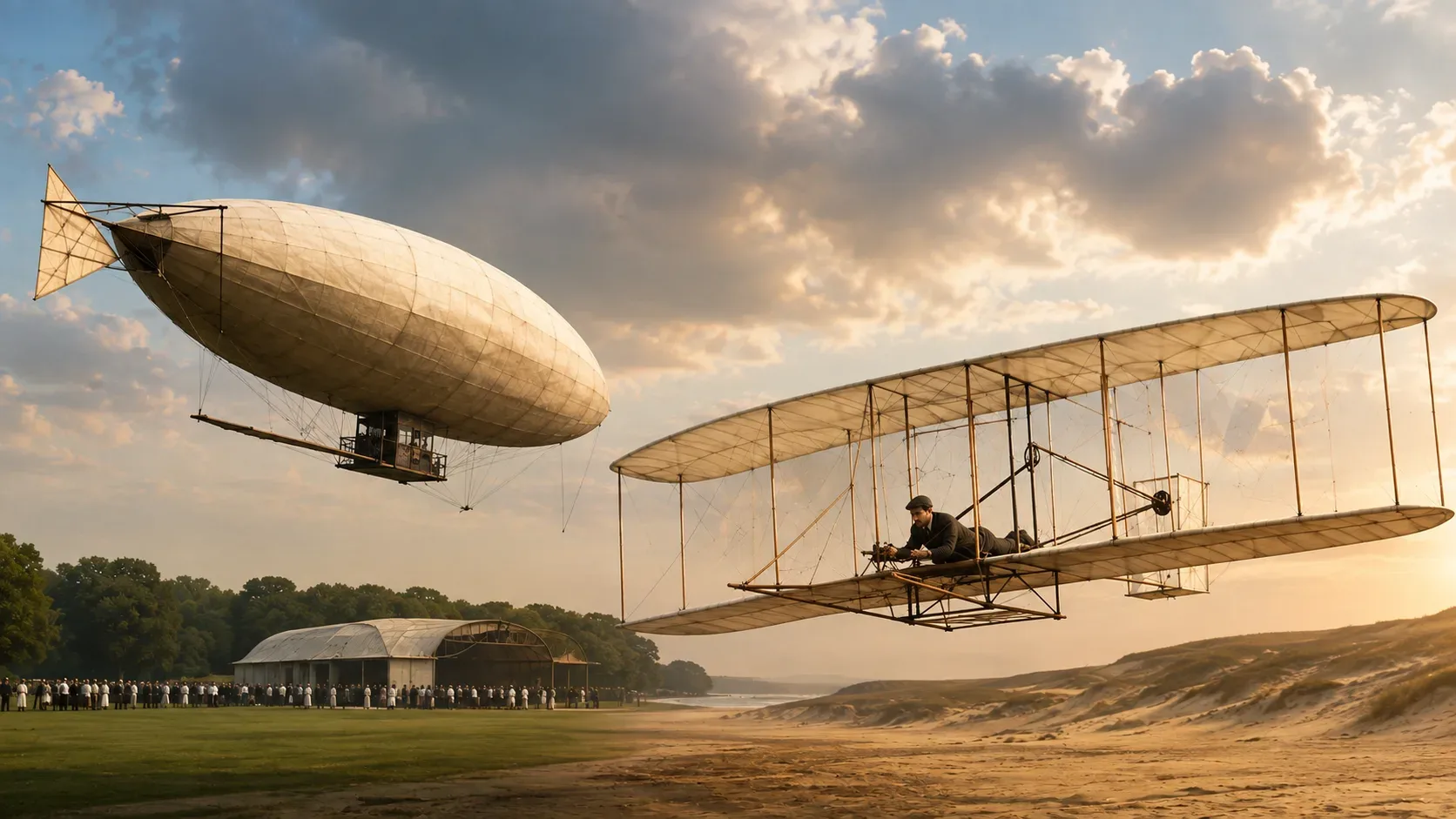
Who invented the airplane? If the criterion is the first powered, sustained and controlled flight of a heavier-than-air machine, Wilbur and Orville Wright take precedence with the flights of December 17, 1903, in the United States. If the requirement includes a public demonstration, in front of aeronautical entities and with take-off on wheels, Alberto Santos-Dumont occupies a unique place with the 14-bis in 1906, in France.
That's why answering just “Santos-Dumont” or “Wright brothers”, without saying which criteria is being used, hides precisely the most interesting part of the story.
What the Wright Brothers Did in 1903
On the morning of December 17, 1903, in Kill Devil Hills, North Carolina, Orville Wright flew the Wright Flyer for 12 seconds and traveled 120 feet. The brothers made three other flights that day. In the fourth, Wilbur remained in the air for 59 seconds and traveled 852 feet, approximately 260 meters. The Library of Congress describes the episode as demonstrating sustained flight of a heavier-than-air machine under pilot control.
The Flyer had its own engine and a control system that combined elevator, rudder and wing torsion. This matters because previous flight attempts often achieved only short hops, glides, or shifts with limited controllability. For institutions like the Smithsonian and the National Park Service, it is this combination of propulsion, lift, and control that makes 1903 the turning point.
There is also a fact that reinforces that the result of 1903 was not an isolated accident. The Wrights continued to improve their machines. On October 5, 1905, Wilbur flew approximately 24 miles in 39 minutes, repeatedly circling Huffman Prairie, Ohio. The Smithsonian considers the 1905 model to be the brothers' first practical plane.
Did the 1903 Flyer use a catapult?
No. This is one of the most frequent confusions in this discussion.
On December 17, 1903, the Flyer was racing on a launch track about 60 feet long, necessary because the aircraft used skis instead of wheels and operated over sandy terrain. The plane was moving along the track, driven by its own engine and facing a strong headwind. The National Park Service records that the takeoff occurred from level ground.
The catapult with turret and counterweight appeared later, in the 1904 experiments at Huffman Prairie, where the Wrights encountered weaker winds. Confusing this later system with the Kitty Hawk flights alters an important element of the historical comparison.
It is also not correct to say that the 1903 flight took place “without witnesses”. Orville's diary records the presence of John T. Daniels, W. S. Dough, A. D. Etheridge, W. C. Brinkley, and Johnny Moore. Daniels activated the camera that recorded the well-known photograph of the first flight. The difference is that it was not a public demonstration organized by an aeronautical entity nor a competition with formal approval.
What Santos-Dumont did in 1906
Santos-Dumont arrived on the plane after having already become known for his work with balloons and airships in Paris. With the 14-bis, it entered the competition for prizes offered to those who managed to carry out verifiable flights with aircraft heavier than air.
On October 23, 1906, in the Bagatelle field, the 14-bis flew about 60 meters, reaching approximately 3 meters in height. The feat gave Santos-Dumont the Archdeacon Cup, offered to the first aviator who completed the distance established by the competition. The International Civil Aviation Organization records the episode as the first sustained flight in Europe and highlights its certification in the French aeronautical environment.
A few weeks later, on November 12, 1906, Santos-Dumont covered 220 meters in approximately 21 seconds with the 14-bis. The Fédération Aéronautique Internationale informs that the 220 meters obtained by him constituted the first official FAI record for a powered aircraft.
This public dimension is essential to understand the strength of Santos-Dumont's name. Its flights took place in Paris in front of observers, experts and the public, within a system of competitions that established distances and allowed results to be verified.
Wright or Santos-Dumont? The criteria changes the answer
| Criteria | Wright Brothers | Santos-Dumont |
|---|---|---|
| First powered, sustained and controlled flight | December 17, 1903, North Carolina | 1906 |
| Take-off system not most cited | Rail on flat terrain, powered by the plane itself; without catapult in 1903 | Race on wheels in the Bagatelle countryside |
| Organized public demonstration | No. There were witnesses, but no official public competition | Yes, in Paris, linked to the French aeronautical awards |
| Development of an airplane capable of long flights and maneuvers before 1906 | Yes. In 1905, I flew about 39 km in 39 minutes | His main flights with the 14-bis took place in 1906 |
| Official FAI registration | The FAI did not yet exist in 1903 | 220 m in 1906 was the entity's first official record for a motorized airplane |
The table shows why two seemingly contradictory sentences can contain true parts. The Wrights arrived first in powered and controlled flight. Santos-Dumont then carried out a public and officially monitored demonstration that became a landmark in international aeronautical records.
So why in Brazil is Santos-Dumont the “Father of Aviation”?
This is not just an informal preference. Santos-Dumont is deeply embedded in Brazilian institutional memory.
Law nº 7,243, of November 6, 1984, proclaimed him Patron of Brazilian Aeronautics. Law No. 12,831, of June 20, 2013, determined that airports, air bases and similar facilities maintain their image accompanied by the inscription “Father of Aviation”.
This helps explain why generations of Brazilians learned a different answer than the one prevalent in books and museums in the United States. There is a dimension of national memory, but it is also based on a concrete achievement: in 1906 Santos-Dumont carried out recognized public flights at the center of the European aeronautical community and inaugurated the series of official FAI records for motorized aircraft.
On the North American side, the privileged milestone is another: the date on which a manned, heavier-than-air, motorized and controllable machine managed to fly before any competitor documented according to this set of criteria.
“Inventing the airplane” is more complicated than choosing a name
The question itself suggests that the plane appeared ready in a single moment. It wasn't like that. Aviation resulted from a sequence of advances in aerodynamics, gliders, engines, propellers, structures and control systems.
The Wrights did not end the development of the airplane in 1903, just as Santos-Dumont did not begin the history of flight in 1906. The brothers continued to improve control and autonomy until arriving at a practical machine. Santos-Dumont publicly showed that a plane could run across the terrain, take off in front of a commission and cover measurable distances at a time when parts of Europe still received reports about North American flights with suspicion.
This distinction allows for a more precise answer: The Wright brothers take chronological precedence in the first widely documented powered, sustained and controlled flight, in 1903; Santos-Dumont was the protagonist of the first major cycle of public and officially registered flights in Europe, in 1906, including the first official FAI registration for a motorized airplane.
Giving the Wrights credit for 1903 does not diminish Santos-Dumont. And recognizing Santos-Dumont's extraordinary importance does not require erasing Kitty Hawk's records. Conflict appears mainly when different facts are treated as if they were the same historical category.