
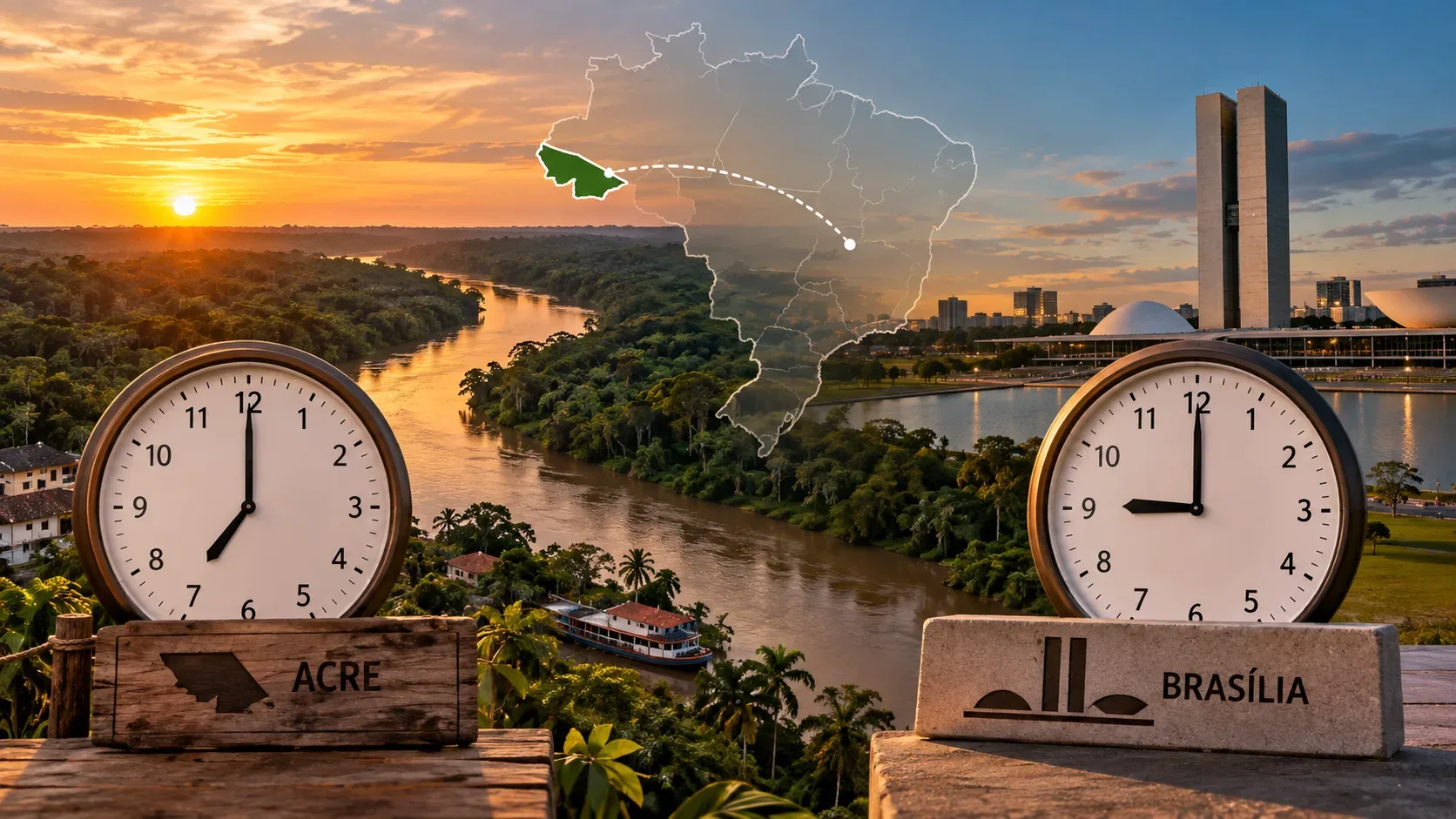
Acre uses UTC−5 because Brazil’s legal time, established by federal rules, places the entire state five hours behind the reference meridian and two hours behind Brasília, which is in UTC−3. The current arrangement is not merely a consequence of geography: it is the result of a well-documented legal sequence. Acre had been in the equivalent of UTC−5 since Brazil organized its national time zones in 1913, was moved to UTC−4 on June 24, 2008, rejected that change in a referendum on October 31, 2010, and legally returned to UTC−5 on November 10, 2013.
What UTC−5 means — and why Acre is two hours behind Brasília
UTC−5 means civil time is five hours behind Coordinated Universal Time. Brazil’s historical legislation uses the wording “Greenwich time minus five hours,” which corresponds to the same offset expressed today as UTC−5. Under the current wording of Decree No. 2,784/1913, as amended by Law No. 12,876/2013, Acre belongs to the fourth zone, minus five hours, while the Federal District belongs to the second zone, minus three hours. The calculation is straightforward: there is a two-hour difference between UTC−5 and UTC−3.
So when it is 12:00 in Brasília under UTC−3 legal time, it is 10:00 in Acre under UTC−5. As of September 13, 2026, Brazil’s Ministry of Mines and Energy still describes national daylight saving time as suspended, and Decree No. 9,772/2019, which ended it, is not listed as expressly revoked. The practical current reference therefore remains a two-hour difference between Acre and Brasília.
Timeline: how Acre left UTC−5, voted against the change, and returned
| Date | Milestone | Effect on Acre |
|---|---|---|
| 06/18/1913 | Decree No. 2,784 organizes Brazil’s legal time | The territory of Acre is placed in Greenwich minus five hours, equivalent to UTC−5. |
| 06/24/2008 | Law No. 11,662/2008 takes effect | Acre moves its clocks forward by one hour, shifting from UTC−5 to UTC−4 and reducing the gap with Brasília from two hours to one. |
| 10/31/2010 | State referendum on the change | 56.87% of valid votes go to the position opposing the time adopted in 2008; the majority chooses a return to the previous zone. |
| 11/10/2013 | Law No. 12,876/2013 takes effect | UTC−5 is restored in Acre and Law No. 11,662/2008 is repealed. |
What changed in 2008
Law No. 11,662, signed on April 24, 2008 and published the following day, changed the boundaries of Brazil’s time zones. For Acre and part of Amazonas, the rule replaced “Greenwich minus five hours” with “Greenwich minus four hours.” The law itself set an effective date 60 days after publication, and the change took effect at midnight on June 24, 2008.
In practical terms, Acre’s clocks were moved forward by one hour. Without daylight saving time, the difference from Brasília fell from two hours to one. The change also reorganized zones in Amazonas and Pará. Arguments made during the legislative process included greater economic, financial, communications and transport integration with other regions of the country.
What Acre voters actually decided in the 2010 referendum
The referendum was held on October 31, 2010, alongside the second round of the presidential election. The official question was: “Are you in favor of the recent change to legal time made in your state?” According to the Regional Electoral Court of Acre, the “No” campaign, which opposed keeping the 2008 change, received 184,478 votes, or 56.87% of valid votes. The “Yes” campaign, which favored keeping it, received 139,891 votes, or 43.13%.
The result was therefore not an abstract vote on “UTC−5” as a technical concept. Voters were asked about the recent measure that had advanced their clocks. A majority rejected that measure and expressed a preference for returning to the two-hour difference from Brasília.
Why the referendum did not change the clocks immediately
The popular consultation expressed the political decision of Acre’s electorate, but Brazil’s legal time was still written into federal law. The 2010 result therefore could not, by itself, move the clocks back. The legislation that had placed Acre in UTC−4 still had to be changed.
This distinction explains the apparent gap between 2010 and 2013: popular will was recorded in the referendum, but the legal effect on the time zone came only with a new federal law. Institutional coverage at the time explicitly noted that legislative approval and presidential sanction were still required after the referendum to restore the previous zone.
How Law No. 12,876/2013 restored UTC−5
Law No. 12,876 of October 30, 2013 amended Decree No. 2,784/1913 once again. The text expressly placed the State of Acre in the fourth zone, defined as Greenwich minus five hours, and also included the part of Amazonas west of the legal line described in the rule. At the same time, it repealed Law No. 11,662/2008.
The law stated that it would take effect on the second Sunday of the month following publication. Because it was published in the Federal Official Gazette on October 31, 2013, the return occurred on November 10, 2013. On that date, Acre officially went back to being two hours behind Brasília under standard legal time.
Geography explains the context; law defines official time
Time zones have a simple astronomical basis: Earth rotates roughly 360 degrees in 24 hours, producing a theoretical reference of about 15 degrees of longitude per hour. Because Acre lies in Brazil’s far west, it naturally belongs in discussions of later time zones relative to the country’s central and eastern regions.
But actual civil time-zone boundaries do not have to follow perfect geometric strips. Governments can adjust official time to follow state borders, economic relationships, social routines and political decisions. Acre itself demonstrates this point: the state’s geography did not change between 2008 and 2013; the legal rule determining which offset should be used did.
That is why saying Acre uses UTC−5 “because it is in the west” is only part of the answer. A more precise formulation is that its western position helps explain why UTC−5 is geographically plausible, but the current official time exists because federal law restored that zone in 2013 after the 2008 change and the 2010 referendum.
What applies today when calculating times
- Acre: UTC−5 under the current legal time.
- Brasília/Federal District: UTC−3 under the legal time-zone division.
- Current practical difference: Acre is two hours behind Brasília.
- Example: 18:00 in Brasília corresponds to 16:00 in Acre under the current rules.
- Note: future changes to daylight saving time or time-zone legislation could alter seasonal differences, so time-sensitive schedules should always be checked for the event date.
Documentary sources
- Decree No. 2,784/1913, updated text: https://www.planalto.gov.br/ccivil_03/decreto/historicos/dpl/dpl2784-1913.htm
- Law No. 11,662/2008: https://planalto.gov.br/ccivil_03/_ato2007-2010/2008/lei/l11662.htm
- TRE-AC, 2010 Referendum: https://www.tre-ac.jus.br/eleicoes/plebiscitos-e-referendos
- Law No. 12,876/2013: https://www.planalto.gov.br/ccivil_03/_ato2011-2014/2013/lei/l12876.htm
- Decree No. 9,772/2019 ending daylight saving time: https://www.planalto.gov.br/ccivil_03/_ato2019-2022/2019/decreto/d9772.htm