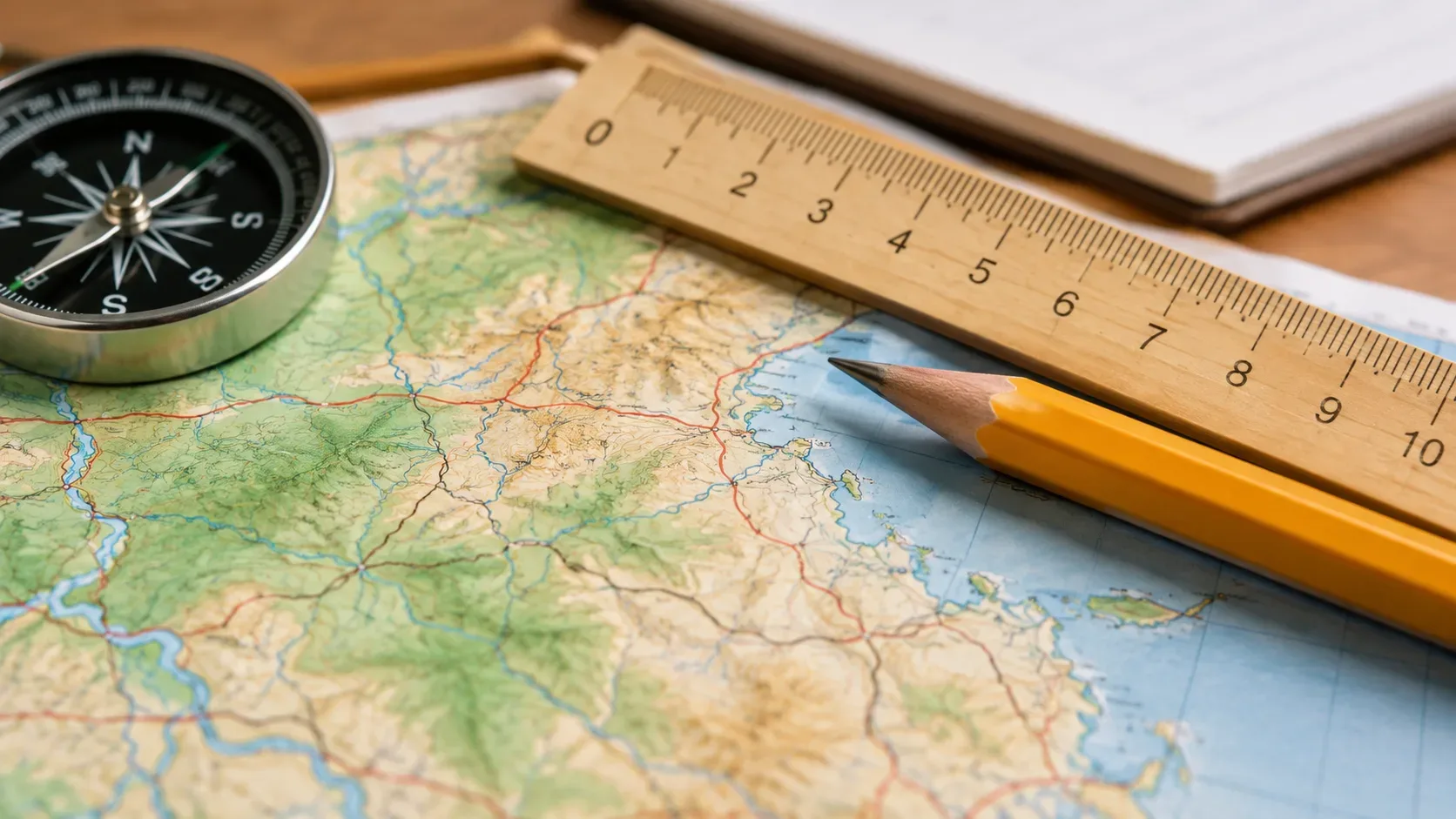
To convert centimetres measured on a map into actual kilometres, read the numerical scale 1:n, multiply the distance on paper by n, then divide by 100,000. This works when the map measurement is in centimetres because 1 km equals 100,000 cm. For example, at 1:200,000, a distance of 3 cm represents 3 × 200,000 ÷ 100,000 = 6 km in a straight line.
What does a 1:n scale mean?
Scale is the ratio between a distance shown on a map and its corresponding ground distance. The notation 1:100,000 means that 1 unit on the map corresponds to 100,000 units of the same kind on the ground. When measuring in centimetres, this reads as 1 cm to 100,000 cm, or 1 km. The number after the colon does not automatically mean kilometres.
To calculate a distance, measure between the two points as the exercise specifies. A straight line on the map gives an estimate of the horizontal straight-line distance, not necessarily the length of a winding road or the route actually travelled.
The essential conversion: centimetres, metres and kilometres
- 1 m = 100 cm.
- 1 km = 1,000 m = 100,000 cm.
- From centimetres to kilometres: divide by 100,000.
- From kilometres to centimetres: multiply by 100,000.
Always check units before setting up a proportion. A numerical scale compares lengths in the same unit; converting to kilometres is the final step when the answer must be in km.
How to solve a ground-distance exercise
Example 1: on a 1:250,000 map, two places are 4 cm apart. First, 4 × 250,000 = 1,000,000 actual cm. Then, 1,000,000 ÷ 100,000 = 10 km. The equivalent proportion is 1 cm / 250,000 cm = 4 cm / x cm, giving x = 1,000,000 cm.
Shortcut with explicit units: ground distance (km) = map measurement (cm) × scale denominator ÷ 100,000. At 1:50,000, every centimetre represents 0.5 km, so 7.2 cm represents 7.2 × 0.5 = 3.6 km.
When the exercise asks for map distance or scale
Map distance: if the actual distance is 12 km and the scale is 1:300,000, convert 12 km to 1,200,000 cm and divide by 300,000. The result is 4 cm on the map. Direct formula: map distance (cm) = ground distance (km) × 100,000 ÷ denominator.
Unknown scale: if 5 cm on the map represents 20 km on the ground, convert 20 km to 2,000,000 cm and calculate 2,000,000 ÷ 5 = 400,000. The scale is 1:400,000. Do not write 1:4 simply because 20 ÷ 5 = 4: those figures are still in different units.
Graphic scale and resizing a map
With a graphic scale, a bar labelled with distances lets you compare a measured segment directly with its marked intervals. On a bar where 2 cm represents 1 km, a 6 cm segment equals three intervals, or 3 km. Use the values actually shown on the bar rather than assuming all maps have identical divisions.
If an image is enlarged or reduced in print or on screen, centimetre measurements no longer match the original numerical scale unless that scale is updated. A graphic scale resized along with the map retains the visual relationship between its intervals. In exercises involving altered copies, check which scale the question instructs you to use.
Common mistakes and how to check
- Skipping conversion: 200,000 cm equals 2 km, not 200,000 km.
- Multiplying instead of dividing: from map to ground, multiply by the denominator; from ground to map, divide by it after matching units.
- Confusing a larger scale with a larger denominator: 1:25,000 is a larger scale and shows more detail than 1:250,000 under comparable mapping conditions.
- Confusing a route with a straight line: measuring directly between points does not account for bends and detours.
Reasonableness check: at 1:100,000, 1 cm must equal 1 km. If 3 cm gives 300,000 km, the division by 100,000 has been missed. Write the unit at each step to make such errors visible.
Practice and check the answers
- Scale 1:150,000, distance 2 cm: 2 × 150,000 ÷ 100,000 = 3 km.
- Scale 1:500,000, actual distance 25 km: 25 × 100,000 ÷ 500,000 = 5 cm.
- 6 cm represents 9 km: 9 × 100,000 ÷ 6 = 150,000; scale 1:150,000.