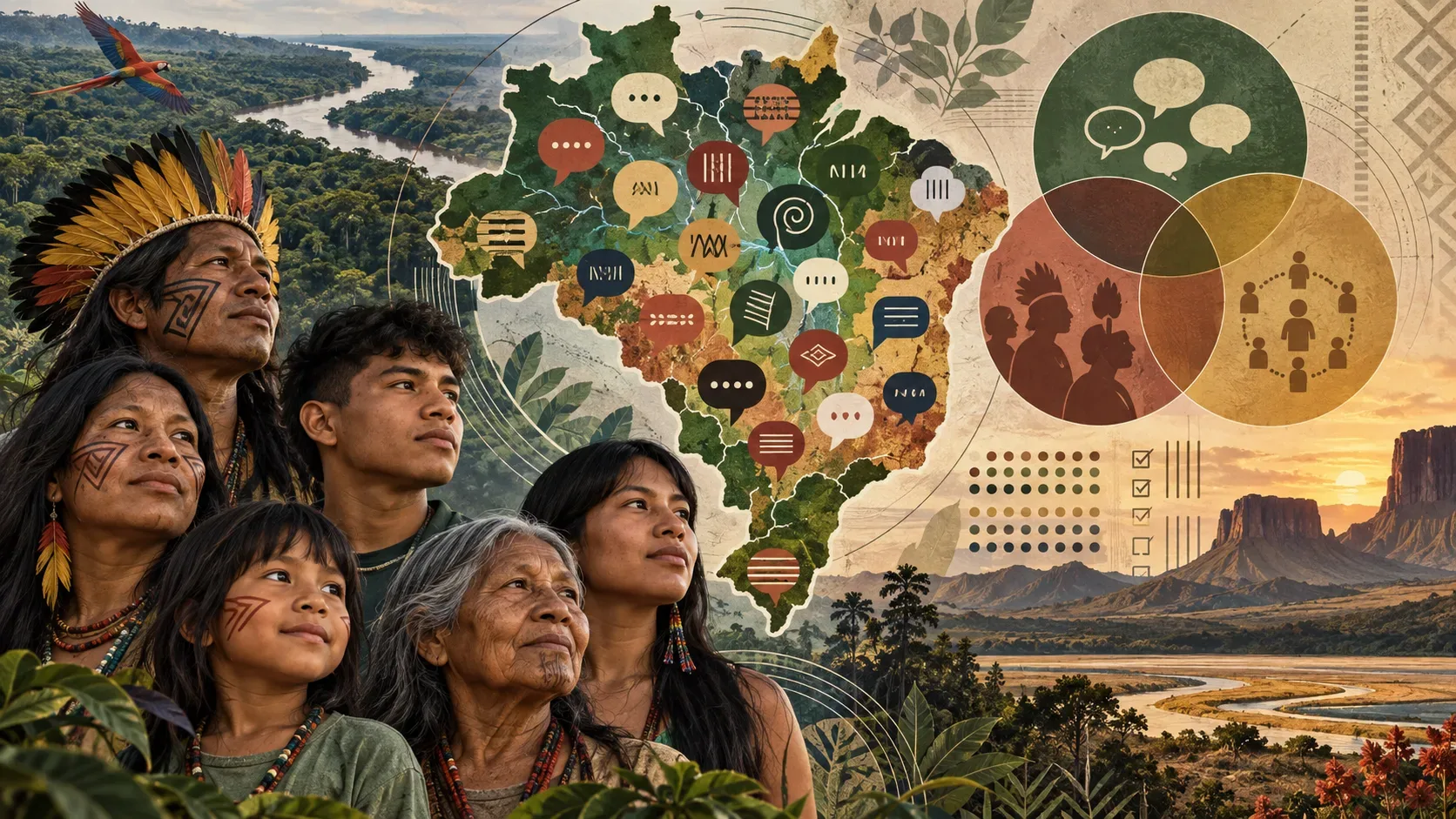
The 2022 Brazilian Census figure is 295 Indigenous languages. That answer needs an important qualifier: IBGE identified 295 Indigenous languages spoken or used at home by Indigenous people aged 2 or older, under the survey's own questions and classification rules. So 295 is a census figure — not a claim that there is one language for each people, nor a definitive inventory of every Indigenous language that has existed or might be recognized under other linguistic criteria.
In the same investigation, the Census recorded 391 Indigenous ethnicities, peoples or groups. The fact that the totals differ already shows why “language” and “people” are not synonyms. A person may belong to more than one people or group, use more than one language, speak Portuguese at home while maintaining another ethnic belonging, or be part of a people whose ancestral language is being revitalized. The categories are related, but they measure different things.
What the figure of 295 languages means
According to the 2022 Census results, 474,856 Indigenous people aged 2 or older spoke or used an Indigenous language at home, equivalent to 29.19% of the Indigenous population in that age group. Languages with the largest numbers of declared speakers included Tikúna, Guarani Kaiowá, Guajajara and Kaingang. IBGE also recorded languages declared by much smaller groups.
The figure of 295 comes from the classification of answers collected by the Census. In IBGE's explanatory material, this total excludes residual categories such as ill-defined or undetermined answers, “does not know”, “no declaration” and other generic categories. For that reason, the most accurate phrasing is “the 2022 Census identified 295 Indigenous languages”, rather than treating the number as an absolute, timeless count of every Indigenous language in Brazil.
Another figure shows the geographic spread: in 1,990 municipalities, at least one Indigenous person aged 2 or older declared speaking an Indigenous language. This distribution should not be read as a map of rigid linguistic borders. Migration, cities, Indigenous Lands, marriages, family networks and movement between territories can place the same language in many different locations.
How the Census separates ethnicity, people or group from language
The questionnaire itself shows that IBGE treated these topics as different dimensions. For people declared or considered Indigenous, there was one question about ethnicity, people or Indigenous group and another, separate question about an Indigenous language spoken at home.
| Dimension | How the 2022 Census asked | Record limit | What the answer represents |
|---|---|---|---|
| Ethnicity, people or Indigenous group | “What is your ethnicity, people or Indigenous group?” | Up to 2 | Declared belonging to Indigenous collectivities |
| Indigenous language | If a person aged 2 or older spoke an Indigenous language at home, the names were recorded | Up to 3 | Indigenous language(s) used for communication at home |
| Portuguese | There was a separate question about speaking Portuguese at home | Separate answer | Use of Portuguese, which can coexist with an Indigenous language |
For the purposes of the census operation, the enumerator's manual defines ethnicity as a human community marked by linguistic, cultural and/or social affinities, also corresponding to an Indigenous people or group with its own culture and form of social life. The presence of “linguistic affinities” in that definition does not mean that language alone determines a people's identity.
Why one language does not equal one people
The relationship between language and belonging is many-to-many. The same people may include individuals with different linguistic repertoires; one person may speak two or three Indigenous languages; and the same language may be used by people from different peoples, communities or territories. Portuguese can also be part of that repertoire without cancelling Indigenous belonging.
There are also situations of language shift, when a community uses more Portuguese or another language; reclamation and revitalization, when a language returns to teaching and everyday use; and differences between self-declared names, linguistic varieties and technical classifications. Counting languages is therefore a statistical and classificatory operation, not a way to automatically define how many peoples exist.
The same caution works in reverse: knowing that someone declared a certain language does not, by itself, establish that person's ethnicity. The ethnicity variable must be checked because the Census asks the two questions separately.
What “self-identification” means in the Census
The Census uses a declaratory principle: enumerators should not assign Indigenous identity based on appearance. Identification starts from the answers given in the household. In Indigenous areas, when a person was not declared Indigenous in the race or color question, there was an additional question asking whether the person considered themself Indigenous. For those declared or considered Indigenous, the ethnicity and language questions followed.
There is an important methodological nuance: the census questionnaire is household-based and one informant may answer for other residents. Thus, “self-identification” describes the identification principle used by the survey, but not every answer necessarily had to be spoken directly by the person being counted. That distinction matters when interpreting the data as a statistical record of identity.
Multiple belonging is not a counting error
The 2022 Census allowed up to two ethnicities for the same person and up to three Indigenous languages spoken or used at home. This was intentional: the instrument recognizes that identities and linguistic repertoires can be multiple.
As a result, a sum across categories can exceed the total number of people. IBGE's own note for the language table states that because each person could declare up to three languages, totals by language may add up to more than the number of people with an Indigenous language declared. The Institute also provides specific tables on dual ethnic belonging and on declarations of two or three languages.
In practice, rows in a table should not be added as if every record represented a mutually exclusive person. Before calculating percentages or rankings, check whether the unit is people, ethnicity declarations, languages recorded, or another measure.
How to compare 2010 and 2022 without mixing universes
The 2022 Census publishes speakers aged 2 or older in several tables, while historical comparisons with 2010 use compatible age groups, especially people aged 5 or older. In the comparable universe, the number of Indigenous people aged 5 or older who spoke an Indigenous language rose from 293,853 in 2010 to 433,980 in 2022. At the same time, their share of the Indigenous population in that age range declined.
Such comparisons require attention not only to age, but also to changes in classification, validation and recording. IBGE publishes translators and proposed groupings for ethnicities and languages precisely to make categories more interoperable across censuses. The safest approach is therefore to use the comparison tables prepared by IBGE rather than placing isolated totals from different editions side by side.
A simple guide to reading IBGE tables
- Check the universe: Indigenous people aged 2 or older, aged 5 or older, residents of Indigenous Lands, or another subgroup.
- Check what is being counted: people, ethnicity declarations, languages spoken or used, municipalities or territories.
- Read the notes: they explain record limits, residual categories and cases in which sums can exceed the number of people.
- Do not turn association into equivalence: language, ethnicity, people, group and territory are related but are not interchangeable variables.
- Use official comparisons: when comparing censuses, preserve the same age group and compatible classifications.
So, how many Indigenous languages are there in Brazil?
If the question is “how many Indigenous languages did the 2022 Census identify?”, the answer is 295. That is the appropriate number to cite when discussing census results, with the qualification that it refers to Indigenous languages declared as spoken or used at home by Indigenous people aged 2 or older under IBGE's classification.
If the question is broader — “how many Indigenous languages exist in a linguistic, historical or community sense?” — the Census alone does not settle it. Decisions about language versus variety, revitalization processes, local names and changes in use can produce other counts. The value of the Census is to provide a standardized national baseline for observing diversity, use and distribution without reducing Indigenous identity to a single variable.
For data and methodology, consult the official 2022 Census page at IBGE, the IBGE Educa explanation of ethnicities and languages, and the 2022 Census questionnaire. The headline figures were also summarized in an official release from Brazil's Ministry of Indigenous Peoples.