
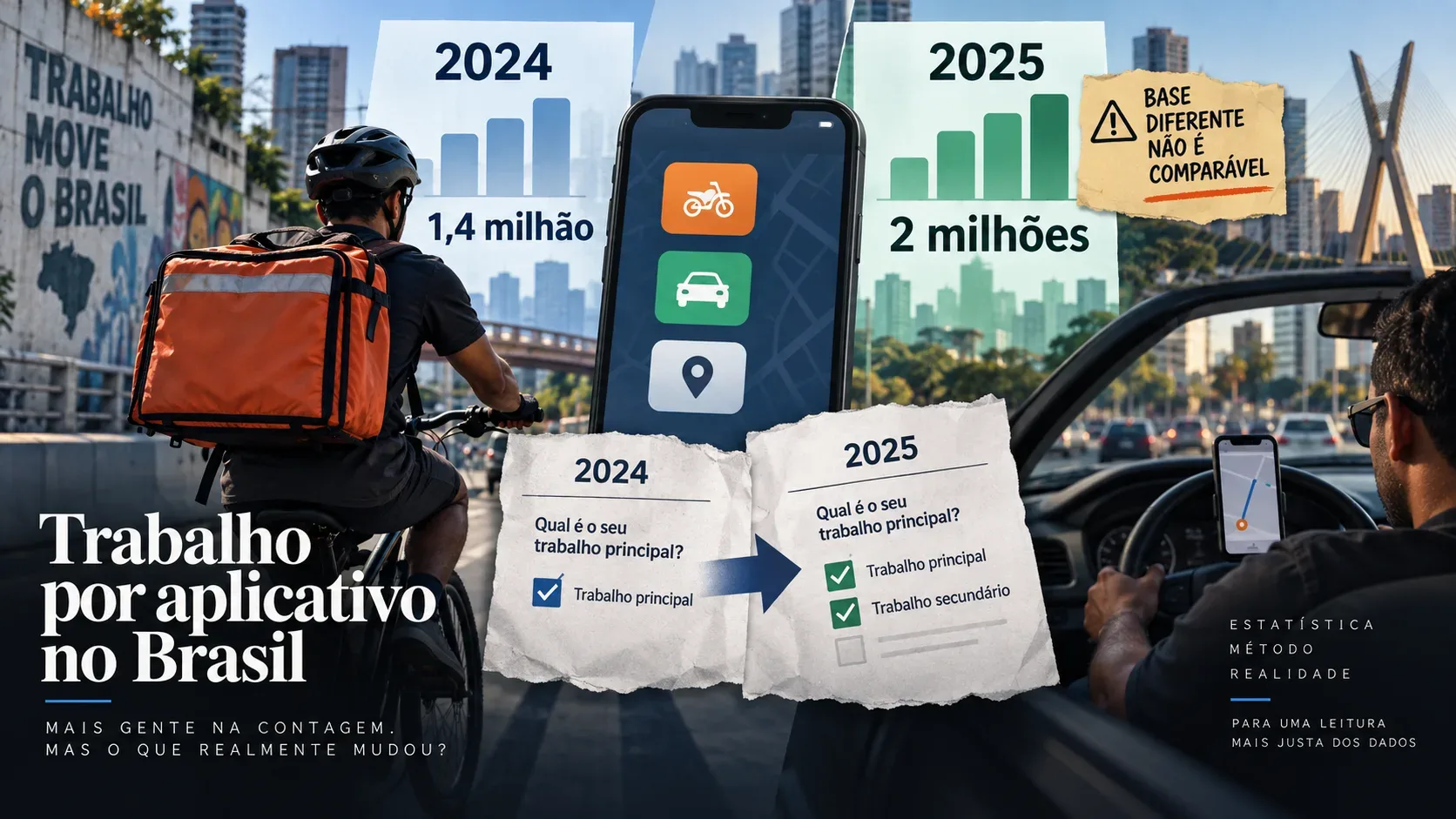
The “2 million” app-based workers reported for 2025 should not be placed side by side, without adjustment, with the 2024 total. The reason is methodological: in 2025, the Continuous PNAD module on digital platforms began to capture the use of apps in secondary jobs as well. In 2022 and 2024, the survey was restricted to the sole or main job.
The 2025 total was 1.959 million people, rounded in headlines to 2 million. That figure answers a broader question than the one asked in previous rounds. To measure change over time, the equivalent scope is different: people for whom platforms were their sole or main job. On that basis, the reported series is about 1.3 million in 2022, 1.7 million in 2024, and 1.8 million in 2025.
What exactly changed in the 2025 Continuous PNAD
IBGE itself warned before publication that the 2025 questionnaire had been expanded. The main change for historical comparison was the inclusion of secondary jobs. The module also began to investigate e-commerce platforms and, for the first time, the number of platforms used, the frequency of platform work, and the main reason for doing this kind of work.
This matters because a statistic is directly comparable only when it measures populations defined in sufficiently equivalent ways. If one year counts only people who use a platform in their main job and the next year also includes those who do so in a secondary job, the second universe is broader by design.
| Year/measure | Relevant scope | Published estimate | Directly comparable? |
|---|---|---|---|
| 2022 | Platform work in the sole or main job | about 1.3 million | Yes, with 2024 and with the equivalent 2025 scope |
| 2024 | Platform work in the sole or main job | about 1.7 million | Yes, with 2022 and with the equivalent 2025 scope |
| 2025 — expanded total | Platform work in the main and/or secondary job | 1.959 million | Not directly with 2022 or 2024 |
| 2025 — comparable scope | Platform work in the sole or main job | about 1.8 million | Yes |
What is the correct comparison with 2024?
To answer “did app-based work increase from 2024 to 2025?”, the scope must remain the same. According to the figures reported by Agência Brasil, considering only people for whom apps were the sole or main occupation, the total rose from about 1.7 million in 2024 to 1.8 million in 2025. The reported one-year increase for this comparable group is 9.1%.
Compared with 2022, again using the sole-or-main-job scope, the reported increase is 36.8% over three years. These are the useful rates for a time comparison because they preserve the essential definition of the observed population.
Why comparing “1.7 million” with “1.959 million” can mislead
A calculation that treats the expanded 2025 total as the automatic continuation of the 2024 total mixes two things: real change in the number of workers and change in the coverage of the question. The resulting growth rate may look objective, but it is not a comparison between equivalent universes.
That does not make the 2025 number “wrong.” It is useful for answering a new and broader question: how many people performed work through digital service platforms in their main or secondary job? The problem arises only when that total is treated as if it had exactly the same basis as earlier editions.
What the new total adds
The broader questionnaire captures people that the previous methodology left outside the main total: workers who use apps as a supplementary source of income. The 2025 release identified 182,000 people doing platform work in a secondary job and 28,000 who reported platform work in both their main and secondary jobs. Because these situations overlap, the groups should not be mechanically added to reconstruct the total.
The survey also reports that the expanded total of 1.959 million represented 1.9% of the employed population. By activity, about 1.2 million used passenger-transport apps, 376,000 made deliveries through apps, and 313,000 used general or professional service platforms. These breakdowns help show the diversity of platform work, but they do not change the basic rule for historical comparison.
How to read headlines without confusing level and change
- “Brazil had 2 million app-based workers in 2025”: this is a rounded presentation of the expanded total of 1.959 million.
- “The total increased X% since 2024”: this is valid only if the calculation uses the same scope in both years.
- For 2024 vs. 2025: use the sole-or-main-job scope, from about 1.7 million to 1.8 million, with a reported increase of 9.1%.
- To understand the full 2025 coverage: use the 1.959 million total and state clearly that it includes secondary work.
There is another caution: the module is experimental
IBGE classifies the statistics on work through digital platforms as Experimental Statistics. This means the indicators are innovative and remain subject to methodological evaluation and revision. The classification does not invalidate the results, but it calls for caution when building series, comparing editions, and interpreting small differences.
The 2024 round, for example, was explicitly designed to investigate the use of platforms in the sole or main job. The 2025 expansion shows that the instrument itself is evolving to capture forms of work that may appear in more than one occupation. For sociological analysis, that change is substantive: it makes visible a portion of platform work that functions as a supplement rather than necessarily as the central occupation.
A practical rule for using the data
If the question is “how many people worked through platforms in 2025, including secondary activity?”, use 1.959 million. If the question is “how much did the comparable group grow relative to 2024 or 2022?”, use the sole-or-main-job series: 1.3 million in 2022, 1.7 million in 2024, and 1.8 million in 2025.
Separating the expanded level from the comparable series prevents a questionnaire change from being mistaken for an acceleration in the app-based labor market.