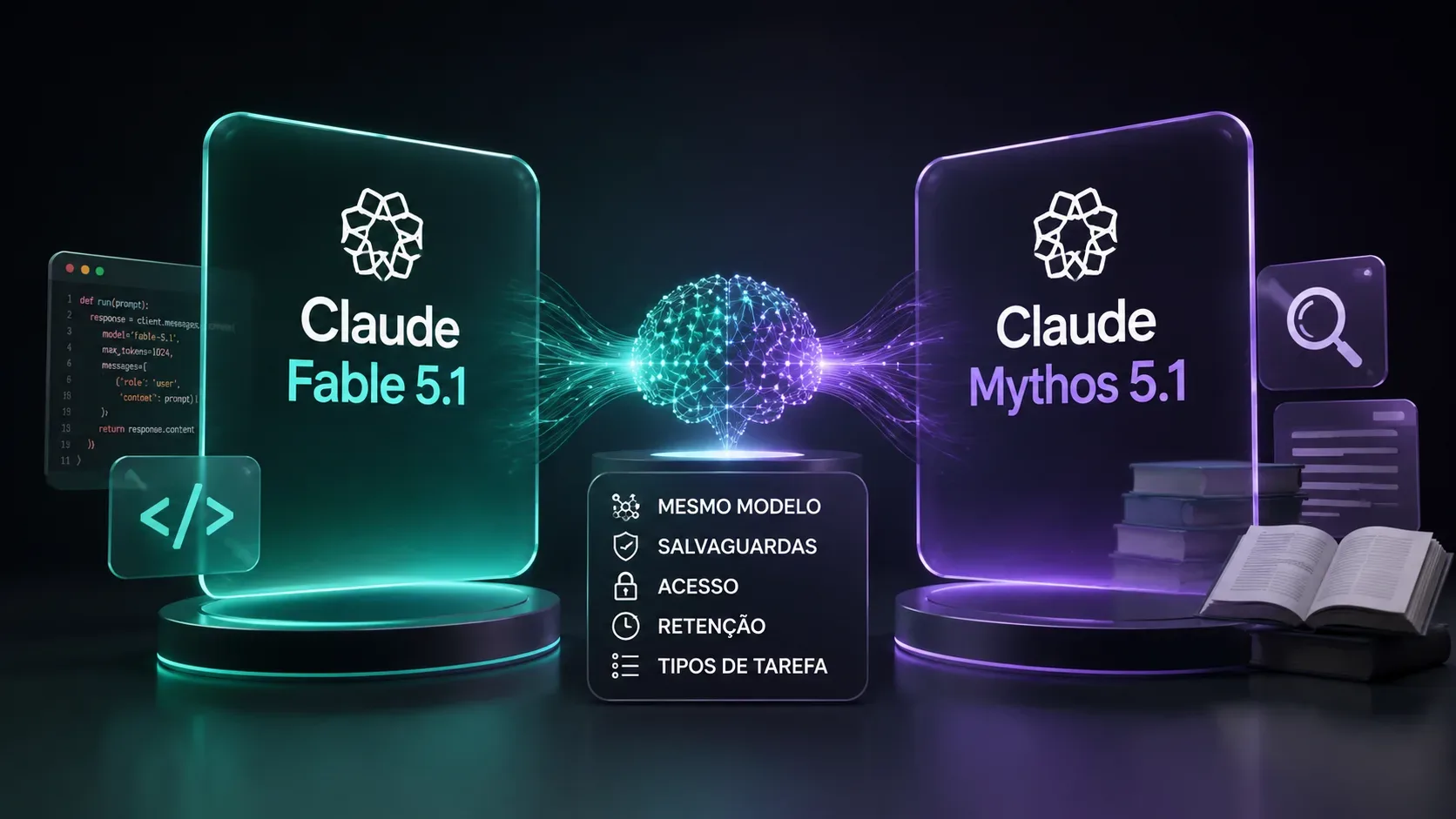
Claude Fable 5.1 and Claude Mythos 5.1 are not two models with different “brains.” Anthropic says they share the same underlying model; the decisive differences are the safeguards layer, who can access each version, and how certain cybersecurity and life-sciences tasks are handled. For coding, research, and general knowledge work, the comparison is therefore less an intelligence ranking and more a choice about access and risk policy.
Fable 5.1 vs. Mythos 5.1: direct comparison
| Criterion | Claude Fable 5.1 | Claude Mythos 5.1 |
|---|---|---|
| Underlying model | The same base model used by Mythos 5.1. | The same base model used by Fable 5.1. |
| Availability | Generally available on supported platforms. | Invite-only through Anthropic’s trusted access programs; at launch, limited to a set of U.S. organizations. |
| Safeguards | More restrictive in cybersecurity, biology, and chemistry; some requests may be blocked or routed to Opus models. | Reduced in sensitive domains for vetted organizations and approved uses, especially defensive cybersecurity and life sciences. |
| Coding | Designed for long-running agentic coding and complex debugging; it can identify source-code vulnerabilities but not develop exploits. | Has the same general capabilities but may preserve more capability on security tasks where Fable safeguards would intervene. |
| Research | Multistep research, knowledge synthesis, and long-form work with documents, spreadsheets, and presentations. | The same general work, with broader capability in approved cyber and bio scenarios. |
| Context and output | 1 million context tokens and up to 128,000 output tokens. | 1 million context tokens and up to 128,000 output tokens. |
| API price | $10/MTok input, $50/MTok output, and $0.25/MTok cache reads. | The same specifications and pricing. |
| Retention | 30 days by default unless Anthropic expressly authorizes an eligible arrangement. | Also a Covered Model with a default 30-day requirement unless expressly authorized otherwise. |
In coding, the difference can come from safeguards
Anthropic positions Fable 5.1 for demanding reasoning and long-horizon agentic work. Its documentation highlights stronger long-running agentic coding, multistep research, and work with documents, spreadsheets, and slides. You therefore do not need Mythos 5.1 access to use the underlying model for advanced software engineering.
The important exception is sensitive security content. Fable 5.1 can identify vulnerabilities in source code, but its safeguards still prevent tasks such as exploit generation, penetration testing, and binary-based vulnerability scanning. Flagged requests may be routed to Opus models depending on the product surface and configuration.
This also changes how benchmarks should be read. Anthropic says Fable 5.1 and Mythos 5.1 are the same underlying model and that differences on terminal or security tasks can reflect cases where Fable safeguards intervened. A standalone score therefore does not prove that Mythos has better general reasoning.
For research, Mythos 5.1 is not a “premium” version for every topic
For multistep research, file analysis, source synthesis, and broad knowledge work, Fable 5.1 is already Anthropic’s generally available option. Mythos 5.1 becomes relevant when research enters areas where Anthropic reduces safeguards only for vetted organizations, mainly cybersecurity and life sciences.
A team researching markets, law, finance, nonsensitive scientific literature, technical documentation, or large document collections should not choose Mythos simply because the name appears to represent a higher tier. The right test is whether the work needs capabilities restricted by Fable safeguards and whether the organization qualifies for the relevant access program.
Access: Fable is general; Mythos is controlled
Fable 5.1 launched on September 1, 2026 as an active, generally available model on supported platforms. Mythos 5.1 launched the same day but remains invite-only and tied to Project Glasswing and trusted access programs. Anthropic says that, at launch, it can currently make Mythos available only to a set of U.S. organizations while it works to expand access.
Operationally, choosing Mythos is not simply a model-ID swap. The organization needs approval and access enabled by Anthropic or the relevant cloud account team.
Data retention: both require special attention
Claude Platform documentation classifies Fable 5.1 and Mythos 5.1 as Covered Models. By default, they require 30-day retention. The rule applies wherever the models are offered, although where retained data resides can vary by platform.
Anthropic has also announced Enterprise Frontier Safeguards (EFS), under which eligible customers store data in cloud infrastructure controlled by the customer. Until EFS is available, Anthropic says eligible customers can use Fable 5.1 with zero data retention. That is an eligibility- and authorization-based exception, not the default policy.
Which one should you choose?
- General coding and software agents: start with Fable 5.1 for long, complex tasks.
- Multistep research and knowledge work: Fable 5.1 covers the general case; Mythos does not provide more context or output because the specifications are the same.
- Defensive cybersecurity research: Fable 5.1 can already analyze source-code vulnerabilities, but Mythos may fit vetted organizations when Fable safeguards limit authorized work.
- Sensitive biology and life-sciences research: Mythos 5.1 is the path intended for approved researchers and organizations.
- Strict retention environments: confirm configuration and eligibility; do not assume ZDR by default.
The main takeaway
Fable 5.1 and Mythos 5.1 are best understood as two ways to deploy the same model, not as conventional steps on a “good, better, best” ladder. For most users, Fable 5.1 delivers the general coding, research, and agentic capabilities. Mythos 5.1 exists for approved cases where Fable’s additional safeguards would reduce usefulness in cybersecurity or life sciences.
The most useful decision framework is to ask four questions: is the task sensitive in cyber or bio? does the organization have approved access? is the retention policy compatible? and do your own evaluations show a real workflow gain? This avoids turning one benchmark into an absolute ranking.
Sources: Anthropic announcement; Fable 5.1 documentation; Mythos 5.1 documentation; Claude Platform data-retention documentation.