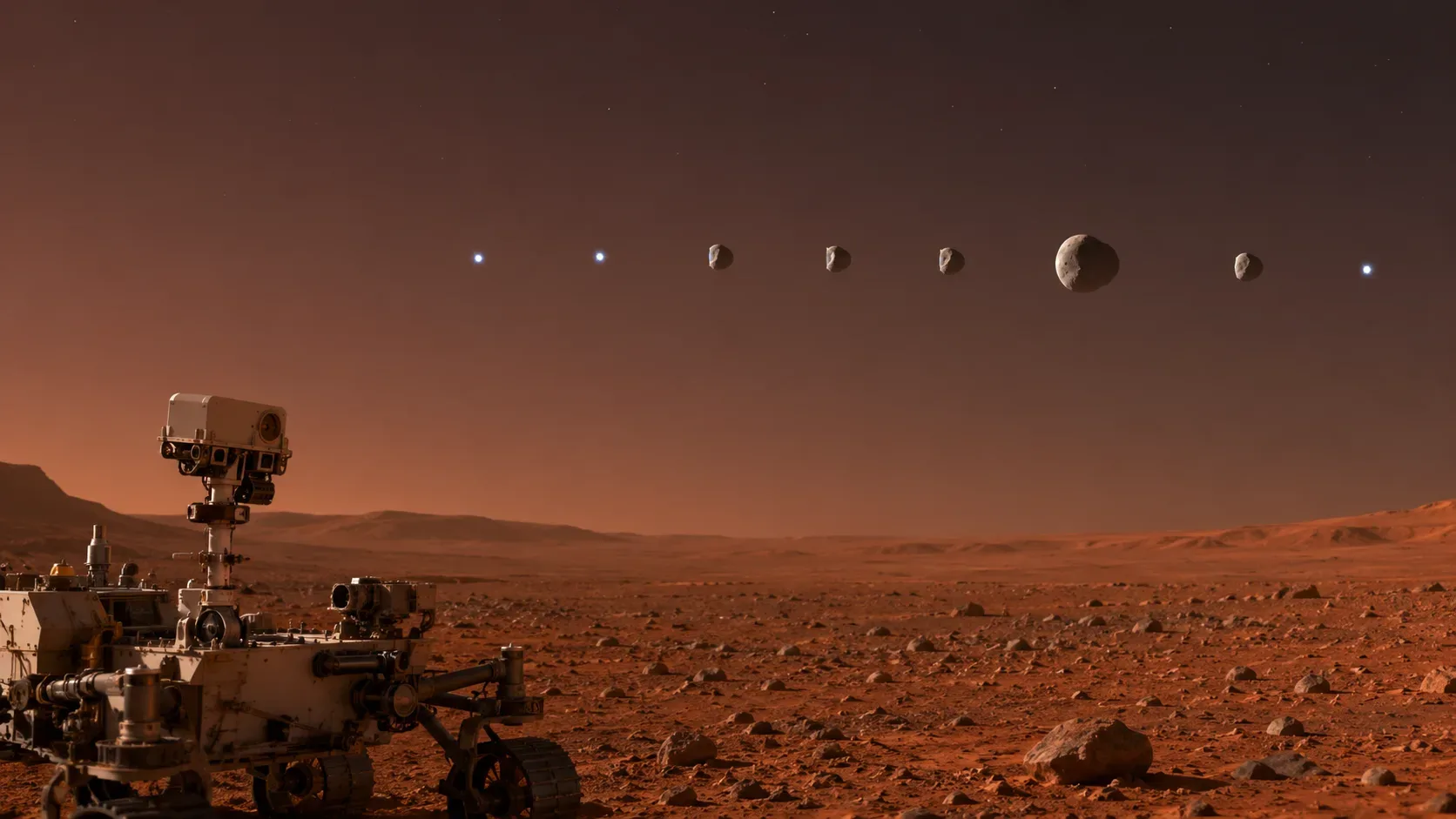
Seen from the surface of Mars, Earth does not appear like the big blue planet in space photographs. In the sequence captured by the Perseverance rover on July 2, 2026, it is just a tiny bright point, approximately one pixel long, that visually approaches the edge of Phobos and disappears behind the Martian moon.
NASA released the images on August 5, 2026 and classified the record as the first known observation of Earth being occulted by a moon, made from the surface of another planet. The most important detail, however, is in the choice of words: Perseverance did not film an Earth eclipse. He registered a concealment.
The difference seems only terminological, but it reveals exactly what happened in that line of sight between Mars, Phobos and Earth.
What Perseverance observed
The sequence was produced with images obtained by the Mastcam-Z camera system, installed on Perseverance's mast. Instead of a continuous transmission or a video followed live from Earth, the material is a succession of frames captured by the rover and subsequently received, processed and organized by the mission team.
In the first few frames, Earth appears close to the irregular outline of Phobos. Then, the luminous point visually touches the edge of the moon and is no longer detected. After remaining hidden for a few moments, it reappears on the other side.
Nothing physically happened to Earth. The planet was only temporarily out of the camera's line of sight because Phobos passed in front of it in the Martian sky.
In astronomy, this type of alignment is called occultation: an apparently larger and closer object covers another that appears smaller and more distant. NASA uses the same definition when describing cases in which the Moon hides a star or in which an asteroid momentarily blocks a background star.
Why this wasn't an eclipse
The word “eclipse” is often used informally for almost any disappearance in the sky, but its astronomical application involves a specific geometry related to the blocking of light or the passage of one body through the shadow of another.
A lunar eclipse, for example, occurs when the Moon enters the shadow cast by the Earth. In a solar eclipse, the Moon is positioned between the Earth and the Sun and its shadow reaches part of the Earth's surface. NASA itself defines eclipses as the total or partial obscuring of one body or its entry into the shadow of another.
In the July 2 observation, Earth did not enter the shadow of Phobos, and the shadow of the Martian moon was not the phenomenon measured. What disappeared was only the image of Earth from the camera's perspective, blocked by the apparent disk of Phobos.
The distinction can be summarized as follows:
| Phenomenon | What happens | Example |
|---|---|---|
| Concealment | A nearby and apparently larger object hides another that is more distant | Phobos covering Earth in Perseverance's view |
| Traffic | A smaller object crosses the visible disk of a larger one without completely hiding it | Phobos passing in front of the Sun |
| Eclipse | A body blocks a light source or passes through the shadow of another | Moon entering Earth's shadow |
Categories may overlap in certain contexts. A transit in front of the Sun, for example, can also be treated as a form of partial or annular eclipse. Still, to accurately describe Earth's disappearance behind Phobos, occultation is the most informative term. NASA also differentiates transits — in which a smaller body crosses the disk of another — from occultations in which the background object is obscured.
Frame-by-frame reading of the sequence
1. The Earth appears as an isolated point
At the beginning of the observation, the Earth is recognizable only as a bright spot in the sky. The scale of approximately one pixel does not represent the actual size of the planet, but the size of its image on the sensor, given the distance, the magnification used and the camera resolution.
This means that the record does not show continents, clouds, or the blue disk of Earth. Identification depends on the predicted position of the planet and the correspondence between the frames.
2. The point approaches the edge of Phobos
In the following frames, Phobos' orbital motion rapidly changes alignment. The Martian moon appears to advance in relation to the celestial background, while the Earth remains practically punctual on that scale.
Phobos is irregularly shaped and measures approximately 27 by 22 by 18 kilometers. Despite being much smaller than Earth's Moon, it orbits extremely close to Mars and can occupy a significant area in the sky of an observer on the surface. The moon completes approximately three orbits around Mars per day.
This is the secret of the apparent disproportion: the size seen in the sky depends on both the real dimensions and the distance from the observer.
3. The Earth disappears
When the line of sight between Mastcam-Z and Earth passes through the body of Phobos, the planet's light signal no longer reaches the camera directly. The dot disappears, even though the Martian moon is not close to Earth in space.
It's a purely perspective alignment: Phobos is close to the rover, while Earth is millions of kilometers beyond it.
4. The dot reappears
As Phobos continues to move, the line of sight becomes clear again. Earth reappears near the opposite edge of the moon.
The complete sequence allows us to recognize the phenomenon with more certainty than a single frame would allow: approach, disappearance and reappearance form the characteristic pattern of an occultation.
How Phobos manages to hide a much larger planet
The Earth is more than 12 thousand kilometers in diameter, while Phobos does not reach 30 kilometers in its largest dimension. Even so, the small moon can obscure the planet because it is incomparably closer to the Martian observer.
It is the same principle by which a finger, placed close to the eye, can hide a distant building. The finger is no bigger than the building; it just occupies a larger angle in the field of view.
Phobos orbits a few thousand kilometers from the surface of Mars. In a comparison published by NASA, the moon may appear in the Martian sky to be a considerable fraction of the size that the Earth's Moon appears to those observing from Earth, despite its actual diameter being more than a hundred times smaller.
The Earth, seen from Mars, occupies a very small angle. In the Perseverance image, all the light reflected by the planet was concentrated in approximately one element of the image. Thus, it was enough for the edge of Phobos to cross that position for the entire point to disappear.
Occultation, transit and eclipse in practice
Perseverance itself has already recorded another type of alignment involving Phobos: the moon crossing the Sun's disk.
In this case, Phobos appears as a dark silhouette moving over a much larger light source. As it does not cover the entire Sun, the phenomenon is usually described as a transit of Phobos or a Martian annular solar eclipse. Observations of this type have already been made by different rovers and help researchers monitor small changes in the moon's orbit.
The Earth sequence is visually different:
- there is no bright solar disk in the background;
- Earth is not large enough in the image to show its own disk;
- Phobos completely covers the detected point;
- disappearance occurs due to blocking of the line of sight.
Therefore, calling the episode just an “eclipse” would erase precisely the most interesting aspect of the observation.
What makes the registry special
The value of the sequence is not in the discovery of an unknown astronomical mechanism. Occultations have long been observed and used to study the positions, dimensions, atmospheres, and orbits of celestial objects.
The news is at the observation point.
Earth-built equipment operating on the surface of Mars turned its camera to the sky and recorded the home planet disappearing behind a Martian moon. According to NASA, it is the first observation of its kind made from the surface of another planet.
The image also inverts the usual perspective of space exploration. We normally see Mars as a point in the Earth's sky or as a landscape sent by probes. This time, it was Earth that became the distant dot — small enough to disappear behind a moon just a few dozen kilometers wide.
What the sequence doesn't show
To avoid misinterpretations, three limits need to be maintained:
- It was not an eclipse of Earth. The planet did not enter the shadow of Phobos.
- It was not followed live. The sequence was composed from images captured by the rover and sent later.
- The Earth has not shrunk to one pixel. This measurement describes its representation on the sensor, not its physical size.
The record functions as a direct demonstration of apparent scale and perspective. Gigantic objects can appear tiny when they are far away; Small bodies can dominate the visual field when they are close.
Seen from Mars, in that specific frame, Earth became a dot — and Phobos was big enough to make it disappear.
Save this explanation to consult when occultations, transits and eclipses are back in the news. Also see the August sky guide and subscribe to the science newsletter to receive new astronomical observations explained without sensationalism.