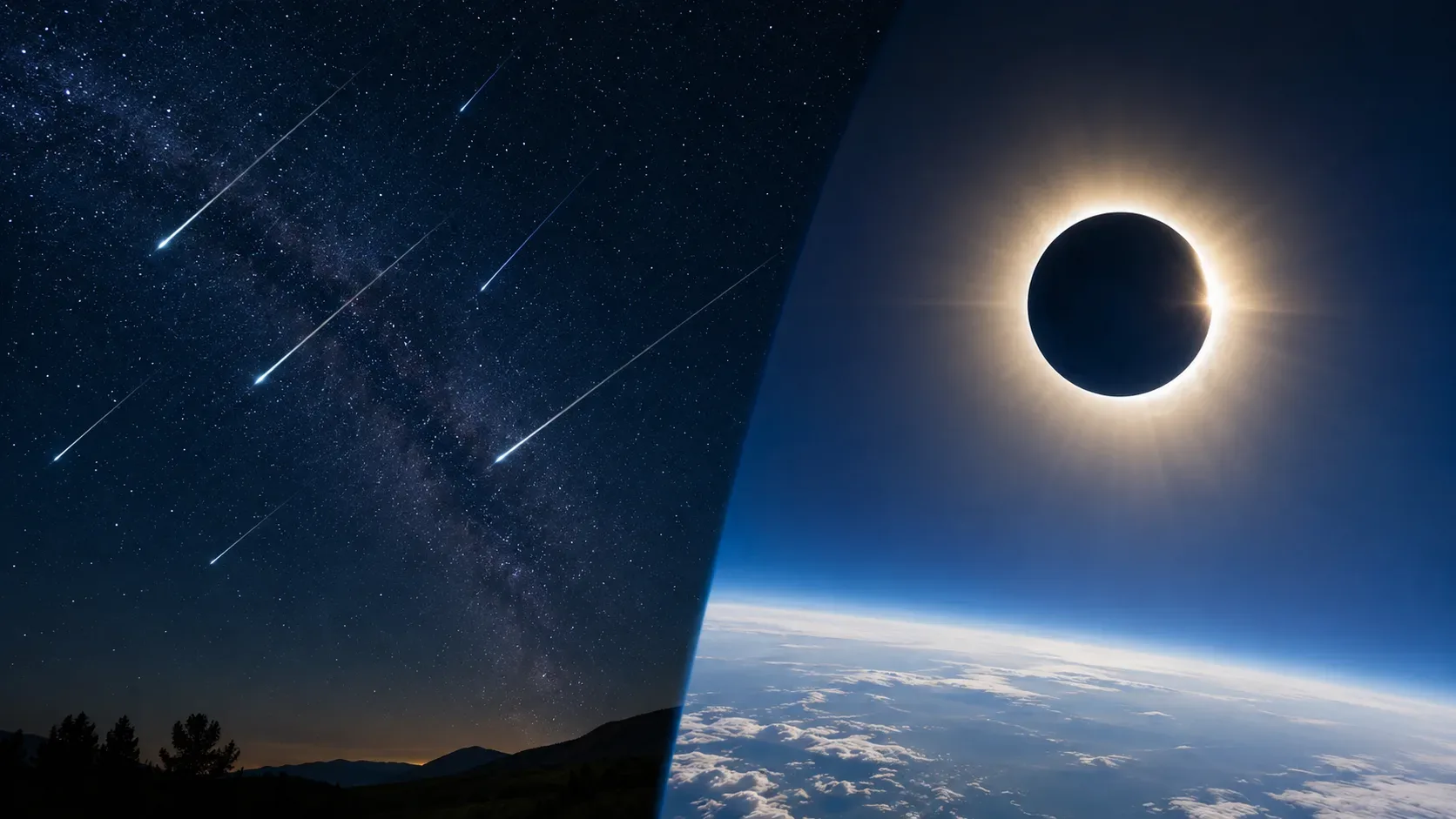
Two astronomical events fall on August 12, 2026, but that doesn't mean they can both be observed from anywhere. For anyone in a Brazilian city, the total solar eclipse will not be visible. The band of totality will pass through northern Russia, Greenland, Iceland, Spain and a small area of Portugal.
There is a technical exception within the national territory: a very small partial phase was calculated for the Penedos de São Pedro and São Paulo, a remote archipelago in the Atlantic occupied by a scientific station. It is not an open observation destination for the public and does not change the practical orientation for Brazilian cities.
The possible observation in parts of Brazil will be that of the Perseids, a meteor shower that reaches its maximum on the night of August 12th to 13th. Still, the expectation needs to be adjusted: the rain's radiant is far to the north in the sky, favoring the North and Northeast regions and greatly reducing the amount observable in the Center-South of the country.
Eclipse and Perseids are not the same event
| Event | What will be visible from Brazil | Relevant time | Realistic expectations |
|---|---|---|---|
| Total solar eclipse | It will not be visible from Brazilian cities. Totality will occur in the Northern Hemisphere. | The greatest global eclipse will be at 17:45:54 UTC, equivalent to 14:45:54 Brasília time. This time refers to a point near Greenland, not Brazil. | Don't expect darkening skies, noticeable changes in light or sun coverage in your city. |
| Partial eclipse at Penedos de São Pedro and São Paulo | A small partial phase was calculated for this Brazilian oceanic territory. | From 4:15 pm to 4:43 pm local time, which is UTC−2. Maximum at 4:29 pm, with magnitude 0.034. | Discreet effect, restricted to a remote archipelago and of no practical use to the general public. |
| Perseids | They can be seen, mainly in the North and Northeast. The observation worsens towards the South. | Predicted main maximum between 02h and 04h UTC on 13/08: from 23h on 12/08 to 1h on 13/08 in BRT. The broad maximum is from 21:00 to 09:00 UTC. | Dark skies and new Moon help, but the low position of the radiant limits the number of meteors in Brazil. |
The times and position of the greatest eclipse come from NASA Goddard Space Flight Center calculations. The Perseid forecasts are from the International Meteor Organization, which treats the maximum as an interval, not an exact instant.
Why a global map can lead to error
An eclipse map doesn't just show times. It shows where the Moon's shadows pass over the Earth's surface.
The umbra, the narrowest and darkest part of the shadow, marks the band where the Sun is completely covered. On August 12, this track will cross regions of the Arctic and North Atlantic before reaching Europe. The wider penumbra produces the partial eclipse around the band of totality.
The green lines on NASA maps indicate times in UTC, while the yellow curves represent percentages of coverage of the solar disk. Seeing a line with “18h UTC” next to the map does not mean that there will be an eclipse at 15h in Brazil. It is necessary to confirm whether the city is also within the area affected by the penumbra at that time.
This is why some pages classify the event as “partial in Brazil”: they consider the entire national territory, including the Penedos de São Pedro and São Paulo. In practice, Natal, João Pessoa, Recife, Maceió, Salvador, Brasília, Rio de Janeiro, São Paulo and other Brazilian cities are outside the useful observation of the eclipse.
What happens at Penedos de São Pedro and São Paulo
In Penedos, the eclipse will begin at 4:15 pm, reach its maximum at 4:29 pm and end at 4:43 pm, always in UTC−2 local time. The calculated magnitude is 0.034, a measure that represents the fraction of the Sun's diameter covered along the line that passes through the apparent centers of the two stars. This does not mean that 3.4% of the solar area will be hidden: magnitude and covered area are different measurements.
The archipelago is home to a scientific station maintained as part of research programs supported by the Brazilian Navy. The presence at the site is linked to expeditions and scientific teams, so this geographic exception should not be treated as a last-minute tourist opportunity.
The Perseids are possible observation, but not equally across the country
The Perseids occur when the Earth passes through a region with particles left by comet 109P/Swift-Tuttle. When these particles enter the atmosphere at high speed, they produce luminous streaks popularly known as shooting stars. Solar eclipse and meteor shower do not cause each other; the coincidence of dates is circumstantial.
In 2026, the Moon will be new on August 12, removing one of the main natural sources of light from the sky. NASA recommends the night from the 12th to the 13th and highlights that the absence of moonlight creates favorable conditions, as long as the location also has little artificial lighting and the weather is open.
The Brazilian problem is geometric. The radiant of the Perseids — the point from which the meteors appear to originate — is in the constellation of Perseus, at an approximate declination of +58 degrees. This places it high in the Northern Hemisphere sky, but too low over the northern horizon for Brazilian observers. The IMO itself reports that rain cannot be observed adequately in most of the Southern Hemisphere.
The expectations by region look like this:
- North and extreme north of the Northeast: offer the best geometric conditions in the country. The radiant rises most during the morning, although it remains well below the height reached in the Northern Hemisphere.
- Other areas of the Northeast: can still record meteors, especially in the hours before dawn, with a clear northern horizon and little light pollution.
- Midwest and Southeast: observation is possible, but tends to yield few meteors associated with the Perseids. The radiant remains close to the horizon and obstacles such as buildings, hills and trees weigh more.
- South: the rain is not favorable. In part of the region, the radiant barely appears above the horizon; in the southernmost points, it can remain practically below it at night.
The hourly zenith rate published for a meteor shower should not be read as a promise of quantity. It assumes very dark skies, high transparency, radiant at the zenith and an unobstructed field of view. None of these geometric conditions are fully met in Brazil for the Perseids. Furthermore, the IMO warns that fund activity in 2026 could be below the traditional benchmark.
Perseid times in Brazilian time zones
IMO forecasts the main maximum between 02:00 and 04:00 UTC on 13 August, within a broader maximum that could extend from 21:00 UTC on 12 August to 09:00 UTC on the 13th.
Main range conversion is:
- Brasília time, BRT — UTC−3: from 11pm on 12/08 to 1am on 13/08;
- Amazon Time, AMT — UTC−4: from 10pm on 12/08 to midnight;
- Acre Time, ACT — UTC−5: from 9pm to 11pm on 12/08;
- Fernando de Noronha time, FNT — UTC−2: from midnight to 2am on 13/08.
In the North and Northeast, however, the radiant gains height as the dawn advances. Therefore, continuing to observe past the predicted core maximum may be more productive than closing at exactly the indicated time, as activity remains elevated over a wider range.
How to observe without creating impossible expectations
- Choose a dark, safe place with an open view of the north and northeast horizon.
- Start in the late evening of August 12th and remain until the pre-dawn hours of the 13th.
- Give your eyes about 30 minutes to adapt to the dark and avoid looking at bright screens.
- Do not use a telescope to look for meteors. Observe a wide area of the sky, without just focusing on the constellation Perseus.
- Confirm the cloud forecast for your city the day before. Overcast skies eliminate observation regardless of predicted activity.
NASA recommends letting your gaze scan the sky, as meteors can appear far from the radiant, and setting aside at least 30 minutes for visual adaptation.
Safety when observing the Sun
Anyone outside Brazil, following an authorized activity in Penedos or trying to observe any partial phase of the eclipse must use appropriate sun protection. Ordinary sunglasses do not protect your eyes.
During all partial phases, it is necessary to use eclipse glasses or a solar visor compatible with the ISO 12312-2 standard. Binoculars, cameras and telescopes require their own solar filter installed on the front of the equipment. Looking through the instrument using only eclipse glasses can cause serious eye damage.
For the reader in Brazil, the practical decision is simple: do not plan a local observation of the total eclipse. Save the date to try to see the Perseids, especially in the North and Northeast, and check the time and location for observation on August 11th. Anyone who wants to follow the eclipse can use the broadcast announced by NASA.