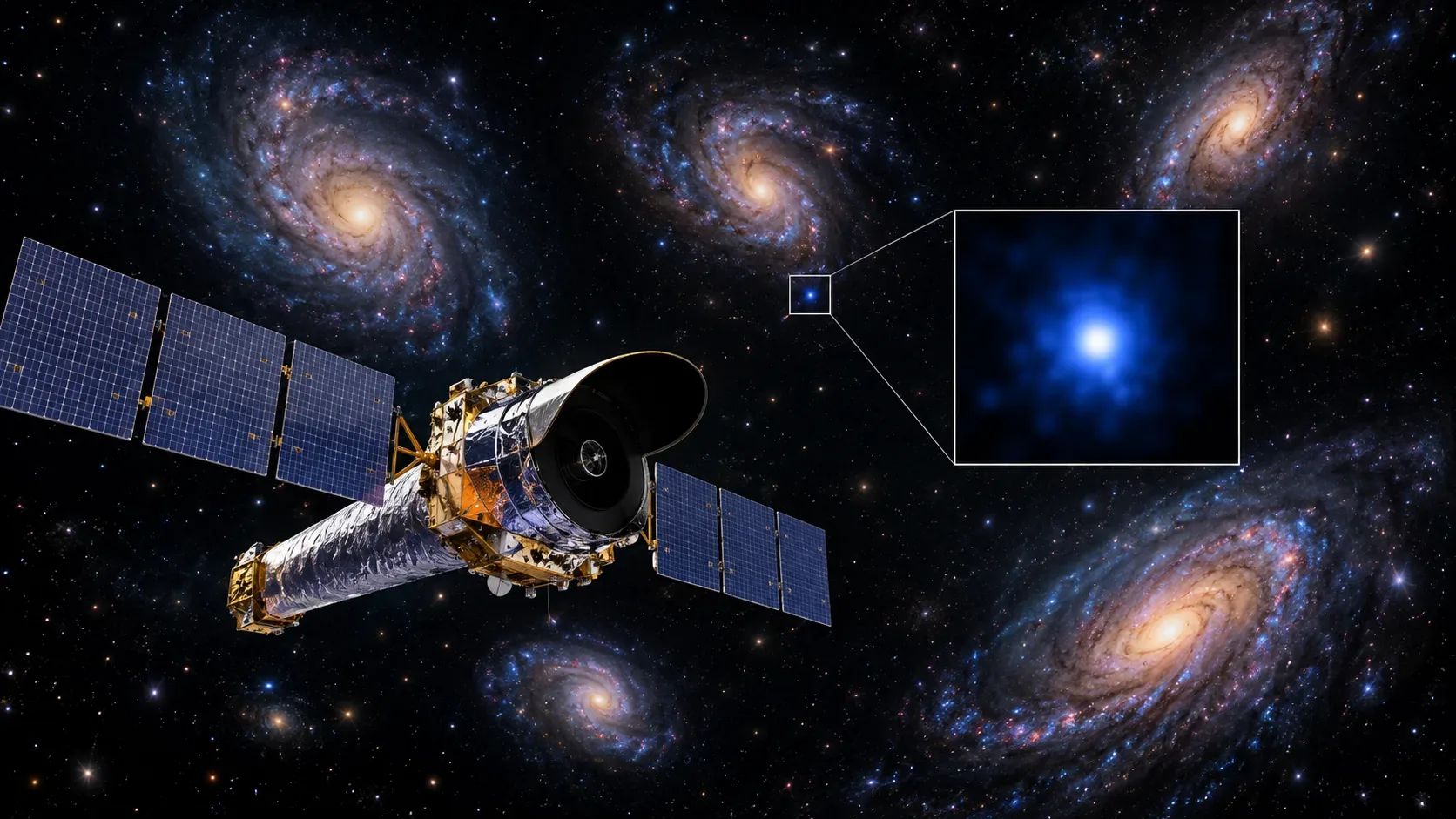
On September 9, 2026, a team led by Mustafa Muhibullah published in Nature Astronomy the identification of 84 unusual X-ray sources in six nearby galaxies using archival data from NASA's Chandra X-ray Observatory. The group was named hypersoft X-ray sources (HSSs): they appear mainly at the lowest energies Chandra can measure and nearly vanish when observations move to a slightly higher energy band.
The most important point is that “HSS” does not yet identify a single physical type of object. It is an observational class, defined by a radiation pattern. The authors propose that the group may include different binary systems, including accreting white dwarfs or post-nova systems and, among the most luminous cases, systems containing compact objects such as black holes. NASA also lists neutron stars among the possibilities. The discovery therefore opens hypotheses; it does not close the identification question.
What Chandra actually found
The researchers searched the Chandra archive for point-like, non-nuclear sources detected mainly between 0.15 and 0.3 keV but showing little or no emission between 0.3 and 1.0 keV. That contrast is what makes the spectrum “hypersoft.” The search found 84 sources in six galaxies: the spirals M31 (Andromeda) and M101 (the Pinwheel Galaxy), plus four elliptical galaxies. HSSs appear both in regions of active star formation and in older stellar populations.
According to the paper, the most luminous examples approach 1038 erg/s in the narrow X-ray band alone. Spectral models indicate that the total luminosity may be higher because much of the energy probably emerges in the extreme ultraviolet (EUV), a band between ultraviolet and low-energy X-rays that is very difficult to observe over large distances.
| What was observed | What it suggests | What is still unresolved |
|---|---|---|
| Emission concentrated at 0.15–0.3 keV | Sources that are exceptionally cool by X-ray standards, with a likely peak in the EUV | The exact spectral shape and total luminosity of each source |
| 84 sources in six galaxies | A previously under-recognized population exists, not just an isolated object | How common this population is beyond the surveyed sample |
| Sources in young and old populations | A single evolutionary origin may not explain every case | Whether HSSs combine several different physical classes |
Why “hypersoft” describes the spectrum, not the identity
In X-ray astronomy, “soft” means dominated by lower-energy photons. The “hyper” prefix highlights how extreme that concentration is at the lowest energies. This describes what reaches the detector; it is not proof that all of the sources have the same engine.
That distinction prevents a common leap in interpreting new results: the study found a new observational grouping of sources with similar properties. Researchers still need to identify which systems produce that signal and whether one or several physical families are hidden under the same label.
What these sources might be
The central hypothesis is that many HSSs are binary systems in which a compact object pulls matter from a companion star. Material heated during accretion can emit X-rays and EUV radiation. The study discusses several candidates because luminosity, apparent temperature, environment and variability do not necessarily point to a single solution.
- White dwarfs and post-nova systems: in M31, some of the least luminous HSSs are associated with novae. A white dwarf accumulating material can undergo nuclear burning on its surface; if the photosphere expands, the effective temperature falls and the emission peak can shift into the EUV, leaving only a very soft X-ray signature.
- White dwarfs with sustained nuclear burning: these are especially interesting because a white dwarf that keeps gaining mass may, in some scenarios, evolve toward a Type Ia explosion. The paper presents HSSs as a possible previously overlooked stage in some of these systems, not as a confirmed origin for all Type Ia supernovae.
- Black holes and other compact objects: the most luminous HSSs may require emitting regions or accretion regimes different from the lower-luminosity cases. The paper cites systems with black holes as a plausible class; NASA's release also includes neutron stars among the possibilities.
Mystery 1: which systems explode as Type Ia supernovae?
Type Ia supernovae are fundamental tools for measuring cosmic distances and played a historic role in the discovery of the Universe's accelerating expansion. Even so, questions remain about which stellar systems reach the explosion and through which evolutionary pathways.
HSSs matter because some models of accreting white dwarfs predict strong EUV and very soft X-ray emission during phases of mass growth or nuclear burning. If part of the 84-source population is in such a stage, astronomers gain an indirect way to search for systems before the supernova rather than inferring the progenitor only after the explosion.
This remains a testable hypothesis. Researchers must establish the nature of individual sources, track their evolution and determine whether any actually reach the conditions that lead to a Type Ia supernova. The current result provides candidates and a search method; it does not identify a universal Type Ia progenitor.
Mystery 2: who supplies the photons that ionize gas in galaxies?
The second problem involves ionization of the interstellar medium. Hot, massive stars produce enough ultraviolet radiation to ionize hydrogen, but explaining ionization states of helium and heavier elements can require more energetic EUV photons, especially in galaxies without an active nucleus supplying that radiation.
Because HSSs appear to release a large share of their energy in the EUV, a numerous population of these sources could contribute to the budget of ionizing photons. That would affect gas temperature and cooling and, in turn, the conditions under which new stars form.
Here too, the key word is “could.” The real contribution depends on how many HSSs exist, how much EUV radiation they produce, how much of it escapes their immediate surroundings and how the gas absorbs it. The study shows that the population deserves to be included in that accounting; it does not demonstrate that HSSs are the only or main ionizing source in every galaxy.
Why they stayed hidden for so long
The problem is a combination of physics and instrumentation. EUV radiation is strongly absorbed by neutral hydrogen and helium along the line of sight. Very low-energy X-rays also sit at the difficult edge of X-ray telescope sensitivity. Chandra itself has progressively lost sensitivity in its softest channels, and many historical analyses focus on energies above 0.3 keV.
HSSs therefore occupy a kind of blind spot: their probable peak lies in a band that scarcely reaches observers, while the small detectable tail appears only at the bottom edge of the X-ray band. Variability in some sources makes the search even harder. Careful use of the Chandra archive made it possible to look specifically for that marginal signature.
What the study still does not show
- 84 is not a census of the Universe. It is the number found in this search of six galaxies with specific data, exposures and sensitivities.
- HSS does not mean one physical type. The paper itself proposes that the class may contain different kinds of binaries.
- The EUV is inferred, not directly observed for each source. The conclusion comes from the X-ray spectral shape and models because EUV radiation is strongly absorbed.
- The links to Type Ia supernovae and ionization are scientific hypotheses. They are plausible implications that require further tests, not problems already solved.
The value of the work is precisely that it turns a blind spot into an observable population: there are now 84 catalogued targets to compare, monitor over time and search at other wavelengths. If future observations separate which HSSs are white dwarfs, black holes, neutron stars or other systems, the same observational class could become a tool for studying stages of stellar evolution and ionizing radiation sources that previously went unnoticed.