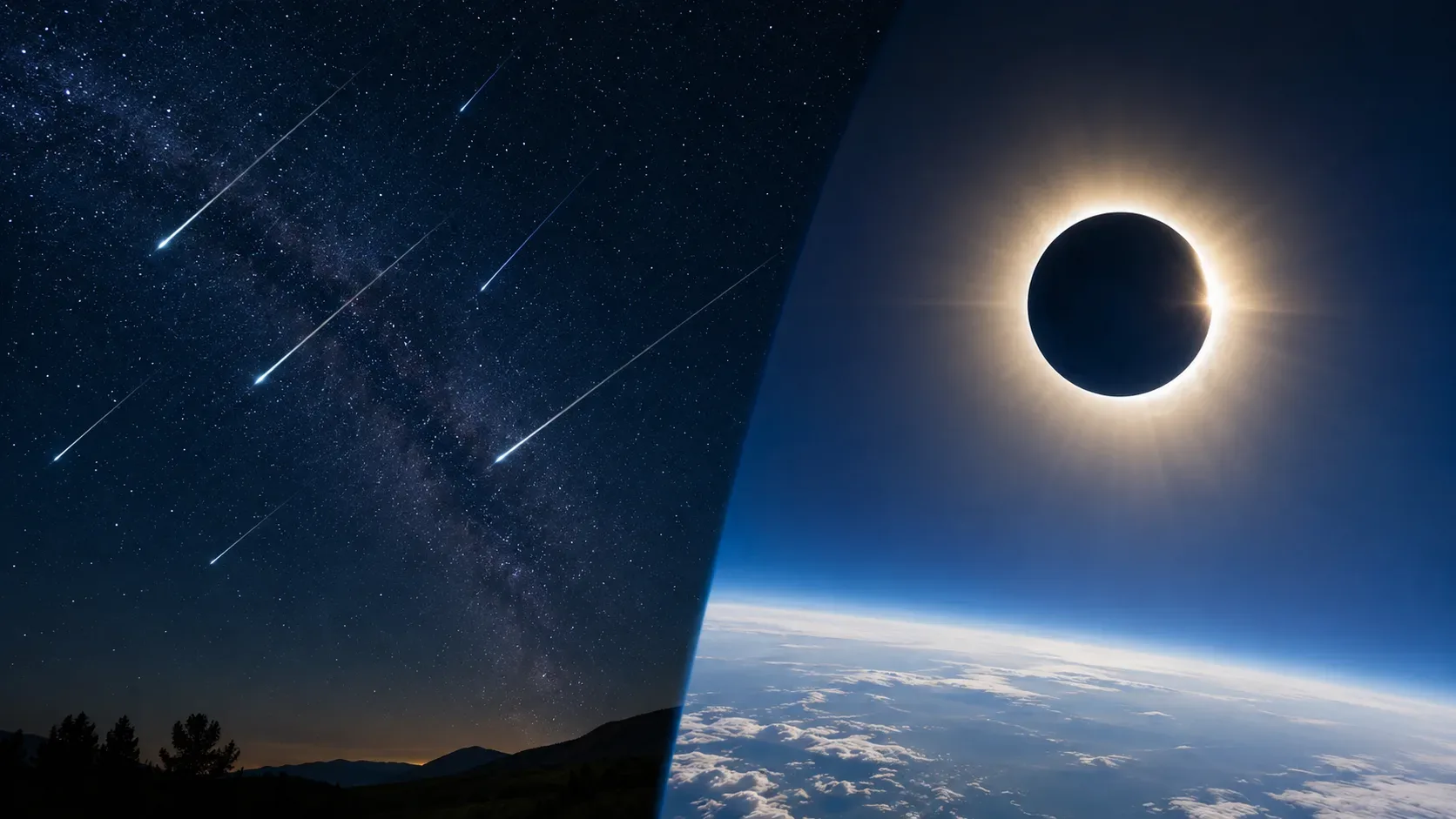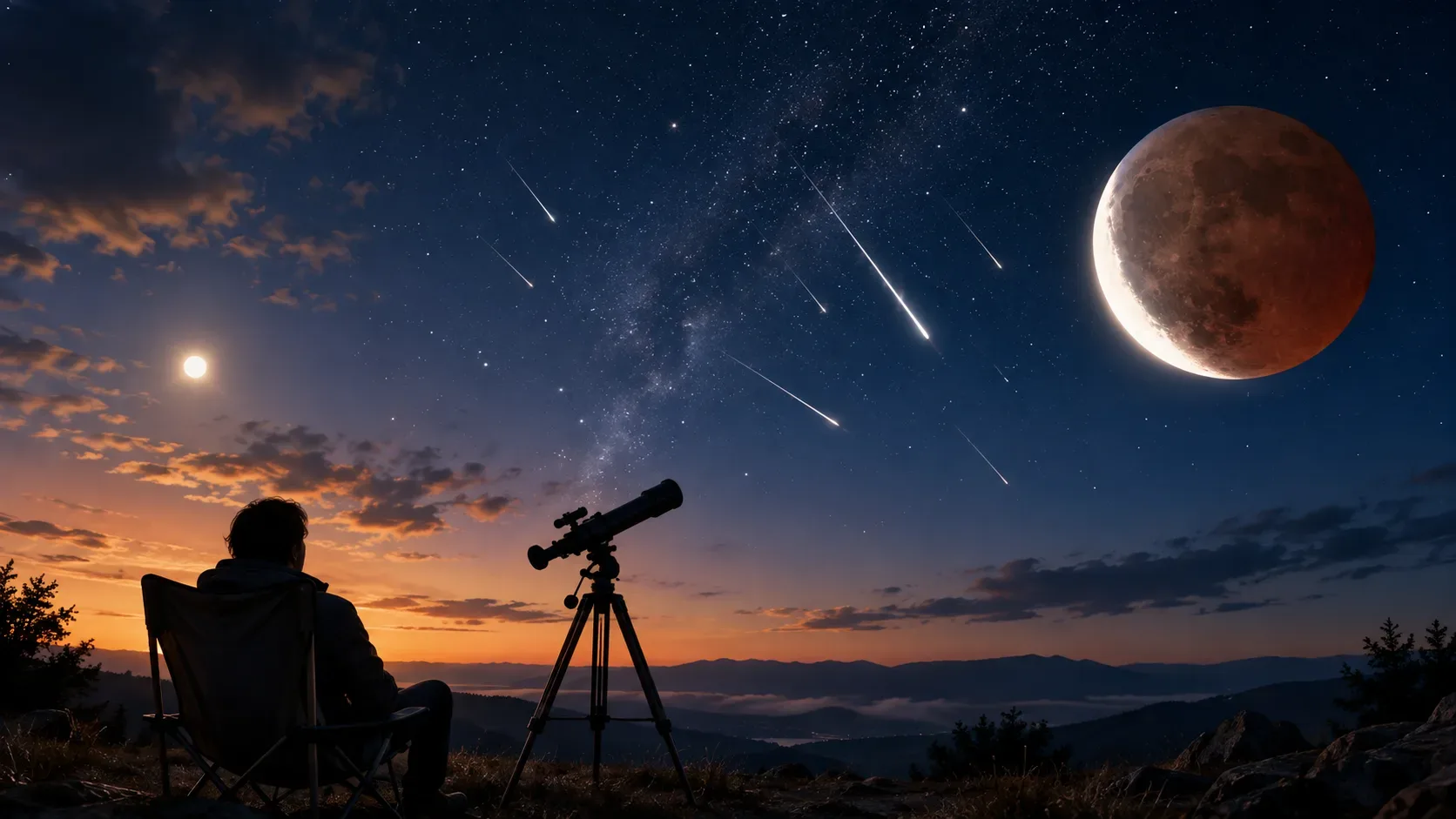
The biggest global astronomical event in August 2026 will not be the easiest to observe in Brazil. The total solar eclipse on August 12th will cross parts of the Arctic and Europe, while only an extremely restricted strip of Rio Grande do Norte will be able to record a minimum partial phase. For most of the country, the most accessible targets will be Venus in the early evening and, especially, the partial lunar eclipse of August 27-28.
The Perseids also appear on international calendars with favorable Moon conditions, but the position of the radiant in the extreme north of the sky greatly reduces the spectacle in Brazilian latitudes. Therefore, simply announcing “up to 100 meteors per hour” for Brazil would be misleading. Actual visibility depends on latitude, time, light pollution, horizon and cloud cover.
No Exaggeration August 2026 Calendar
The times below are approximate and use Brasília time, UTC−3, when there is no other indication. Near-horizon events and eclipse contacts should be double-checked for exact city coordinates.
| Global event | Visible from Brazil? | Best Brazilian region | Approximate time | Required equipment |
|---|---|---|---|---|
| August 12 — total solar eclipse | Almost no. Only a very restricted area of the coast of Rio Grande do Norte, near Guamaré, may have a partial shallow phase. There will not be totality in the country. | Extreme northern coast of Rio Grande do Norte, after confirmation by coordinates | Between 4:15 pm and 4:43 pm, in the area indicated by the local map | Suitable solar viewer or indirect projection; never look without protection |
| August 12 to 13 — Perseid peak | Yes, but with strong latitude limitations. The quantity observed must be well below the global calls. | North and northernmost portion of the Northeast, with a free northern or northeastern horizon | Best attempt between 3am and the start of dusk local time | Unarmed eyes, reclining chair and dark sky |
| August 14 to 16 — Venus at maximum eastern elongation | Yes, nationwide, if the western horizon is clear | All regions | Start about 30 to 45 minutes after sunset | Eyes unarmed; telescope is optional |
| August 27 to 28 — partial lunar eclipse | Yes. The entire phenomenon will be visible from Brazil, subject to time | Entire country; the best place will be the one with less cloudy skies | Partial phase visible from 11:33 pm to 2:51 am in UTC−3; maximum at 1:12 am | Eyes unarmed; binoculars or telescope are optional |
The table combines NASA ephemerides, lunar eclipse contacts calculated by the Goddard Space Flight Center, the International Meteor Organization calendar, and the local solar eclipse simulation for Rio Grande do Norte.
Solar eclipse of August 12: huge in the world, almost absent in Brazil
The August 12 eclipse will be total in Greenland, Iceland, northern Russia, northern Spain and a small corner of Portugal. Other areas of the Northern Hemisphere will have a partial phase. This is the global dimension of the event that explains its presence among the main astronomical highlights of the year.
In Brazil, however, the situation is very different. A specific simulation for Rio Grande do Norte indicates that the edge of the partial visibility region reaches an area close to the Guamaré Terminal. The state page reports starting at 4:15 pm and ending at 4:43 pm, without any phase of totality. The map suggests a very restricted geographic range, and not a statewide observation available.
This means that for almost the entire country, the solar eclipse will not be directly visible. Even on the coast of Rio Grande do Norte, coverage must be small and may require precise location, an unobstructed horizon and absence of clouds.. It is not prudent to organize a trip using only state time: the observer must check the simulation for their coordinates and follow guidance from local astronomical institutions.
Solar safety is not optional
In a partial phase, no matter how small, there is never a safe moment to look directly at the Sun without proper protection for solar observation. Ordinary sunglasses won't work. The viewer must be in good condition, come from a reliable supplier and meet the international standard applicable to direct observation of the Sun.
Binoculars, cameras and telescopes concentrate solar radiation. They can only be pointed at the Sun with a specific filter, securely fixed on the front of the optics. Wearing eclipse glasses while looking through an instrument without a front filter can cause serious eye damage. For simple observation, the safest alternative is indirect projection, keeping the observer facing away from the Sun and looking only at the projected image.
Perseids in Brazil: why the global announcement does not turn into 100 meteors per hour
The International Meteor Organization predicts Perseid activity between July 17 and August 24, with a main maximum between 2 am and 4 am UTC on August 13. This corresponds, in Brasília, approximately to the period between 11pm on August 12th and 1am on August 13th. The New Moon on August 12 eliminates much of the lunar interference, which would be excellent under favorable geometric conditions.
The Brazilian problem is the position of the radiant — the apparent point from which meteors appear to emerge. In the Perseids, it is in the constellation Perseus, with declination close to +58 degrees, far north of the celestial equator. The IMO itself states that rain cannot be observed adequately in most of the Southern Hemisphere and identifies the mid-latitudes of the Northern Hemisphere as the most favorable.
At the narrowest peak time, the radiant will still be below or very close to the horizon in much of Brazil. It gains some height during the early hours of the morning, which is why the best Brazilian attempt does not exactly coincide with 11pm or midnight: it is better to observe in the last hours of the night, from approximately 3am until the sky lightens.
The difference between ZHR and what a person will actually see
The frequently reported number for the Perseids is the zenithal hourly rate, or ZHR. This is a standardized index for ideal conditions: very dark sky, radiant at the zenith, free visual field and experienced observer. It is not a promise of individual counting.
In addition to the latitude disadvantage, the IMO's own 2026 calendar records that models point to background activity possibly lower than the rate of 100 normally cited. There are predictions of encounters with ancient dust structures, but without sufficient basis to promise a large meteor “explosion”.
Where to try makes the most sense
North and north of the Northeast: offer the best geometry within Brazil. Look for a dark place, with a low north or northeast horizon and no buildings, trees or hills. Allow at least an hour before dawn.
Central-West and Southeast: isolated meteors may still appear, including far from the radiant, but the rate should be modest. A very open northern horizon and distance from urban lights make a big difference.
South: is the least favored region. The radiant passes very low, barely skimming the horizon in the most southern latitudes. A casual observation may record a meteor, but it should not be treated as a high activity session.
Do not use a telescope or binoculars to look for meteors. The field of view of these instruments is narrow. The most efficient strategy is to observe with the naked eye, lying down, looking at a wide area of the sky and avoiding bright screens for about 30 minutes to adapt your vision to the dark.
Venus: the simplest target for those who don't want to cross the dawn
Between August 14 and 16, Venus reaches its maximum eastern elongation, that is, the greatest apparent angular separation from the Sun during this afternoon presentation. The ephemeris from the National Astronomical Observatory of Japan places the central event on August 15, with a separation of approximately 45°53'.
In practice, Venus will be in the western sky after sunset and can be identified as a very bright point. No telescope is necessary: a clear horizon and the absence of clouds are enough. Start looking 30 to 45 minutes after the Sun disappears, and never use binoculars while there is still a risk of accidentally pointing them at the Sun.
With a small telescope, Venus should present a phase close to “half moon”, because we can only see part of the planet's illuminated hemisphere. NASA highlights the period from August 14th to 16th as a good opportunity to understand this phase.
Although it doesn't have the drama of an eclipse, Venus will probably be the simplest event of the month for families, beginners and urban observers: it doesn't require completely dark skies, a trip to a rural area or an early morning vigil.
Partial lunar eclipse from August 27th to 28th: the main event for Brazil
For the Brazilian public, the partial lunar eclipse is the most consistent event in August. NASA's visibility map places all of Brazil in the area where all phases can be monitored. At most, about 93% of the lunar diameter will be within the umbra, the darkest part of Earth's shadow. The Moon will not disappear completely, but a large portion of the disk is expected to darken and may take on a coppery hue.
The lunar eclipse is safe to observe with the naked eye. Binoculars and telescopes only magnify the view of the curved edge of the shadow advancing across the lunar surface; no special filters are required.
Lunar eclipse times in each Brazilian time zone
The contacts were converted from the times in Universal Time recorded in the NASA ephemeris. The minutes have been rounded.
| Local zone | Entrance in the shadows | Start of partial phase | Maximum | End of partial phase | Egress from the shadows |
|---|---|---|---|---|---|
| UTC−2 | 23:23 on 27/8 | 0:33 on 8/28 | 2:12 am on 8/28 | 3:51 am on 8/28 | 5:01 am on 8/28 |
| UTC−3 — Brasilia | 10:23 pm on 8/27 | 11:33 pm on 8/27 | 1:12 am on 8/28 | 2:51 am on 8/28 | 4:01 am on 8/28 |
| UTC−4 | 21:23 on 27/8 | 10:33 pm on 8/27 | 0:12 on 8/28 | 1:51 am on 8/28 | 3:01 am on 8/28 |
| UTC−5 | 8:23 pm on 8/27 | 21:33 on 27/8 | 11:12 pm on 8/27 | 0:51 on 8/28 | 2:01 a.m. on 8/28 |
Entering dim light produces a subtle darkening, which may go unnoticed at first. The most evident transformation begins when the Moon enters the umbra, at 11:33 pm on August 27th Brasília time. The partial phase lasts approximately three hours and 18 minutes.
How to prepare each observation
Check the address, not just the city
For the solar eclipse, differences of a few kilometers can decide whether there will be a partial phase. In the case of the Perseids, a rural area with a free northern horizon can yield more than an apparently privileged urban location.
Prioritize the correct horizon
The solar eclipse will occur in the late afternoon in the narrow region of possible visibility. Venus needs a clear western horizon. The Perseids favor the northern or northeastern quadrant, although meteors can streak other areas of the sky. The lunar eclipse, in turn, will be the least demanding in relation to the horizon during its main phases.
Review the forecast near the date
As of August 3, 2026, it is too early to make decisions based on specific weather forecasts for August 27 and 28. Carry out an initial check between three and five days before and a final review in the previous 24 to 48 hours. For the lunar eclipse, consider traveling only if there is a clear difference in cloud cover between nearby locations.
Take the appropriate equipment — and nothing more than necessary
- Solar eclipse: safe solar viewer or indirect projector.
- Perseids: reclining chair, coat, insect repellent and dim light flashlight.
- Venus: no equipment; optional telescope, only after sunset.
- Lunar eclipse: no equipment; binoculars help you notice details.
Which event deserves to be saved in the calendar?
For most Brazilians, the priority should be the partial lunar eclipse on the night of August 27th to 28th. It will be visible from across the country, will occur at a relatively accessible time and will not require an instrument or filter.
Venus is the second recommendation, especially for those who live in cities. The Perseids are worth an attempt, aware of the limitations, especially in the North and North of the Northeast. The solar eclipse of August 12th should be understood as a major international event with Brazilian visibility only marginal and localized.
Save this calendar and subscribe to the newsletter to receive a reminder before events and cloud forecast updates.
Sources used in this guide
- NASA — August 2026 Sky Observing Guide, published July 31 and updated August 3, 2026.
- NASA — global trajectory of the August 12, 2026 total solar eclipse.
- NASA Goddard Space Flight Center — contacts and map of the August 28, 2026 partial lunar eclipse.
- International Meteor Organization — 2026 meteor shower calendar.
- National Astronomical Observatory of Japan — ephemeris of the maximum elongation of Venus.
- NASA and American Astronomical Society — safety guidance for solar observation.