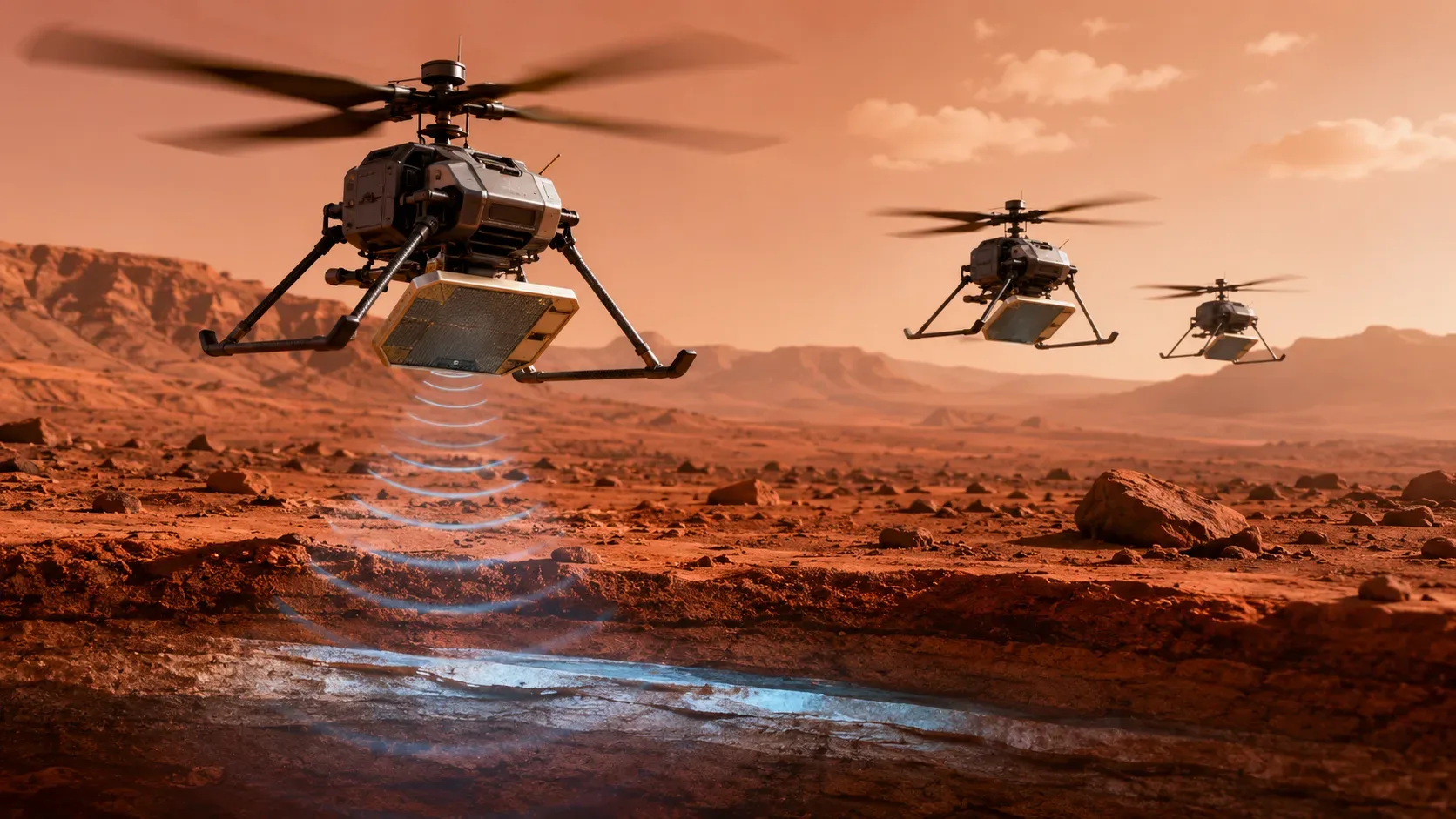
NASA announced on August 6, 2026 an advance in the development of SkyFall: a flexible and very light antenna intended for the ground-penetrating radar of future Martian helicopters underwent a test campaign at the Jet Propulsion Laboratory (JPL).
This doesn't mean that three new helicopters are already flying over Mars. SkyFall officially appears as a future mission. NASA is currently working with a three-aircraft plan, scheduled for launch in late 2028 and arrival on the Martian surface in the second half of 2030. The landing site has not yet been chosen, and important components continue to be developed and qualified.
The scientific interest is in a swath of the planet that is difficult to study in detail from orbit: the first few meters below ground. It is precisely there that accessible deposits of water ice can store information about the climate history of Mars and, in the future, serve as a resource for human missions.
What exactly did NASA test
The highlight of the August announcement was not a complete helicopter nor the entire radar, but the radar antenna.
The instrument planned for SkyFall needs to emit and receive radio waves while the aircraft flies close to the terrain. The problem is physical: a conventional antenna suitable for the chosen frequencies would be too large to fit safely under such a small Martian helicopter.
According to NASA, the minimum distance between the bottom of the fuselage and the ground is only about 15 centimeters. A conventional antenna for this range could be approximately 48 centimeters long. The solution chosen was a Vivaldi-type antenna, which can be produced in flat and flexible materials and operates over a wide range of frequencies.
The team built the antenna with metallized fabric, polyester and layers of Vectran, a resistant material also used in the airbag systems of the Spirit and Opportunity missions. Flexible fiberglass springs help it regain shape after the antenna bends, while a small magnesium frame holds it in place.
The entire set weighs approximately 150 grams.
Flexibility is necessary because the antenna will be below the helicopter. It needs to fold if it touches the ground or a rock during landing and return to the correct position when the aircraft takes off again.
In tests released on August 6, the prototype was subjected to thermal variations, repeated bending and radio frequency assessments. NASA says the antenna has withstood the equivalent of 200 Martian landings without loss of performance, more than double what was needed for the planned primary mission.
Still, there's an important difference between getting through this campaign and being ready for Mars. The team itself reports that the antenna is not yet fully qualified for flight. The next engineering model must face, among other procedures, vibration tests, operation in a simulated Martian environment and external evaluations at JPL's Mars Yard.
Why look for ice flying close to the ground
Mars has already had underground ice deposits identified or estimated by different missions and methods. The SWIM project, for example, combines data from multiple probes to map where water ice may exist relatively close to the surface, especially at mid-latitudes considered interesting for future human exploration.
The problem is transforming a regional map into something detailed enough to answer questions like: where does the ice start? How thick is the layer of dust and rock that covers it? Does the deposit continue for hundreds of meters horizontally or disappear just beyond?
Orbital radars are excellent for investigating deep and extensive structures, but they have resolution limitations near the surface. SHARAD, installed on the Mars Reconnaissance Orbiter, for example, was designed for large-scale surveys and has a nominal vertical resolution of about 15 meters in free space.
The radar planned for SkyFall works with another strategy. Flying low, it will be aimed at the first few meters underground. The mission's official page reports a nominal ice detection range between approximately 0.5 and 3 meters deep, with the possibility of reaching deeper in favorable conditions.
A study published in March 2026 in the Journal of Geophysical Research: Planets reinforces this logic. Researchers tested drone-mounted radar over land-based glaciers used as analogues of Martian deposits and were able to resolve shallow layers that orbital instruments like SHARAD cannot directly distinguish. The study is not a test of SkyFall, but it offers independent confirmation of the scientific utility of bringing radar much closer to the ground.
How radar can reveal hidden ice
A ground-penetrating radar sends electromagnetic waves toward the surface and records some of the energy that returns.
When the wave passes through materials with different electrical properties — for example, layers of regolith, rock and ice — part of the signal can be reflected at the interface between these layers. The return time, intensity and other characteristics of the echo help reconstruct the structure beneath the ground.
This requires interpretation. The radar does not function as a “water molecule detector” that simply lights up when it encounters ice. Scientists analyze the echoes along with models of the materials' dielectric properties and other available data to determine which composition is compatible with the observed signal. Laboratory studies with mixtures of simulated Martian regolith and ice show precisely how these properties can be used in the interpretation of radar soundings.
In SkyFall, NASA intends to use a very wide band, from 500 to 2,500 megahertz. Lower frequencies, with longer wavelengths, favor greater penetration; higher ones help distinguish finer details in layers close to the surface.
The idea is to combine this information with visible and infrared images obtained by the helicopters themselves. Therefore, the underground map will not be analyzed in isolation from what exists on the surface.
Why is Martian ice so interesting
There are two main reasons, and they meet in SkyFall.
The first is scientific. Layers of ice, dust and sediment can preserve records of different environmental conditions. Determining the depth and extent of the ice helps reconstruct how water, atmosphere and climate have changed throughout Mars' history. NASA itself places climate research among the mission's scientific objectives.
The second reason is operational. Water is heavy to transport from Earth. An accessible deposit on Mars could, in principle, provide drinking water and raw materials to produce other resources, including oxygen and components needed to make propellant.
This is why it is not enough to know that “there is ice on Mars”. For human exploration, it is important to discover where there is accessible ice, at what depth and under what type of terrain. The SWIM project maps are already produced with this concern: finding regions that reconcile the probable presence of ice and less extreme conditions for landing and operation.
Why three helicopters
The official SkyFall architecture envisions three aircraft derived from the Ingenuity experiment. During arrival on Mars, they must be released while still in the air and land individually, instead of depending on a conventional landing module. Afterwards, they will be able to disperse throughout the exploration region.
This configuration allows you to distribute observations along different trajectories. NASA currently estimates that a single helicopter can travel about 1 to 2 kilometers during a flight lasting approximately two and a half minutes, collecting information from the surface and underground. Mission documentation shows the three aircraft departing the drop zone in different directions.
In addition, helicopters are planned to independently transmit data to spacecraft orbiting Mars. It's a change from Ingenuity, which relied on the Perseverance rover as a communications intermediate station.
There is, however, a limit to what the available documentation allows us to say: the pages consulted explain how the three helicopters can disperse and expand the mapping, but they do not present a study demonstrating that three is a scientifically optimal or minimum number. Therefore, attributing the quantity specifically to “redundancy” or a coverage formula would go beyond what NASA has published thus far.
SkyFall is heir to Ingenuity, but has another role
Ingenuity was initially shipped as a technology demonstration. Its objective was to prove that powered and controlled flight was possible in the extremely rarefied atmosphere of Mars. It ended up carrying out 72 flights before its mission came to an end in January 2024.
SkyFall starts from this experience, but is thought of as a much more instrumented scientific platform. Each aircraft must carry radar, cameras and environmental sensors, in addition to its own communication resources.
This leap explains why reducing mass remains so important. On Mars, each added instrument needs to be carried by rotors operating in an atmosphere much less dense than Earth's. Saving hundreds of grams on a part like the antenna opens up space to transform a helicopter that previously only demonstrated the possibility of flying into a vehicle capable of carrying out science during flight.
What the August test really changes
The test released by NASA solves a concrete engineering question: can an antenna large enough to make radar work be light, flexible, survive successive landings and continue transmitting and receiving signals properly?
The prototype has passed this step.
However, hardware qualification, integration, additional tests and all mission development still remain. On August 7, 2026, SkyFall should be understood as a future mission in development, with launch currently scheduled for the end of 2028 and arrival planned for 2030 — not as a fleet of three helicopters already searching for ice on the red planet.
The interest of the concept lies precisely in filling a gap between two ways of exploring Mars: orbiters can indicate large promising regions; ground vehicles observe very specific locations. A small, low-flying fleet with radar could quickly map the space between these two scales and show where the surface layer hides ice, rock or dangerous structures.