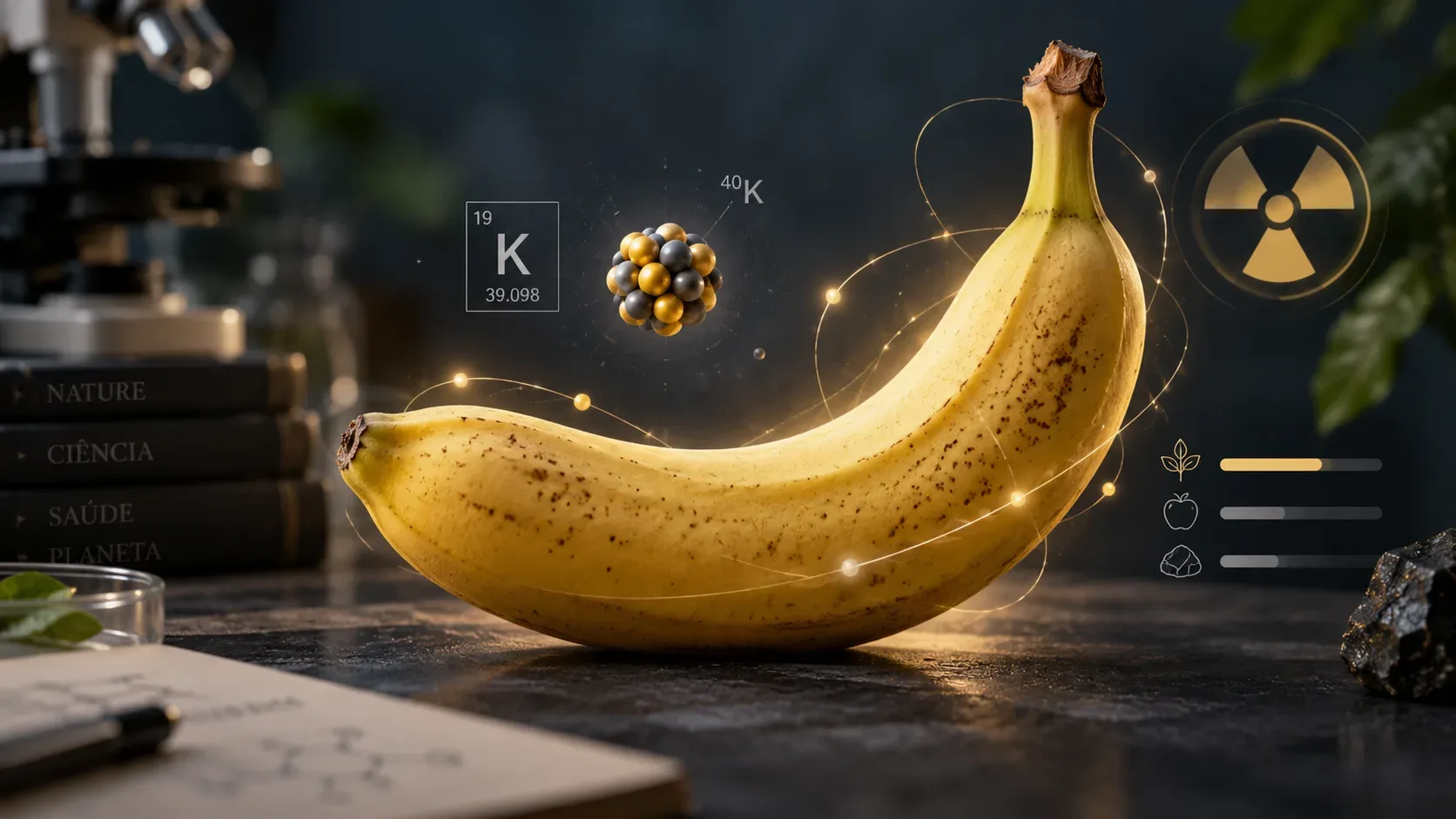
Yes: a banana is, technically, radioactive. That is because it contains potassium, and a tiny fraction of natural potassium is the radioactive isotope potassium-40 (40K). The important part comes next: “radioactive” does not, by itself, mean “dangerous.” The activity is small, potassium is an essential nutrient, and the body regulates its amount quite efficiently.
That is exactly why the so-called banana equivalent dose is useful and, at the same time, easy to misunderstand. It turns a very small dose into a familiar comparison, but it can falsely suggest that every banana adds a permanent parcel of radiation to the body.
What is radioactive in a banana?
Natural potassium is made of different isotopes. One of them is 40K, present in a very small proportion but enough to produce measurable activity. Because potassium is found in many foods and in the human body itself, 40K is part of everyday natural radioactivity.
The U.S. Nuclear Regulatory Commission (NRC) lists bananas at about 3,520 picocuries of 40K per kilogram, or roughly 130 becquerels per kilogram. For an average-sized banana, the order of magnitude is about 15 Bq, a value also used by the University of Groningen Academy for Radiation Protection.
The key point is that becquerel measures activity, not dose. One becquerel means one nuclear decay per second. That number describes what the source is doing; by itself, it does not tell you how much energy the body absorbs or what the biological effect will be.
Activity and dose are not the same thing
| Concept | Unit | What it answers | Banana reference | Limit of the comparison |
|---|---|---|---|---|
| Activity | Bq | How many decays occur per second | About 15 Bq per average banana | Does not tell you the dose absorbed by the body |
| Activity by mass | Bq/kg | How much radioactive activity is present in a mass of food | About 130 Bq/kg of 40K, based on the NRC value | The actual value varies with mass and composition |
| Effective dose | Sv, usually μSv or mSv for small exposures | Relates deposited energy to its radiological significance | The EPA uses about 0.1 μSv for one banana | It is a comparison model, not a permanent “load” in the body |
| Environmental comparison | Order of magnitude | Helps visualize a very small dose | The EPA compares about 100 bananas with one day of natural radiation in the U.S. | It does not mean eating 100 bananas is biologically identical to that environmental exposure |
The distinction also appears in the NRC explanation of radiation measurements: activity units such as curie or becquerel describe the source, while dose units such as rem or sievert deal with energy deposited in tissue and its radiological significance.
Where does the “banana equivalent dose” come from?
The U.S. Environmental Protection Agency (EPA) states that eating one banana corresponds to a total dose on the order of 0.01 millirem, or 0.1 microsievert (μSv). That is the basis for the popular “banana equivalent” comparison.
As a communication tool, the idea works because it converts otherwise abstract numbers into an everyday scale. The EPA also notes that it would take roughly 100 bananas to reach the same order of magnitude as the radiation exposure a person receives in one day from natural background in the United States.
That comparison answers a specific question: “How small is this dose?” It should not automatically be turned into another question: “How many bananas stay accumulated inside my body?”
Where the analogy helps
- It gives scale to very small numbers. For readers unfamiliar with microsieverts, an everyday reference makes the order of magnitude easier to grasp.
- It shows that natural radioactivity exists outside nuclear plants and medical equipment. Soil, water, food and the human body all contain naturally occurring radionuclides.
- It helps separate detectable radioactivity from meaningful dose. A measurable activity does not automatically imply a high dose.
Where the analogy fails
The main problem is biological. The body keeps its potassium content within a relatively stable range. When intake rises, metabolic and renal mechanisms adjust potassium excretion. Because 40K accompanies natural potassium, it participates in the same balance.
A report from the International Atomic Energy Agency (IAEA) summarizes the point: potassium absorption — and therefore 40K absorption — is controlled by metabolic processes, and the internal contribution of 40K is treated as a naturally occurring exposure that is essentially regulated by the body.
This means it is not accurate to imagine banana doses as a stack that grows forever. Multiplying “0.1 μSv per banana” can be useful as an arithmetic comparison, but it does not faithfully describe long-term potassium retention in the body.
The University of Groningen treats the BED as an informal unit and notes that eating bananas hardly changes the real committed dose in the same way implied by the simplified calculation, precisely because excess potassium is excreted.
Four common mistakes when using “banana equivalents”
- Confusing activity with dose. Fifteen becquerels are not fifteen microsieverts. The units measure different things.
- Adding bananas as if all the 40K stayed in the body. Potassium homeostasis makes that interpretation misleading.
- Using BED as an official radiological-protection unit. It is a teaching analogy, not a formal unit.
- Treating every exposure as biologically identical. External dose, ingested radionuclides, medical imaging and background radiation differ in geometry, duration and distribution.
Is a radioactive banana a food-safety problem?
Not in the sense usually implied by the word “radioactive.” The EPA states that the small amounts of naturally occurring radionuclides found in foods such as bananas do not pose a radiation risk under normal consumption conditions.
It is also important not to confuse natural radioactivity in food with food irradiation. Irradiation is an industrial process that uses ionizing radiation to reduce microorganisms and pests; it does not make the food itself radioactive. A banana's radioactivity, by contrast, comes from naturally occurring isotopes already present in its composition.
So what is the best way to interpret the banana equivalent?
Use the banana as an order-of-magnitude ruler, not as a biological counter. It is excellent for showing that 0.1 μSv is an extremely small dose and for introducing the difference between a source being measurably radioactive and representing a meaningful exposure.
But when the comparison becomes “this many bananas = exactly this much risk” or “every banana adds 0.1 μSv forever,” it goes beyond what the analogy can support. The most useful takeaway is twofold: yes, bananas have measurable natural radioactivity; no, that does not mean the dose accumulates linearly in the body with every banana eaten.