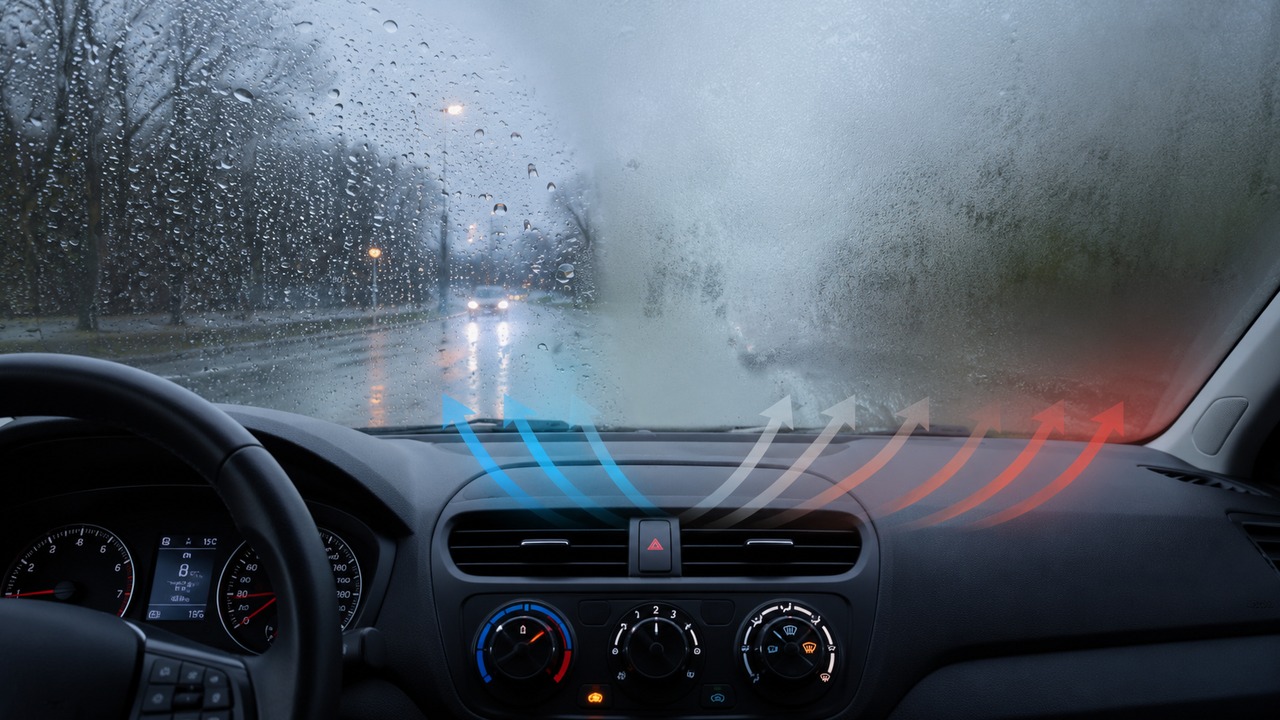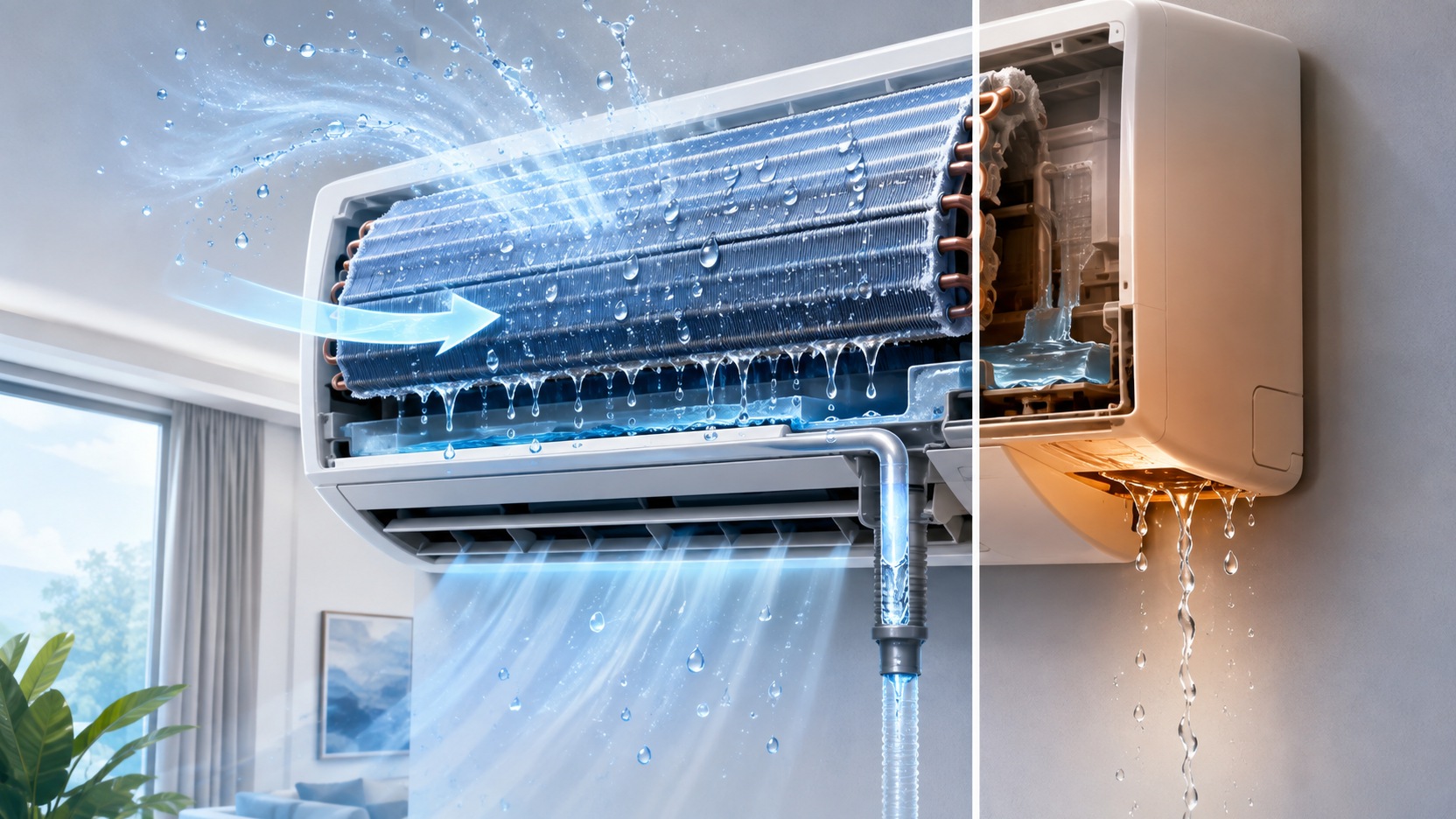
The water that comes out of an air conditioner is not produced by the device nor does it come from an internal reservoir. It was already in the environment, in the form of water vapor. When moist air passes through the indoor unit and encounters the cold evaporator coil, some of that moisture condenses into droplets. The equipment design foresees that these drops fall into a tray and follow a drain. Therefore, water coming out of the correct drainage point can be perfectly normal; Water dripping from the front, sides or into the room is not the expected path and deserves attention.
The water was already in the air before it appeared as a drop
Even when the environment appears dry, the air contains some amount of water vapor. This vapor is invisible. For it to go into a liquid state, it is enough for the air or a surface to enter a condition in which that amount of vapor can no longer remain entirely in the gaseous phase.
That's where the dew point comes in. It is the temperature at which, for a given amount of moisture in the air, condensation begins to occur. The principle is the same as water appearing on the outside of a very cold bottle: the bottle is not leaking. Its surface cools the air immediately around it until the vapor turns into small droplets.
In air conditioning, the cold surface equivalent to the bottle is the evaporator. The fan makes the air in the room pass through this coil. If parts of the surface are below the dew point of the incoming air, moisture settles there and forms condensate.
The evaporator does not just remove temperature
When we think about air conditioning, it is natural to just imagine reducing the air temperature. But cooling a humid environment has two important components. One is sensible heat, associated with the drop in temperature. The other is latent heat, associated with the phase change of water from vapor to liquid.
By condensing moisture on the coil, the system is also removing moisture from the air. This is why a device in cooling mode usually leaves the environment less humid while it works. Technically, part of the cooling capacity is being used in removing moisture, not just lowering the number shown on the thermometer.
This also explains why the amount of water does not just depend on the power of the device. It varies with air humidity, temperature and dew point, operating time, environmental thermal load, air flow and the conditions of the coil itself. Two similar appliances can produce very different volumes of condensate on different days without malfunction.
A lot of water in the drain could be normal
In hot and humid periods, the air that reaches the evaporator carries more moisture available to condense. If the equipment runs longer, a greater amount of air passes through the coil. The result can be a visible, continuous flow into the drain.
Therefore, there is no single volume of water that, in isolation, separates normal functioning from a problem. A very active drain on a muggy afternoon may be consistent with the ambient conditions. In drier climates, using the same appliance and at the same temperature setting, drainage may decrease significantly.
The place where the water appears is a more useful indicator than the simple impression that “a lot of water is coming out”. If it is being collected and carried through the planned drainage system, the phenomenon is exactly what is expected from condensation. If it starts to escape into the room, the problem stops being the existence of the condensate and becomes the path it is taking.
Wet drain and device dripping inside are different situations
In an installation working as expected, the drops formed in the evaporator descend to the condensate tray and follow through the drain hose or piping. Seeing water coming out of the end of this drain during refrigeration, especially on humid days, is consistent with normal operation.
Drip from the air outlet, the fairing or the wall next to the internal unit indicates that the water is not being drained as it should. Possible causes include obstructions or kinks in the drainage path, installation problems that impair drainage, and conditions that cause condensate to escape from the tray. Manufacturers also point out that a very dirty filter can contribute to condensation and leaks in the internal unit by impairing air flow.
The presence of water, in itself, does not mean a refrigerant leak. Condensate belongs to the air side: it is ambient humidity that has changed phase when touching cold surfaces. The refrigerant circulates in a separate circuit, within the system piping.
Why does drainage change from day to day
A device can run for weeks without the user noticing a large amount of water and then suddenly start draining much more in a humid period. This is not contradictory. The air temperature and humidity change from one day to the next, altering the dew point and the amount of vapor that can turn into liquid on the coil.
This effect also helps explain why the same setting on the remote control does not always produce the same amount of condensate. The thermostat reports a target temperature, but does not fix the amount of water present in the air. The more humid the air entering the unit and the longer the coil remains cold, the greater the opportunity for condensation.
On the other hand, a persistent change in drip location is more important than a seasonal change in drain volume. If the water previously only came out through the external drainage and starts to appear inside the room, it is worth treating this as a sign of an abnormality, even if the device continues to cool.
Why is there talk of latent heat removal
Transforming water vapor into liquid involves energy. During condensation, latent heat is released, and the refrigeration system needs to transport this energy along with the heat removed from the air. This is why, in air conditioning engineering, cooling capacity can be separated into a sensitive portion, linked to temperature, and a latent portion, linked to moisture removal.
For the user, the practical consequence is simple: part of the air conditioning's “work” on a humid day is occurring without appearing directly as a large additional drop in temperature. The device may be removing water from the air and taking this water to the drain. Condensate is therefore visible evidence of a part of the air conditioning process that normally takes place without attracting attention.
When dripping deserves evaluation
If the water is leaving the intended drain and not returning to the environment, there is no reason to consider the condensation itself a failure. The situation changes when the indoor unit drips onto the floor, furniture or wall, when water appears in places where it did not appear before or when the expected flow through the drain appears to have stopped at the same time that a leak appears inside the room.
In these cases, it is not necessary to disassemble the device to conclude that the drainage has stopped following the normal path. As water inside the environment can damage finishes, furniture and parts of the equipment itself, manufacturers advise stopping use if there is a leak from the internal unit and requesting inspection when the problem cannot be resolved by a simple check of the external drainage.
The central distinction is this: producing condensate is a normal part of refrigeration; dumping this condensate into the environment is not. The water in the drain shows that the moisture taken from the air has found its intended outlet. The water in front of the device shows that something diverted this path.