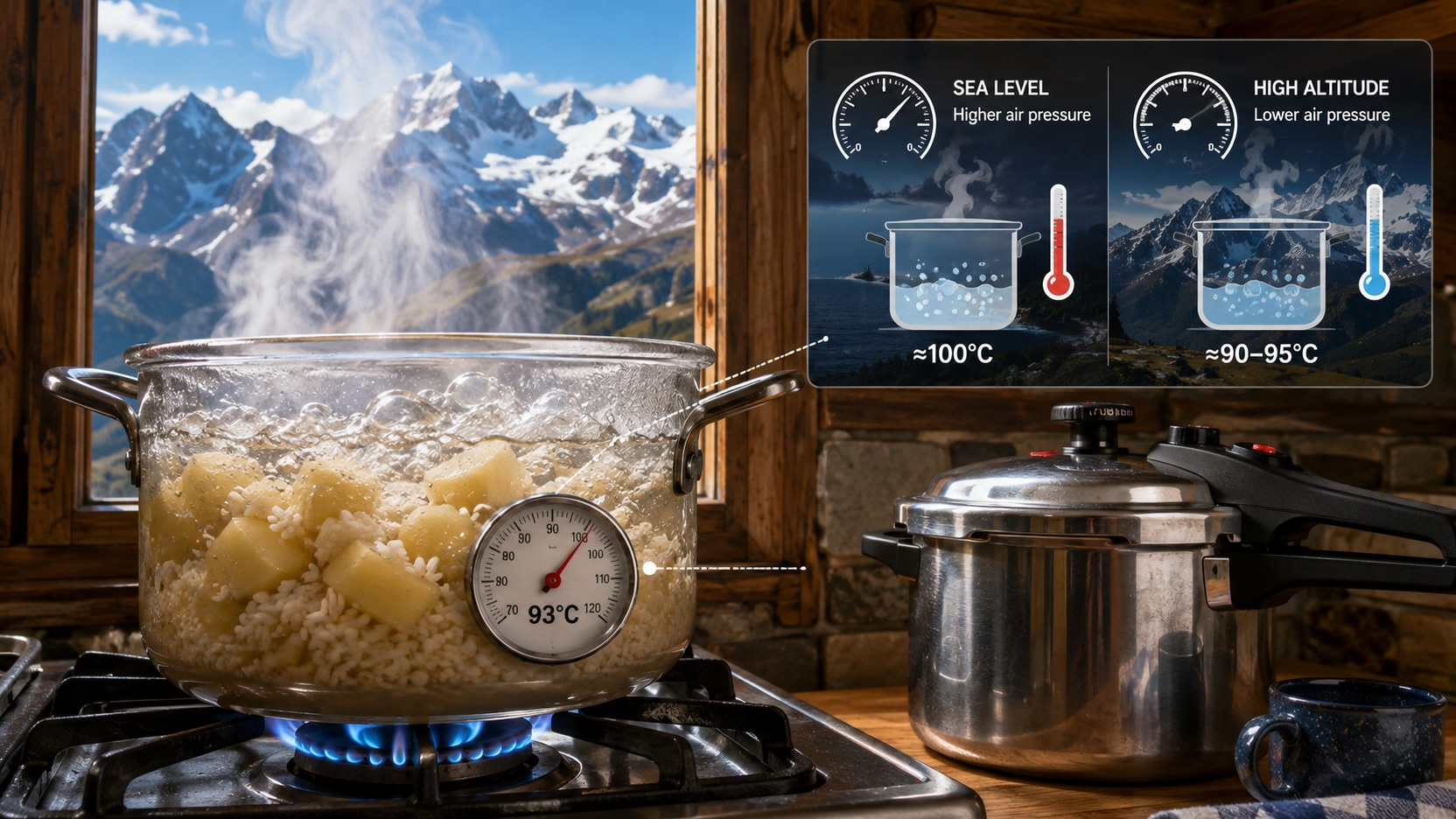
The contradiction is only apparent. In high places, water may start to boil earlier because the atmospheric pressure is lower and, therefore, the boiling point drops. But this boiling water is also colder than it would be at sea level. For food, it is the actual temperature of the cooking medium that matters, not the presence of bubbles.
Boiling does not always mean reaching 100°C
Water boils when the vapor pressure it produces becomes sufficient to overcome the pressure exerted on the liquid. In an open pan, this external pressure is essentially atmospheric pressure.
At sea level, the average pressure is high enough for pure water to boil at close to 100°C. Climb a mountain and the column of air above you gets smaller. With less atmospheric pressure, vapor bubbles are able to form and escape at a lower temperature.
This changes the intuitive idea that "boiling" is synonymous with "being at 100 °C". One hundred degrees Celsius is a reference linked to a specific pressure, not a universal boiling temperature.
What altitude does to boiling point
The decline is gradual. A practical reference gives approximately 100°C at sea level, 98°C around 600 meters, 95°C around 1,500 meters, 92°C around 2,300 meters and 89 to 90°C around 3,000 meters above sea level.
These values are approximate because atmospheric pressure also varies over time and local conditions. The composition of the liquid interferes a little, and the amount of salt or sugar dissolved can shift the boiling point. Still, for everyday cooking, altitude is one of the most important causes of this difference.
So why does the water seem to boil sooner?
Imagine two identical pans, with the same amount of water at 20 °C and receiving the same power from the stove. At sea level, water needs to reach close to 100°C to boil. In a place where it boils at 95°C, the heat needs to travel about five degrees less.
Therefore, under similar conditions, the pan can reach boiling in less time. The difference observed in practice depends on water volume, burner power, pan material, use of lid, initial temperature and heat loss to the environment.
The bottom line is that the "shortcut" ends when the water starts to boil. It reached its local limit earlier precisely because that limit is lower.
After it boils, more heat doesn't make the water much hotter
In an open pan with approximately constant pressure, the water temperature remains close to the boiling point as long as there is liquid. The extra energy provided by the stove mainly supports vaporization: more molecules escape as steam and the boiling becomes more intense.
Increasing the heat can be useful to restore the boil after adding cold ingredients or to compensate for heat losses. But once the boil is steady, turning a moderate bubbling into a bubble storm doesn't make the water jump from 95°C to 100°C. To truly raise the boiling temperature, you need to change the pressure or composition of the liquid.
Why food takes longer to cook
Cooking involves heat transfer and physical and chemical transformations within the food. Grains absorb water and soften, starches gelatinize, vegetable fibers lose rigidity and proteins change structure. In many of these processes, a few degrees less makes a difference in speed.
If the liquid surrounding the food is boiling at 95°C instead of 100°C, the food receives heat from a cooler medium. It continues cooking, but temperature-dependent transformations tend to progress more slowly.
This is why beans, legumes, eggs, soups, stews, and meats cooked by soaking or gently boiling may need more time at high altitudes. Just because the pot is bubbling vigorously does not mean that the contents are receiving the same temperature as they would at sea level.
A small difference in temperature can produce a large difference in time
Five or ten degrees seem little when seen on the thermometer, but the accumulated effect during preparation can be noticeable. The speed of many transformations increases with temperature, and a thick food still needs to conduct heat from the surface to the interior.
So the effect is not a simple rule like "five degrees less means five percent more time". Each food responds in a different way. An egg, a dried bean, a potato and a piece of meat have different structures, sizes and cooking mechanisms.
The best way to think of it is this: altitude lowers the temperature ceiling of an open pan of water. The more the result depends on long moist cooking, the more this lower ceiling may appear on the clock.
The common lid helps, but it doesn't turn the pan into a pressure cooker
Placing a lid reduces heat and steam loss into the environment. This can bring the water to a boil more quickly, save energy, and decrease evaporation during long cooking.
But a common lid is not sealed to maintain an internal pressure well above atmospheric pressure. Steam escapes through the gaps, and the pressure inside the pan remains close to the ambient pressure. The boiling point therefore changes very little.
The pressure cooker changes the rules of the game
The pressure cooker does exactly what altitude does: it increases the pressure around the water. As the container is sealed and controls the escape of steam, the internal pressure rises above atmospheric pressure.
With a higher pressure, vapor bubbles can only form in a sustained manner at a higher temperature. The water and steam inside the pan can then exceed 100 °C, depending on the design and operating pressure of the equipment.
This is the physical reason why the pressure cooker speeds up the preparation of beans, grains, meats and other foods that accept moist heat. It doesn't magically "push" heat into the food; it allows the cooking medium to operate at a higher temperature.
At altitude, the pressure cooker remains an especially useful tool, but the exact time may need to be adjusted depending on the model and elevation. The equipment manual is a
correct reference for this detail.
The paradox disappears when you separate two questions
The first question is: at what temperature does water start to boil? This answer depends on the pressure. At altitude, lower atmospheric pressure reduces the temperature required for boiling.
The second is: at what temperature is the food being cooked? In an open pan, it is limited by the temperature of the surrounding liquid. If water boils at a lower temperature, wet cooking takes place in a cooler environment and tends to take longer.
Therefore, both sentences can be true at the same time: at altitude, water boils earlier because it needs to heat up less; and the food cooks more slowly because that boiling water is colder. The pressure cooker solves precisely this difference by raising the pressure again and, with it, the boiling point.