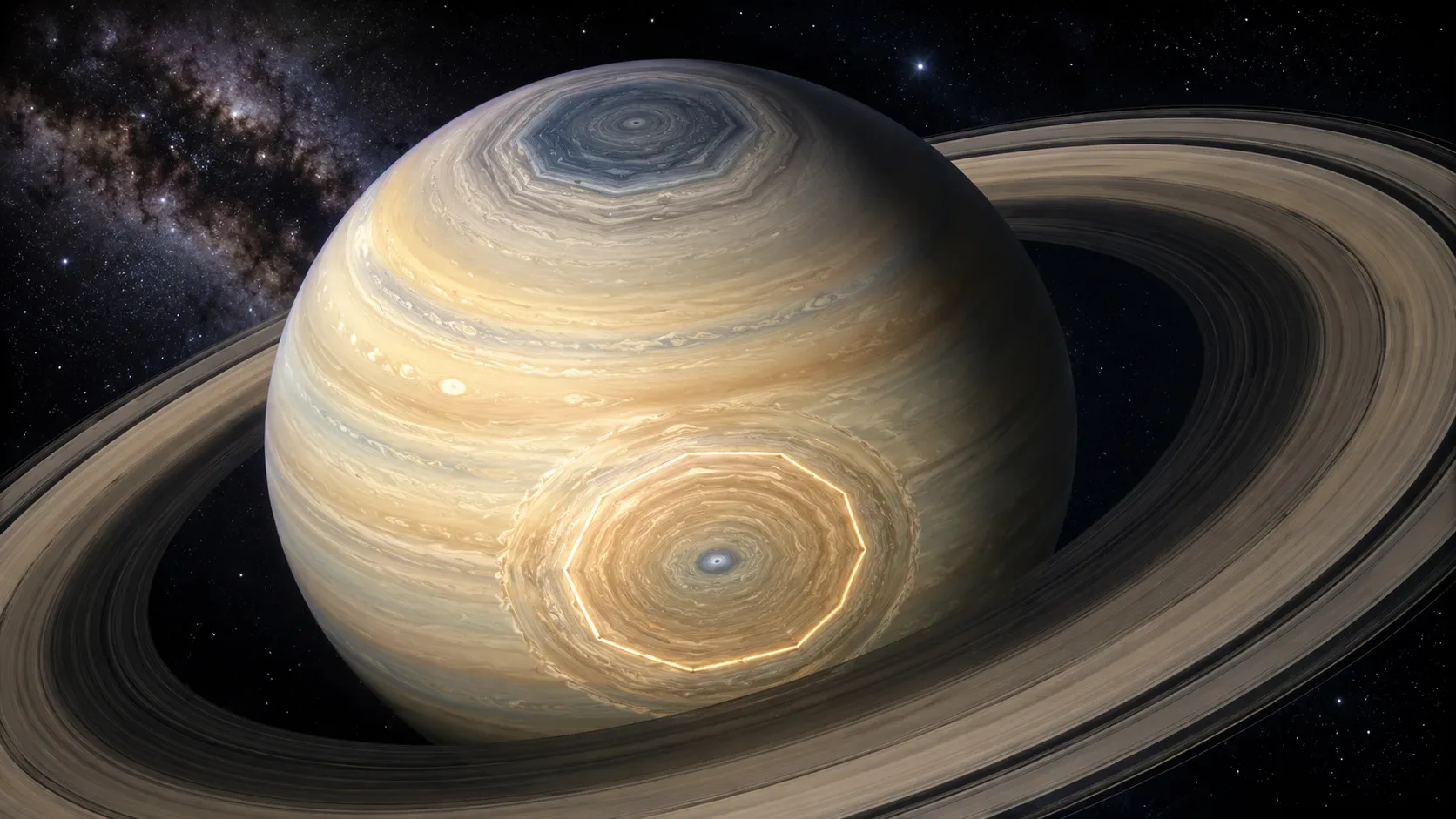
Hubble did not find a solid ten-sided object on Saturn. What appears in the data is a ten-sided atmospheric wave, a decagon, encircling the planet’s south pole and embedded in a jet stream. NASA and ESA announced the discovery on September 2, 2026, after researchers combined Hubble observations with images taken from Earth. The result is striking because Saturn is already famous for another polygonal structure: the six-sided hexagon that has surrounded its north pole for decades.
The visual similarity, however, does not mean the two phenomena are equivalent. The southern decagon appears recent and is still evolving; the northern hexagon is a persistent structure repeatedly observed for more than 40 years. That difference is precisely what makes the new discovery valuable for studying how waves and jet streams organize themselves in the atmosphere of a gas giant.
What Hubble found at Saturn’s south pole
According to NASA’s science release, recent Hubble images revealed a large atmospheric wave with ten regular sides around the south pole. It is the first large regular-sided jet pattern of this kind observed in Saturn’s southern hemisphere.
The discovery did not come from a single photograph. The OPAL program (Outer Planet Atmospheres Legacy), which regularly images the giant planets with Hubble, allowed researchers to reconstruct the pattern’s evolution. Telescope data show hints of the structure going back to 2023. In 2024, ground-based images drew attention to an undulating band near the south pole, and 2025 observations strengthened the interpretation that a decagon was present.
The single-filter image published by NASA makes the ten-sided outline especially clear. NASA also emphasizes that the pattern is not merely a marking in the uppermost clouds: the wave appears at different wavelengths, which probe different altitudes, indicating a structure that extends vertically through multiple atmospheric layers.
A decagon does not mean a geometric “wall”
On a gaseous planet like Saturn, the polygonal outline is produced by atmospheric motion. The decagon is embedded in one of the planet’s strong jet streams. Its sides therefore correspond to an organized wave in the atmospheric flow, not to a rigid surface.
It is also important not to read small positional differences between images as evidence that the feature is “falling apart.” Hubble observes Saturn at several wavelengths, and each band of light reveals different levels of the atmosphere. As a result, the apparent position of the wave can shift slightly from one image to another.
South-polar decagon vs. north-polar hexagon: the main differences
| Aspect | South-polar decagon | North-polar hexagon |
|---|---|---|
| Observed shape | A wave with 10 sides. | A wavy jet stream with 6 sides. |
| Observation history | Hubble confirms hints since 2023; the pattern became clearer in later observations. | Observed for more than 40 years, since the Voyager era, and studied in detail by Cassini. |
| Current state | Appears to be strengthening and may still be forming or reorganizing. | Known for its long-term persistence. |
| Relation to jets | Embedded in a powerful jet stream and extends through multiple atmospheric layers. | A six-sided jet stream; NASA has described it as roughly 30,000 km across with winds around 200 mph. |
| Earlier southern counterpart | No long-lived structure of this kind had been identified in earlier observations. | Served as the reference pattern in the long search for an equivalent southern feature. |
The historical contrast is particularly important. The team had searched for decades for a southern counterpart to the hexagon. Images from the Cassini spacecraft, which orbited Saturn from 2004 to 2017, showed no sign of a long-lived southern formation of this kind. That strengthens the case that the decagon now being observed may be relatively new rather than an old structure that was simply hidden.
For comparison, NASA described the northern hexagon as a six-sided jet stream about 30,000 kilometers across with winds of roughly 200 miles per hour. Its persistence over decades is one reason it has become a classic case in studies of Saturn’s atmospheric dynamics.
Saturn’s seasons helped reveal the south — but they do not explain the origin
Saturn has long seasons, and the lighting and viewing geometry of its poles changes over the course of its orbit. The recent improvement in visibility of the southern hemisphere helped astronomers on Earth and Hubble follow the polar region more effectively. That explains why the decagon could be observed better now, but it does not prove that seasonal change physically caused the feature to form.
The distinction matters: one issue is the condition that made the phenomenon visible; another is the mechanism that created or strengthened the wave. The research team says it still does not know why the pattern appeared now, why it has ten sides, or how long it will last.
What is evidence and what remains a hypothesis
- Observed: a ten-sided wave exists around Saturn’s south pole.
- Observed: Hubble data trace hints of the structure back to 2023, and the pattern became more distinct in later observations.
- Observed: the decagon is associated with a jet stream and appears across different atmospheric levels.
- Observed: Cassini did not record a comparable long-lived southern counterpart during its Saturn mission.
- Still open: which instability or combination of atmospheric conditions produced the ten-sided wave.
- Still open: whether the decagon will stabilize and persist for decades like the northern hexagon or instead transform and disappear.
- Still open: whether the dominant physical mechanism is essentially the same as the hexagon’s or merely produces a similar-looking shape.
Why continued Hubble and Webb observations will matter
The scientific value of the discovery lies less in a single image than in the ability to follow the feature’s evolution. OPAL provides a regular time series, which helps distinguish a transient feature from a long-lived atmospheric organization. NASA and ESA say new Hubble observations, James Webb Space Telescope data and computer simulations will be used to test how the wave forms and changes over time.
The ESA/Hubble release emphasizes that the next goal is to determine whether the decagon settles into a stable configuration like the northern hexagon or continues to evolve. The scientific study was published in Science Advances under the title A decagon wave around Saturn's south pole.
What the discovery changes about our view of Saturn
The new decagon shows that Saturn’s atmospheric geometry may be more varied and dynamic than the existence of a single northern hexagon suggested. There is now evidence for another large-scale polygonal pattern in the opposite hemisphere, but with a different number of sides and apparently different behavior over time.
For now, the safest conclusion is straightforward: Saturn has a ten-sided atmospheric wave at its south pole, but scientists are still watching its development and trying to explain its origin. Comparing it with the northern hexagon helps frame the right questions, but it is still too early to claim that both phenomena have the same cause or the same longevity.