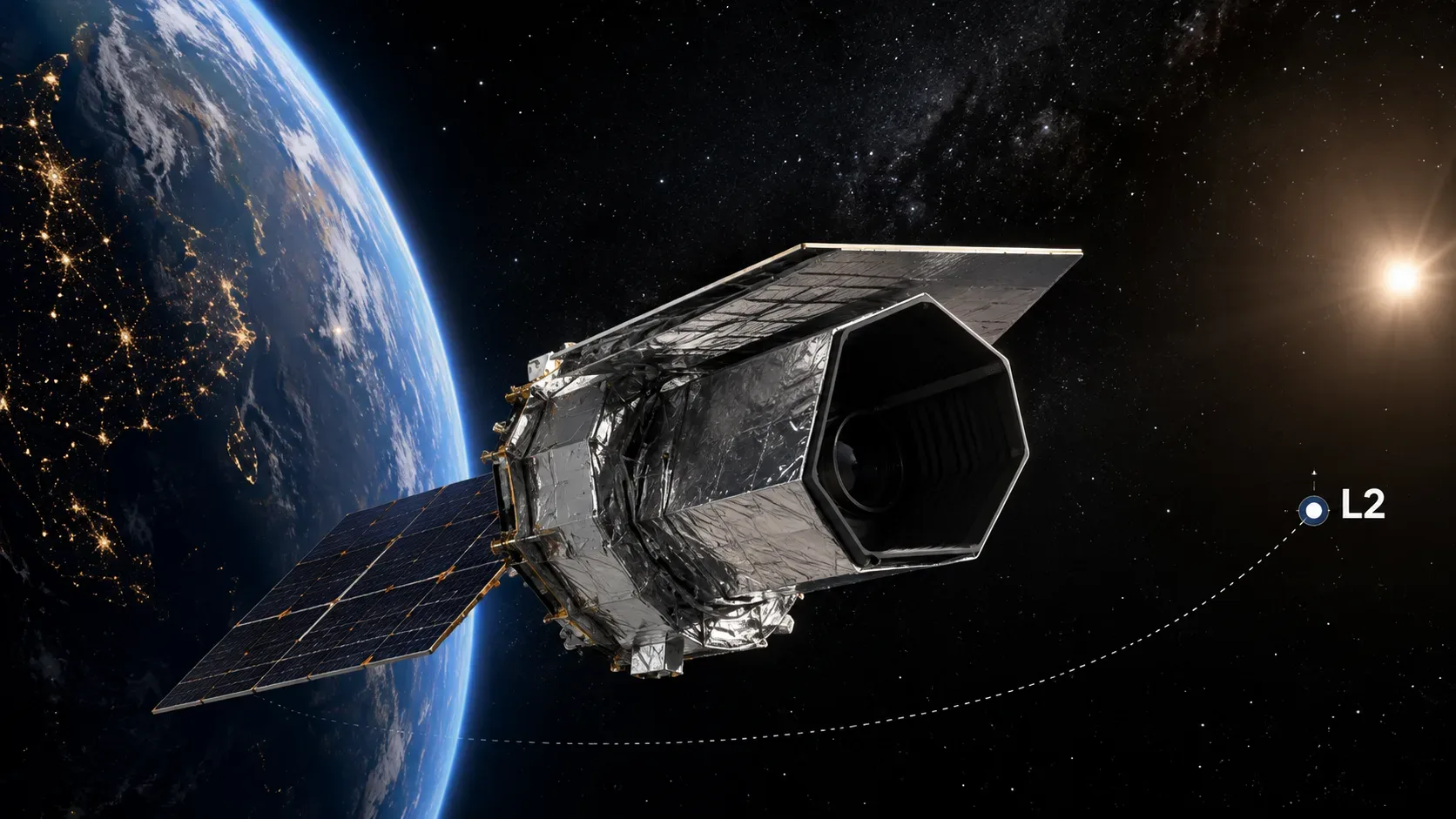
NASA’s Nancy Grace Roman Space Telescope launched on August 30, 2026, at 7:26 a.m. EDT aboard a Falcon Heavy. Launch, however, is only the start of an approximately three-month phase in which the team must turn an observatory fresh from the rocket into a calibrated scientific instrument ready for operations. NASA calls this phase commissioning: systems are powered on, adjusted, tested, and calibrated while Roman travels toward the second Sun-Earth Lagrange point, L2.
For anyone following the mission, the key is to separate three things: the trip to L2, commissioning of the observatory and instruments, and the release of the first images. NASA expects the first images in early 2027, while noting that the schedule can change as the team evaluates the observatory’s in-flight performance.
What has happened since launch
Roman lifted off from Kennedy Space Center in Florida and separated from the rocket’s upper stage about half an hour later. From that point, flight operations and commissioning began. NASA said the observatory started a roughly one-million-mile journey toward the second Sun-Earth Lagrange point, L2. NASA’s launch release describes this phase as an approximately three-month journey.
Several major milestones were completed in the first days. On August 31, Roman performed its first mid-course correction, an approximately three-minute burn to refine its path to L2. The team then confirmed deployment of the high-gain antenna and the visor-like cover that helps shield the telescope from unwanted light. On September 1, the Coronagraph Instrument powered on successfully.
What “commissioning” means for Roman
Commissioning a space telescope is not simply checking whether it turns on. It is a preparation process in which engineers and scientists verify that the observatory behaves in flight as expected from ground testing. On Roman’s commissioning page, NASA summarizes the phase as the period when systems are powered on, adjusted, calibrated, and prepared for science operations.
This work includes deploying structures that traveled folded inside the rocket, establishing high-rate communications, stabilizing temperatures, verifying pointing and attitude control, testing the telescope, and bringing both science instruments into observing condition. The order and duration of individual activities can change as real flight data are evaluated.
Timeline: what to watch during the roughly three-month period
| Phase | What happens | Public status or reference |
|---|---|---|
| First days | Rocket separation, power, communications, structural deployments, and initial trajectory adjustments. | Launch on Aug. 30; first course correction on Aug. 31; antenna and visor confirmed deployed on Sept. 1. |
| Early weeks | Progressive activation of subsystems and instruments, plus thermal, electrical, optical, and control checks. | The coronagraph powered on Sept. 1. NASA said the Wide Field Instrument would power on a couple of weeks later, without giving an exact date in that update. |
| During the cruise | Calibrations, performance testing, pointing adjustments, and preparation for validation observations. | NASA treats all of this work as part of commissioning and notes that the schedule is subject to change. |
| Arrival in the L2 region | Insertion into a halo orbit around L2 and transition to the operational configuration. | NASA said orbital insertion is expected approximately 100 days after launch. |
| End of commissioning | Initial observations, instrument validation, and preparation for routine science. | NASA expects to release the first images in early 2027. |
Why Roman is going to L2
L2 is about one million miles from Earth, in the direction opposite the Sun. Roman will not sit motionless at a point; it will enter a halo orbit around the L2 region. For an infrared telescope, this environment offers important advantages, including improved thermal stability and a view of the sky that is less frequently interrupted by Earth.
The cruise itself is part of commissioning. NASA said that after the first course correction, a second maneuver is planned if needed. Orbital insertion is expected about 100 days after launch. Once operating around L2, Roman will require periodic station-keeping maneuvers.
When the Wide Field Instrument enters the picture
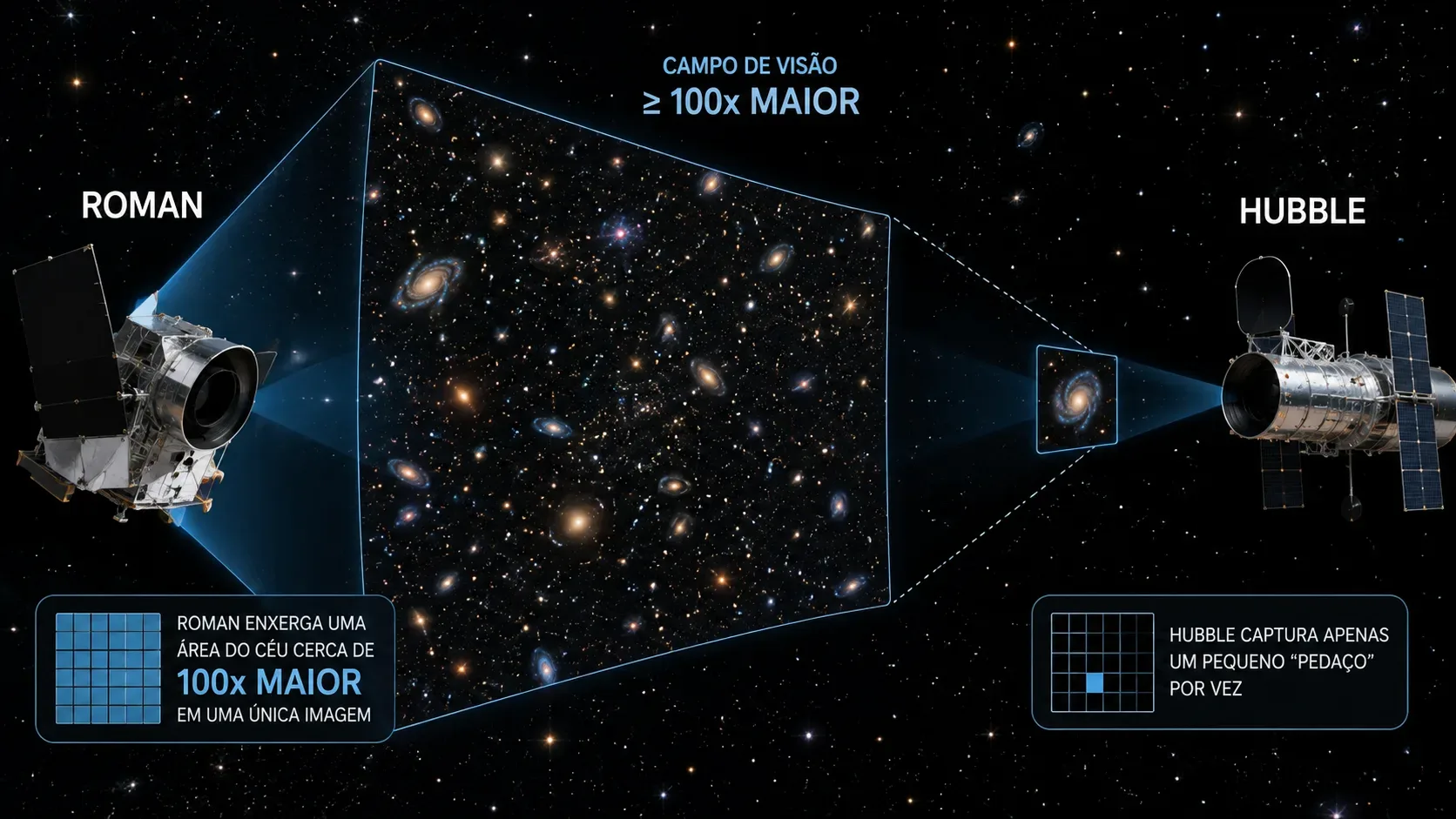
The Wide Field Instrument (WFI) is Roman’s primary science instrument. It combines high-resolution infrared imaging with a field of view far larger than Hubble’s. NASA describes the WFI as a roughly 300-megapixel camera capable of capturing, in a single exposure, a patch of sky larger than the apparent size of the full Moon. NASA’s instrument page details these capabilities.
During commissioning, powering on the WFI is only one step. It is followed by detector and electronics checks, calibrations, testing of imaging and spectroscopy modes, and measurements that characterize the system’s true in-flight performance. On September 1, NASA said the WFI would power on “in a couple of weeks,” without setting a specific day in that update.
What about the coronagraph?
The Coronagraph Instrument is a technology demonstration designed to block starlight so much fainter planets and dust disks nearby can be observed. It was activated on September 1 and will go through a monthslong series of calibrations and tests before full science operations.
That does not mean the coronagraph will spend three uninterrupted months producing public images. NASA explains that the instrument has planned observations spread across the mission’s first year and a half. The milestone “Roman’s first images” should therefore be understood mainly as the observatory’s public debut, not as the simultaneous start of every science campaign for both instruments.
When will Roman’s first images be released?
NASA’s clearest public forecast is early 2027. The agency says that after the sequence of deployments, calibrations, and tests during commissioning, it expects to share Roman’s first images. In the updates reviewed through September 3, 2026, NASA had not announced a more precise calendar date.
There is also a WFI First Look Observations program intended to produce some of the observatory’s earliest images and spectra during commissioning. NASA said these observations are expected to use approximately 12 to 24 hours of commissioning time and prioritize a small set of programs that demonstrate the WFI’s capabilities.
First images do not mean the whole mission starts at once
The first image release is a public and validation milestone, but Roman’s science will unfold across a five-year primary mission. The WFI will conduct broad surveys to study dark matter, dark energy, galaxies, stars, and exoplanets, while the coronagraph will test technologies for direct imaging of planets.
The best way to read the next few months is therefore as a sequence: cruise and trajectory adjustments → system activation → calibrations and tests → arrival and operations at L2 → validation observations → first public images → routine science. If a test needs to be repeated or adjusted, NASA may shift dates without that alone indicating a serious problem.
Where to follow the next milestones
For short-term updates, the best source is the official Roman mission blog, which has reported the course correction, deployments, and coronagraph activation. For a consolidated view of the journey and the systems being prepared, NASA’s commissioning page provides the mission’s overall status.
For now, the central message remains unchanged: Roman launched successfully, is in its approximately three-month commissioning process, and is expected to show its first images to the public in early 2027 if testing and calibration proceed as expected.