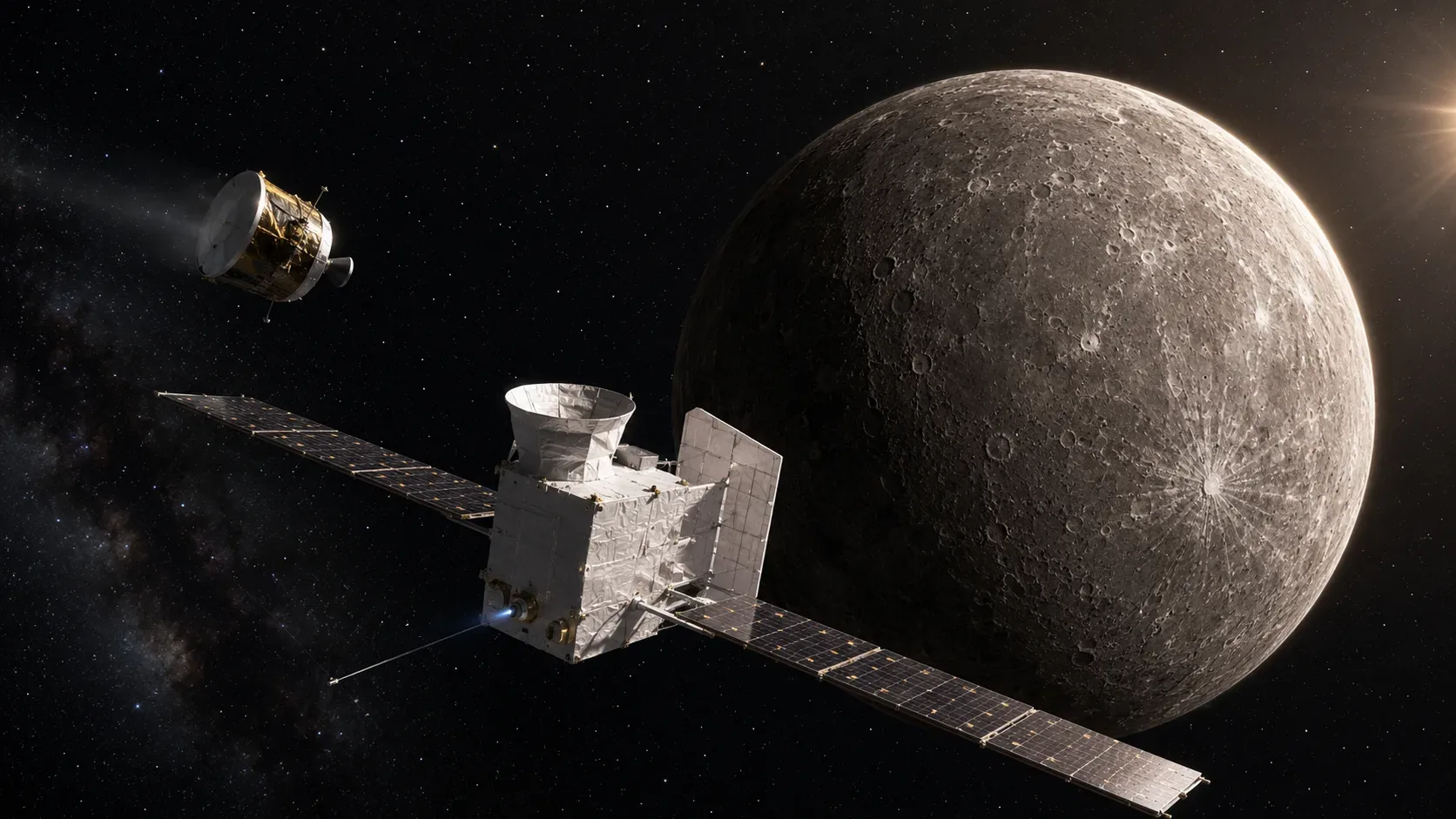
The separation of the Mercury Transfer Module (MTM) on September 3, 2026 did not mean that BepiColombo had already entered orbit around Mercury. It marked the start of the arrival phase. Confirmation came through two Estrack antennas, and ESA reported that the separation was successful, with all systems nominal. The next decisive milestone is November 21, 2026, when the combined Mercury Planetary Orbiter (MPO) and Mercury Magnetospheric Orbiter (Mio) is scheduled to be captured into orbit around Mercury.
In one line: September 3 = MTM separation → November 21 = MPO+Mio stack enters orbit → December 9–10 = MPO and Mio separate → April 6, 2027 = planned start of the science phase.
What happened on September 3, 2026
The MTM was the module responsible for providing power and, above all, solar-electric propulsion during the long interplanetary cruise. After almost eight years of travel, its role ended before orbital insertion. On September 3, it was separated from the rest of the spacecraft, leaving MPO, Mio and the Japanese orbiter's protective sunshield structure together.
ESA's official arrival updates page records that confirmation of separation arrived at 15:52 CEST through deep-space antennas in Cebreros, Spain, and Malargüe, Argentina. Telemetry indicated nominal systems, and MPO's solar panels were charging the stack's batteries.
This event matters because it changes the spacecraft configuration and the propulsion system used for the final approach, but it is not orbital insertion. After MTM is discarded, MPO's chemical thrusters take over the corrections and manoeuvres needed for arrival.
Why “separation” is not the same as “arrival”
ESA uses “arrival phase” for a campaign lasting several months, not for a single instant. MTM separation opens that campaign; entering orbit, separating the two orbiters, adjusting their orbits and commissioning instruments are later steps.
| Date | Milestone | What it means |
|---|---|---|
| September 3, 2026 | MTM separation | The transfer module completes its role. MPO, Mio and the MOSIF protection structure continue together toward Mercury. |
| November 21, 2026 | Mercury orbit insertion | The MPO+Mio stack is captured into a polar orbit. This is when the mission moves from approach to orbital operations. |
| December 9–10, 2026 | MPO and Mio separation | MPO releases Mio into its elliptical polar orbit for magnetospheric observations. |
| December 16, 2026 | MOSIF release | The sunshield used to protect Mio during cruise is discarded, and MPO continues lowering its orbit. |
| March 10, 2027 | MPO reaches final orbit | The European orbiter completes the altitude-lowering sequence into its science orbit. |
| April 6, 2027 | Science phase begins | After separations, orbital adjustments and commissioning, the two orbiters are scheduled to begin the science phase. |
ESA's official arrival timeline notes that exact dates may change for operational reasons.
What MTM, MPO and Mio do
MTM: the module that carried the mission to final approach
The ESA-built Mercury Transfer Module carried the two orbiters using solar-electric propulsion. Its ion thrusters were essential during cruise, but MTM is not a spacecraft that will remain in a science orbit. That is why it is jettisoned before capture at Mercury.
MPO: the European orbiter that studies the planet
ESA's Mercury Planetary Orbiter is designed to investigate Mercury's surface, composition, interior, topography, magnetic field and other properties. It also takes over propulsion for the remaining stack after MTM separates. Its planned science orbit is polar and lower than Mio's.
Mio: the Japanese orbiter that observes Mercury's environment
Mio, developed by JAXA, is primarily dedicated to the magnetic field, magnetosphere, plasma, exosphere and dust around the planet. According to JAXA's official mission description, it will operate in an elliptical polar orbit complementary to MPO's orbit. Using two spacecraft at different altitudes is a central part of the mission's science strategy.
What actually happens on November 21
November 21 is the correct milestone for saying that the spacecraft stack enters orbit around Mercury, but it still does not represent the final science configuration. MPO and Mio will remain stacked when orbital capture occurs. From there, a sequence of manoeuvres will continue shaping the orbits through March 2027.
In other words, “entered orbit” and “ready for routine science” are different statements. The first describes the gravitational capture of the stack; the second depends on separations, orbit adjustments and the commissioning of spacecraft systems and instruments.
When the two orbiters begin operating separately
MPO and Mio are scheduled to separate on December 9–10, 2026. Mio will be released into the elliptical polar orbit used for its observations. On December 16, MPO is expected to release MOSIF, the structure that protected Mio from the intense thermal environment during the journey, and will continue lowering its own orbit using chemical thrusters.
ESA's current schedule has MPO reaching its final orbit on March 10, 2027. A further commissioning period is then needed before coordinated science operations can begin.
When BepiColombo science at Mercury begins
The science phase is planned to begin on April 6, 2027. At that point, MPO and Mio, already in their separate orbital configurations, are expected to carry out Mercury and space-environment observations as a regular programme.
Until then, headlines saying BepiColombo has “arrived” need context. In September 2026 the arrival phase began; in November the spacecraft enters orbit; in December the orbiters separate; and routine science follows only in April 2027.
What to watch next
- November 21: confirmation that the MPO+Mio stack has been captured into orbit around Mercury.
- December 9–10: confirmation of Mio's separation and its status after release.
- December 16: MOSIF jettison and continuation of MPO's orbital manoeuvres.
- March 10, 2027: MPO's planned arrival in its final science orbit.
- April 6, 2027: planned start of the mission's science phase.
For last-minute operational changes, the safest reference is ESA's arrival updates page, because the schedule can be adjusted according to spacecraft status and manoeuvre execution.