Short answer: the best bet for seeing the 2026 Orionids in Brazil is the night of October 21–22, especially after the Moon sets and before dawn begins. The shower will be active for weeks, but the peak coincides with a bright waxing gibbous Moon. That means the number of meteors you actually see will likely be lower than the ideal dark-sky rate of 10 to 20 per hour.
Are the 2026 Orionids worth watching?
Yes, but with one condition: in 2026, strategy matters more than simply knowing the peak date. NASA lists activity from October 2 to November 7, with the peak on the night of October 21–22 and about 10 to 20 meteors per hour under dark skies. The American Meteor Society (AMS) also places the peak on October 21–22, while noting that the Moon will be about 80% illuminated and that the best part of the night will be the interval between moonset and dawn.
- It is more worthwhile if you can leave urban lighting behind, stay out into the late predawn hours and watch for at least an hour.
- It is less worthwhile if you can only watch early in the night, from a bright city center or under partly cloudy skies.
- Do not treat “20 meteors per hour” as a promise. That figure describes much better conditions than moonlight will allow during most of the night.
When is the peak, and what is the best time in Brazil?
NASA places the Orionid peak on the night of October 21–22, 2026 and recommends watching during the hours after midnight. In Brazil, the most efficient window should come late in the predawn period, when the radiant is already high and the Moon begins to leave the sky.
There is no single clock time that works for the whole country. Moonset and twilight vary with longitude and latitude. As a reference, astronomical calculations for city centers show a short truly dark window on the morning of October 22:
| City | Moonset (approx.) | Astronomical twilight begins (approx.) | Approximate dark window |
|---|---|---|---|
| Recife | 02:00 | 03:43 | 1h43 |
| Manaus | 02:41 | 04:28 | 1h47 |
| Brasília | 02:58 | 04:26 | 1h28 |
| São Paulo | 02:57 | 04:09 | 1h12 |
| Porto Alegre | 03:20 | 04:15 | 0h55 |
The times above are approximate references for each city center and do not account for terrain, the local horizon, clouds or light pollution. For an observing plan, check moonset for your exact location with an ephemeris such as the U.S. Naval Observatory (USNO) daily service, and update the weather forecast close to the date.
Why is the Moon such a problem in 2026?
On October 22, the Moon will be waxing gibbous, heading toward the October 26 full Moon. The official USNO phase table places first quarter on October 18 at 16:12 UTC and full Moon on October 26 at 04:12 UTC. That is consistent with roughly 80% lunar illumination on peak night, as reported by the AMS.
Moonlight brightens the sky background and washes out fainter meteors. Brighter ones can still be visible, but counts fall. The advantage in 2026 is that the Moon sets before dawn across much of Brazil, creating a moonless window — short, but far more productive than the preceding hours.
Some online calendars currently conflict about lunar interference for the 2026 Orionids. For a practical go/no-go decision, the safest approach is to combine the NASA/AMS peak date with an up-to-date phase and moonset ephemeris. The USNO phase chronology itself shows that October 21–22 is not a moonless night.
How many meteors can you realistically expect?
The answer depends on what “per hour” means. NASA gives about 10 to 20 meteors per hour under dark skies. The AMS lists ZHR 20 for the Orionids. ZHR, or zenithal hourly rate, is a standardized measure: according to the AMS glossary, it is the rate a shower would produce under a clear, dark sky with the radiant at the zenith.
In practice, almost nobody observes under exactly those conditions. The radiant is below the zenith, there may be artificial light, atmospheric transparency varies and, in 2026, moonlight affects much of the night. The AMS FAQ uses the Orionids to illustrate how actual rates are commonly lower than ZHR: its reference table gives roughly 5 per hour in city skies or under a full Moon, 10 per hour in intermediate conditions and 15 per hour in a moonless rural sky, versus a corrected ZHR of 23. Those figures are general calibration values, oriented mainly toward central U.S. latitudes, not a specific forecast for Brazil in 2026.
For a Brazilian observer at the 2026 peak, the prudent expectation is this: during moonlit hours, expect mainly the brighter meteors and a modest count; after moonset, a transparent rural sky can raise the visible rate to several meteors per hour and, in a good stretch, into the low-teens range. There is no basis for promising 20 visible meteors in every hour of the night, much less a continuous “meteor storm.”
Where to look: the radiant helps, but it is not the target
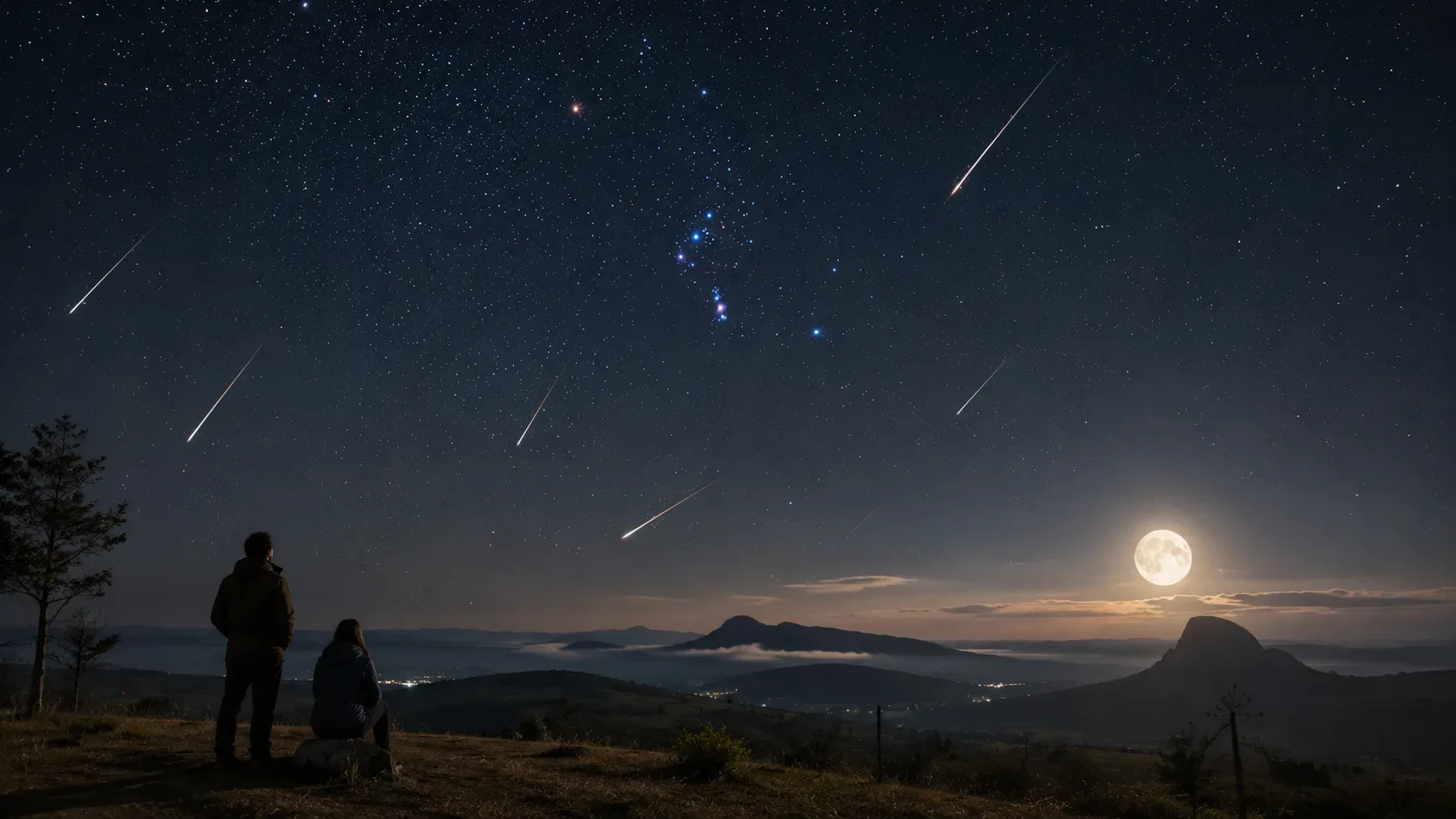
The Orionids appear to radiate from a region north of Betelgeuse in Orion, but meteors can cross large portions of the sky. NASA recommends that observers in the Southern Hemisphere lie back with their feet generally toward the northeast and look upward, taking in as much sky as possible.
No telescope or binoculars are needed: they narrow the field of view too much. It is also not ideal to stare directly at the radiant. Meteors seen farther away from it tend to show longer apparent trails.
How to set up an observing session that makes sense
- Choose a dark, open site. Get away from streetlights, building facades, parking lots and heavily blocked horizons.
- Arrive before moonset. That gives you time to settle in and begin dark adaptation.
- Protect your night vision. NASA says eyes adapt in less than 30 minutes in the dark. Avoid bright screens; if you need your phone, turn the brightness as low as practical.
- Watch as much sky as possible. In the Southern Hemisphere, the general Orionid orientation is toward the northeast, without fixing your gaze on a single point.
- Stay for at least 60 to 90 minutes. Meteors arrive irregularly; several quiet minutes do not mean the shower has ended.
- Check clouds close to the date. On August 31, it is still too early for a useful weather forecast for October 21–22.
Why are the Orionids connected to Halley’s Comet?
The meteors are produced when Earth passes through particles left by comet 1P/Halley. Entering the atmosphere at high speed — about 66 km/s according to NASA — these grains create luminous streaks. Their speed also favors persistent trains and, occasionally, very bright meteors.
Orion is not the physical source of the fragments. It is only the apparent direction of the radiant. The material itself comes from Halley’s debris trail, which is also associated with the Eta Aquariids in May.
Final decision: when should you go out?
If the sky is clear, the best strategy is to watch during the night of October 21–22, starting shortly before moonset and continuing until twilight begins. In Brazil, that generally means a concentrated session in the second half of the predawn hours, with less than two hours of truly dark sky in many state capitals.
It is worth it for observers who accept a moderate shower, want to see fast meteors and can reach a dark site. It is not worth expecting “20 per hour” as a guaranteed count: in 2026, the Moon and the short useful window are central parts of the observing conditions.