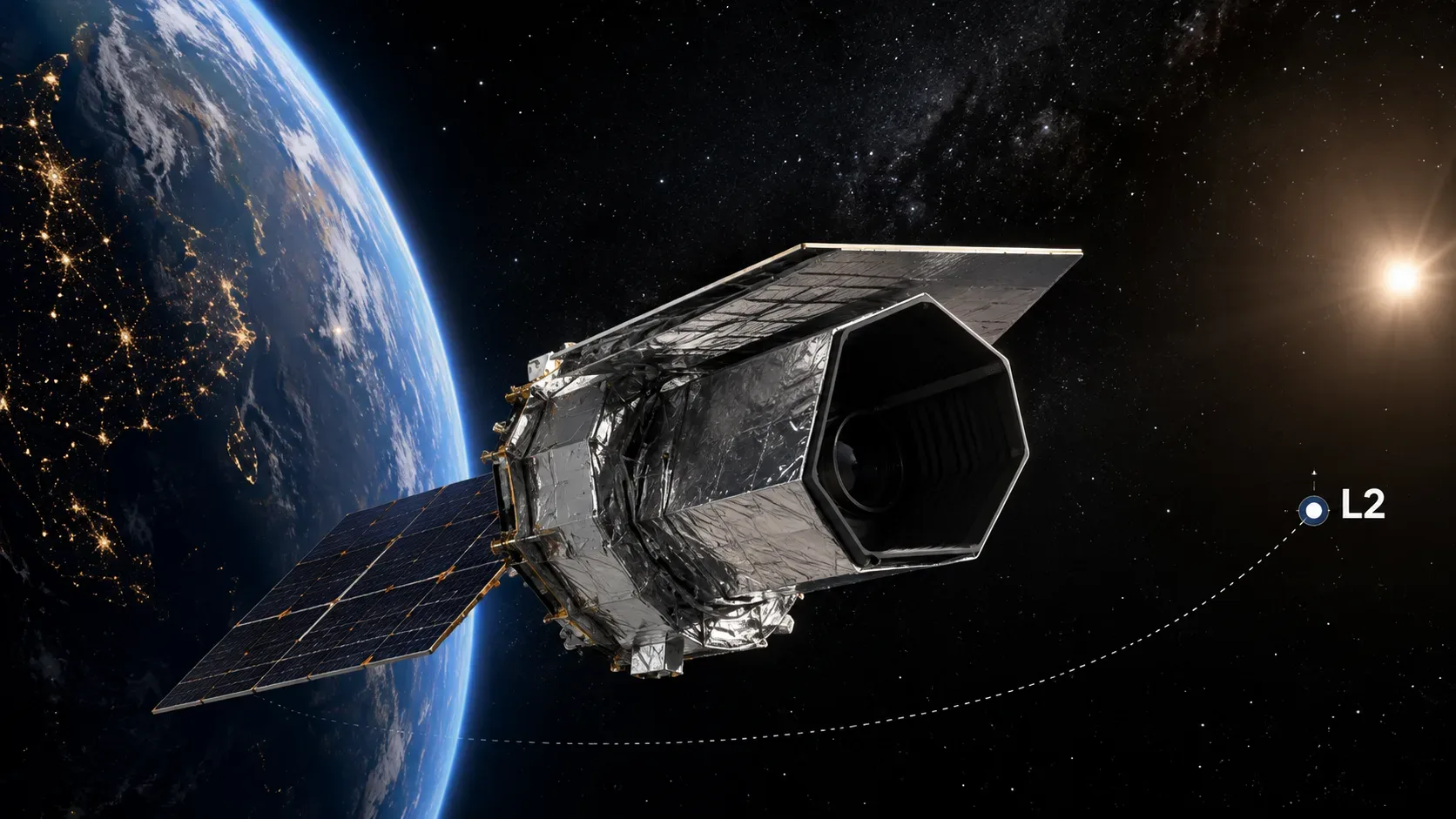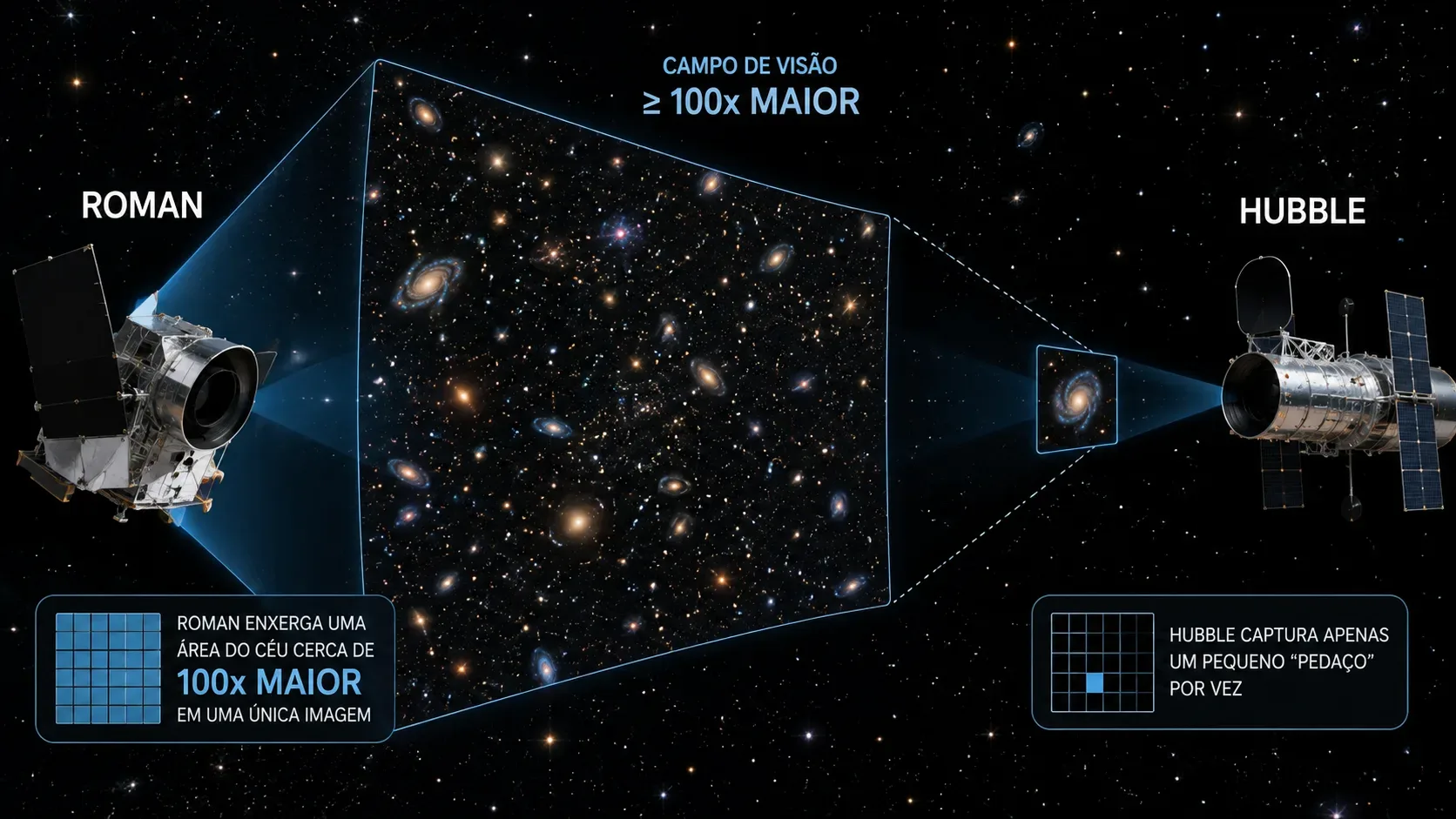
The Nancy Grace Roman Space Telescope and Hubble have primary mirrors with the same diameter — 2.4 meters — but that does not force them to see the same amount of sky. Mirror size is mainly tied to light-gathering power and potential angular resolution; the field of view also depends on the optical design, focal length, and the size of the camera placed at the focal plane. That is why Roman can combine infrared resolution comparable to Hubble’s with a much more panoramic image.
The short answer: mirror size and field of view measure different things
NASA summarizes the comparison simply: Roman and Hubble use 2.4-meter primary mirrors, but Roman’s optical system was designed with a much shorter focal length relative to the mirror diameter. That opens up the framing. The agency itself uses the analogy of a wide-angle lens for Roman and a zoom lens for Hubble. In NASA’s official comparison of the two observatories, the agency explains that Roman’s three-mirror design can maintain good optical performance across a much wider region of the focal plane.
| Feature | What it affects | Roman vs. Hubble |
|---|---|---|
| Primary mirror diameter | Light collection and resolution limit | Both are 2.4 m |
| Focal length and optical design | Image scale and field width | Roman was optimized for a much wider field |
| Detector/camera size | How much of the focal plane is recorded at once | Roman’s WFI uses 18 detectors and 288 megapixels |
| Field of view | Area of sky captured in one exposure | Roman: about 0.28 square degree and at least ~100x the field used in NASA comparisons |
Why Roman records so much sky in a single exposure
1. The optical system works like a wide-angle lens
In a telescope, the primary mirror does not work alone. Reflected light passes through an optical system that determines where the image forms and what angular scale reaches the camera. According to NASA, Roman uses a Three-Mirror Anastigmat design and a shorter focal length than Hubble, allowing a corrected image across a larger area. In practical terms, individual objects do not need to become 100 times smaller or blurrier just to fit in the frame; the instrument was designed to preserve good image quality over a much larger focal plane.
2. The Wide Field Instrument records a much larger share of that focal plane
The Wide Field Instrument (WFI) is a 288-megapixel infrared camera made of 18 detectors. The mission’s official FAQ gives a field of view of about 0.28 square degree. NASA’s comparison page also describes a frame about 0.8 by 0.4 degree — slightly larger than the apparent diameter of the full Moon in one dimension. Hubble’s Advanced Camera for Surveys Wide Field Channel, by contrast, covers about 0.056 by 0.056 degree. The result is an enormous increase in the sky area recorded with each pointing.
The mosaic analogy: the advantage appears when you need to map
Imagine a wall covered by a mural. A narrow-frame camera must photograph small squares and stitch them together into a mosaic; a wide-angle camera covers larger blocks each time. The detail in each small feature can be similar, while the number of photographs required changes dramatically.
NASA illustrates the difference with a concrete example: an animation comparing Hubble and Roman says it took 432 Hubble pointings to cover roughly the same region Roman could span with only two. That example does not mean every observation will have exactly that ratio, but it makes clear why Roman’s advantage is especially important for large-area surveys.
So is Roman “100 times better” than Hubble?
No. The ~100x figure refers to sky area per exposure, not overall quality. NASA says the WFI delivers infrared resolution and sensitivity comparable to Hubble’s, but that does not mean an image is 100 times sharper, 100 times deeper, or 100 times more magnified.
The observatories are also not copies of one another. Hubble covers ultraviolet, visible, and near-infrared wavelengths and has instruments specialized for detailed observations and spectroscopy. Roman was optimized for panoramic surveys in visible and especially near-infrared light. The most useful comparison is therefore functional: Hubble excels at examining targets in detail; Roman was designed to find and map entire populations of objects across large regions of sky.
Why some sources say “100x” and others “200x”
Because Hubble has more than one camera, and each instrument has its own field of view. The official WFI page says Hubble infrared images made with Wide Field Camera 3 are about 200 times smaller, while even the widest Advanced Camera for Surveys exposures are nearly 100 times smaller. So “about 100x” is a safe shorthand for Roman’s panoramic advantage, but the exact factor depends on which Hubble camera is used as the reference.
What the wider field changes for science
The main gain is survey power. Roman can observe enormous populations of galaxies, stars, and variable events without spending most of its time building mosaics from narrow fields. NASA projects that, in its first five years of observations, Roman will image more than 50 times as much sky as Hubble covered in 30 years. That favors statistical studies of dark matter and dark energy, exoplanet censuses, searches for transient events, and the creation of large catalogs for follow-up by other telescopes.
This “survey power” should not be confused with the 100x field-of-view number alone. NASA discusses survey speeds of up to 1,000 times Hubble’s for certain programs; that performance combines field of view, sensitivity, observing efficiency, and mission design rather than coming from a simple 100x multiplication.
The 2026 launch moves the comparison into a new phase
Roman successfully launched on August 30, 2026 aboard a Falcon Heavy. Once science operations begin, the difference between “zoom” and “panorama” will move from a design comparison to an operational one: Roman was built specifically for broad, repeated surveys, while Hubble continues to provide complementary wavelength coverage and detailed observing capabilities.
In one sentence
Roman photographs far more sky not because its mirror is larger — it has the same diameter as Hubble’s — but because its entire optical system and camera were designed to record a much wider field at once. The mirror supports light collection and resolution; focal length, optical design, and the detector mosaic determine how much sky fits in the frame.