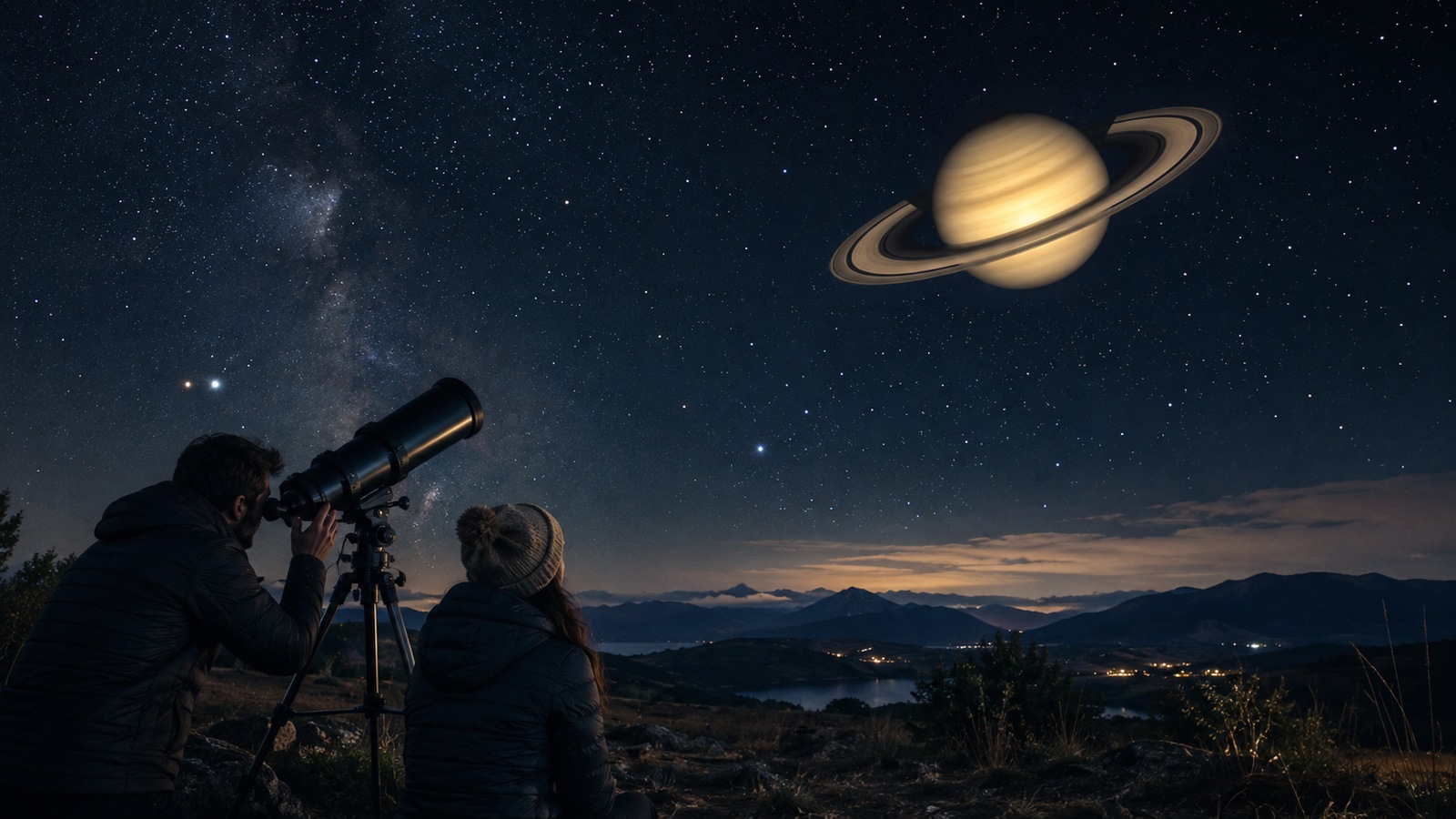
Saturn's opposition on October 4, 2026 is the central point of the best observing season of the year for the planet. For observers in Brazil, the practical advantage is simple: Saturn rises near sunset, remains in the sky for nearly the entire night, and reaches a high altitude across much of the country. There is no need to hit a specific minute. The nights immediately before and after offer a practically equivalent view.
Opposition also does not turn Saturn into an enormous or extremely bright object. Ephemerides based on the Jet Propulsion Laboratory's DE440 place the planet on that date at around magnitude +0.3, with an apparent disk about 19.7 arcseconds across and a distance from Earth near 8.43 astronomical units, about 1.26 billion kilometers. To the naked eye, it still looks like a point of light. The rings still require a telescope.
When to look on October 4, 2026
The Royal Observatory Greenwich lists October 4 as the date of Saturn's opposition in 2026. At opposition, Earth lies between the Sun and an outer planet. As a result, when the Sun sets in the west, Saturn appears on the opposite side of the sky, near the east. The planet climbs through the night, reaches its highest point near solar midnight, and descends toward the west before dawn.
On a civil clock, the time of the highest point changes with the city's time zone and longitude. For observing, the most useful rule is not to focus on the exact minute of opposition. Wait for Saturn to gain altitude. Early in the evening it will still be low on the eastern horizon, where atmospheric turbulence often reduces sharpness. In many Brazilian cities, the interval from late evening into the first part of the early morning will be more favorable than the moment just after sunset.
Where to find Saturn in the Brazilian sky
At the time of opposition, Saturn will be in the region of the constellation Cetus, close to the area of Pisces. The coordinates calculated for the event are near right ascension 00h44m and declination +1°49'. For observers who do not use celestial coordinates, that translates into a simpler direction: look for a relatively bright yellowish point in the east after nightfall. As the hours pass, it climbs and crosses the upper part of the sky.
Because Saturn's declination will be only a few degrees north of the celestial equator, it is particularly well placed for Brazil. At its highest point, the approximate altitude will be 65° in São Paulo, 72° in Brasília, 80° in Recife, 85° in Manaus, and 58° in Porto Alegre. Across most of the country, it crosses the northern part of the sky; in the far north of Brazil, it may pass very close to the zenith or slightly south of it.
Those altitudes are an important advantage for telescopes. The higher a planet is, the less atmosphere its light passes through and the less blurring tends to be caused by air near the horizon. To locate Saturn without memorizing constellations, a planetarium app configured for the observer's city is the quickest route. Once you identify it, it becomes easy to recognize on the following nights.
What opposition really means
Opposition describes a geometry, not a sudden physical change in Saturn. Seen from Earth, the planet lies approximately in the direction opposite the Sun. This configuration brings three useful effects at the same time: Saturn remains in the sky for almost the entire night, is near its minimum distance from Earth in that annual cycle, and presents its largest apparent size and greatest brightness of the year.
The word "largest" needs context. Saturn is very far from Earth, and its distance variation over an apparition is moderate compared with Mars. In 2026, the planet's disk reaches about 19.7 arcseconds at opposition. That is larger than near conjunction with the Sun, but it remains tiny to human eyes. The real benefit of opposition is the combination of the best brightness of the year, the largest apparent dimension of the year, and a long observing window.
There is also no sharp boundary between one "good" night and one "bad" night. Saturn moves slowly. If there are clouds on October 4, observing on October 3, October 5, or a few days later does not mean missing the phenomenon. Opposition is the center of a season, not an event that disappears in a few minutes.
How much brighter Saturn gets
Near opposition, Saturn should reach a visual magnitude of around +0.3. That makes it easy to notice with the naked eye under an open sky, including in cities, as long as the horizon is unobstructed and the weather is clear. Even so, it does not come close to the brightness of Venus and normally does not look like an intense spotlight in the sky. The expected appearance is that of a clear, yellowish, relatively steady "star."
The brightness difference from one night to the next is small. For that reason, someone comparing Saturn on October 1, 4, and 8 will probably not notice a dramatic transformation without photometric measurements. The phrase "brightest of the year" is correct, but it does not mean the planet suddenly switches on at the date of opposition.
What changes in the rings - and what does not
The opening of the rings is not created by opposition. That angle depends mainly on the tilt of Saturn's axis and Earth's relative position with respect to the ring plane over the years. On March 23, 2025, Earth passed through the ring plane, a configuration in which the rings were almost edge-on to us. NASA explains that these passages occur at intervals of about 13 to 15 years and can make the system appear to almost disappear in small telescopes.
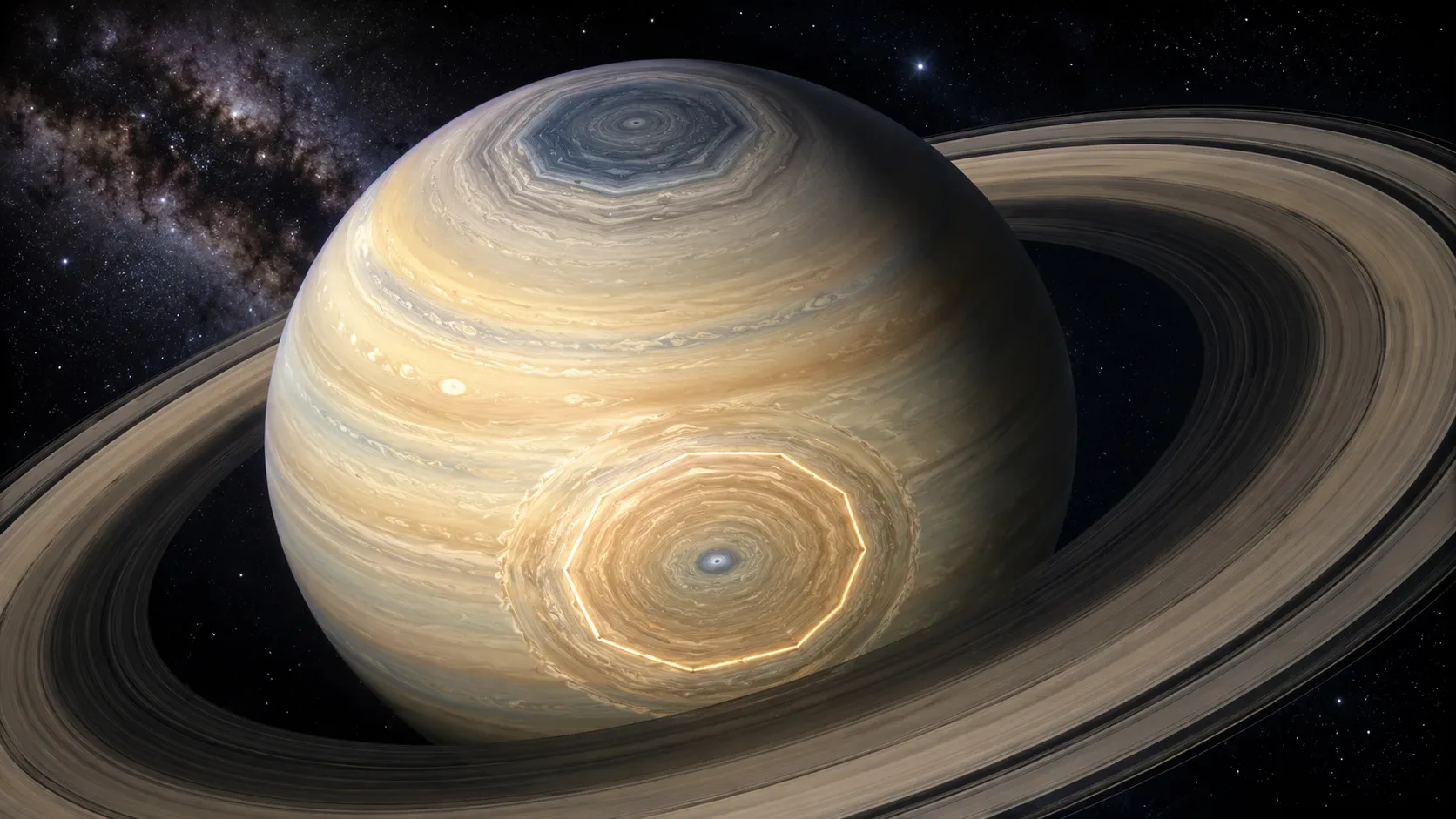
By October 2026, the rings will be visible again, but they will still be narrow. Ephemerides and observing charts place the tilt at around 7° to 8° relative to our line of sight. Therefore, anyone who remembers images of Saturn with very widely open rings should adjust expectations: in 2026, the appearance will be a thin ellipse, clearly recognizable in a telescope, but far from the maximum opening the system reaches at other stages of Saturn's cycle.
Opposition can, on the other hand, temporarily alter the apparent brightness of the rings. When the Sun is almost directly behind the observer relative to Saturn, the shadows cast by ring particles are hidden behind the particles themselves, and light scattered back toward the observer can be enhanced. This increase is known as the opposition effect or Seeliger effect. NASA recorded the phenomenon in images from the Cassini mission. It can make the rings relatively brighter for a short period around opposition, but it does not change their tilt or "open" them.
What is visible to the naked eye
Without an instrument, Saturn appears as a point of light. It is not possible to separate the planet's disk, see the rings, or distinguish atmospheric details. Opposition helps because the planet is brighter and remains accessible for many hours, not because the human eye suddenly becomes able to resolve its shape.
The best visual clue is to look for a yellowish point that shines more steadily than many nearby stars.
The idea that planets "do not twinkle" is a simplification, because the atmosphere can also make them scintillate when they are low. The higher Saturn is, the steadier it tends to look.
What binoculars show
Common binoculars such as 7x35, 8x42, or 10x50 are excellent for locating Saturn and stabilizing the view among the stars, but NASA notes that, in general, they do not resolve the rings. Under very good conditions, the planet may appear slightly elongated, especially in larger, well-supported instruments, but do not expect a clean separation between globe and rings.
That makes binoculars a searching tool, not the ideal equipment for Saturn's main feature. If the goal is to confirm "I am looking at Saturn," they help a great deal. If the goal is to see the ring system as a separate structure, move to a telescope.
What a small telescope already shows
A modest telescope completely changes the experience. Observing references from NASA and Sky & Telescope indicate that magnifications around 25x to 30x can already reveal the rings, while near 50x the separation between the globe and ring system becomes much more evident under good conditions. In 2026, because the rings are only slightly tilted, a steadier image and a little more magnification may help.
With telescopes of 60 to 100 millimeters in aperture, Saturn can show its yellowish globe, the ellipse of the rings, and, under steady skies, brightness differences between regions of the system. Titan, Saturn's largest moon, is also an accessible target in many amateur telescopes as a small star-like point near the planet. Fine details such as the Cassini Division depend much more on aperture, optical quality, atmospheric stability, and the tilt of the rings that night.
There is no advantage in forcing the highest available magnification. If the image starts to "boil" or loses contrast, reduce the power. In planetary observing, a smaller, sharp image usually shows more than a large, blurry one.
How to choose the best time in Brazil
For Saturn, a completely dark sky is less critical than it is for galaxies and nebulae. The planet is bright enough to be observed from urban areas. The main obstacles are clouds, atmospheric turbulence, heat rising from roofs and pavement, and low altitude near the horizon.
If you can choose, set up the telescope in a location with an unobstructed view to the east and north, away from surfaces that are still releasing heat. Give the equipment some time to reach the ambient temperature. Start with a lower-power eyepiece to locate the planet and increase magnification only when the image is stable.
Saturn's high position across much of Brazil is one of the best reasons to take advantage of this opposition. In São Paulo, Brasília, Recife, Manaus, and other cities at similar latitudes, the planet passes well above the horizon in the middle of the night. That reduces the amount of atmosphere in the light path and can greatly improve the view of the rings compared with observations made just after the planet rises.
If it rains on October 4, is it still worth observing
Yes. The night of October 4 is an orbital reference, not a single chance. In the following days, Saturn remains almost as bright and almost the same apparent size. Because it rises a few minutes earlier each night, it becomes increasingly convenient for observers who prefer the early evening.
The best strategy is to treat the first half of October as a window. Choose the clearest night, wait for the planet to climb, and prioritize atmospheric stability. For most observers, that will make more difference at the telescope than being there at the exact mathematical instant of opposition.
What to expect from the 2026 opposition
To the naked eye, expect an easy-to-find point of light. With binoculars, expect more comfortable locating, but not clearly separated rings. With a small telescope, the rings come into view and make Saturn unmistakable. In 2026 they will be relatively narrow, a consequence of the tilt cycle that passed through an almost edge-on view in 2025.
What opposition really delivers is a favorable combination: Saturn is available for almost the entire night, reaches its greatest brightness and largest apparent size of the year, and climbs high in the Brazilian sky. The opposition effect can temporarily boost the brightness of the rings, but it does not change their opening. Understanding that difference between geometry, brightness, and ring tilt avoids the misleading expectation of a "super night" in which Saturn visually transforms from one hour to the next.