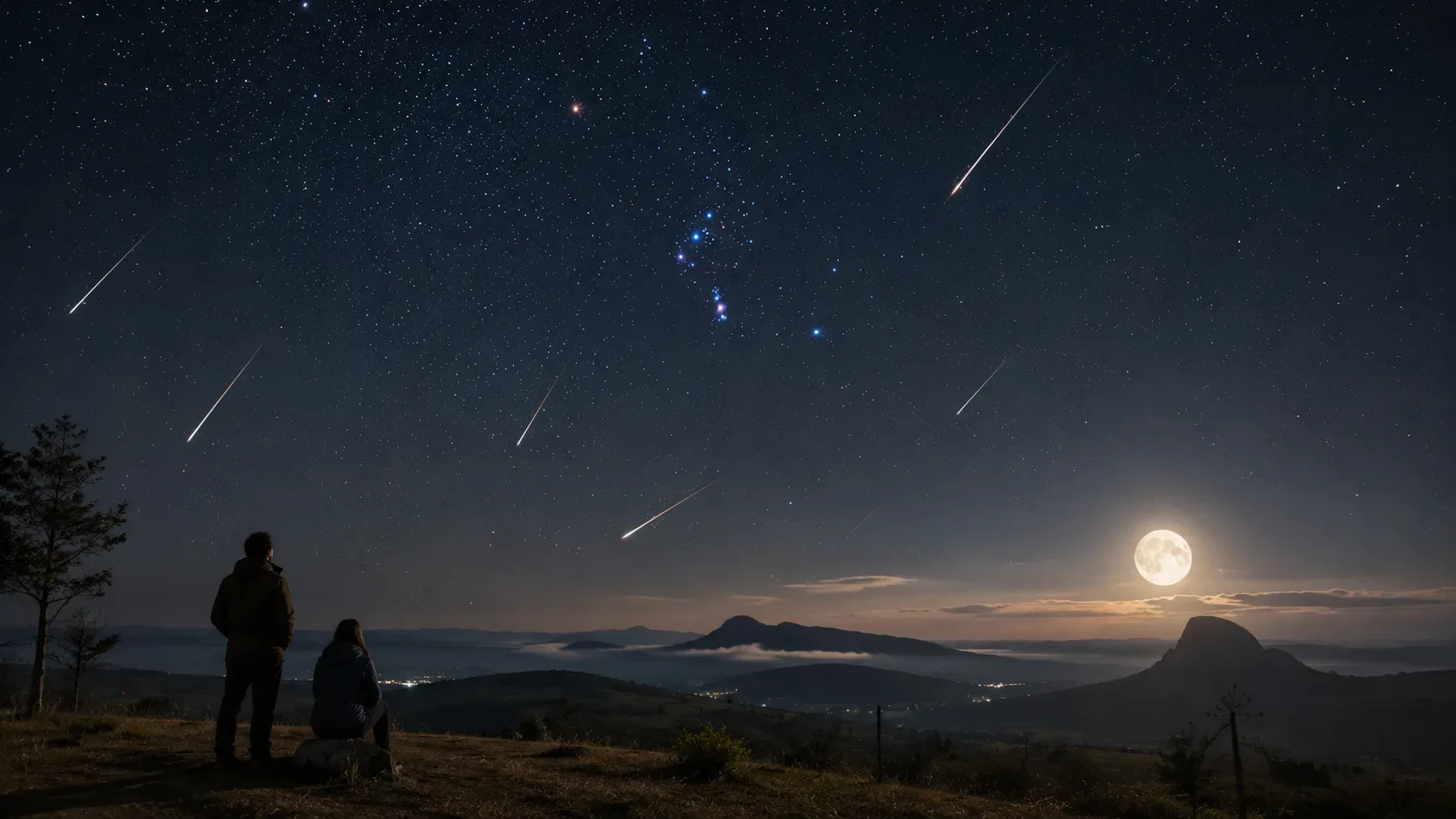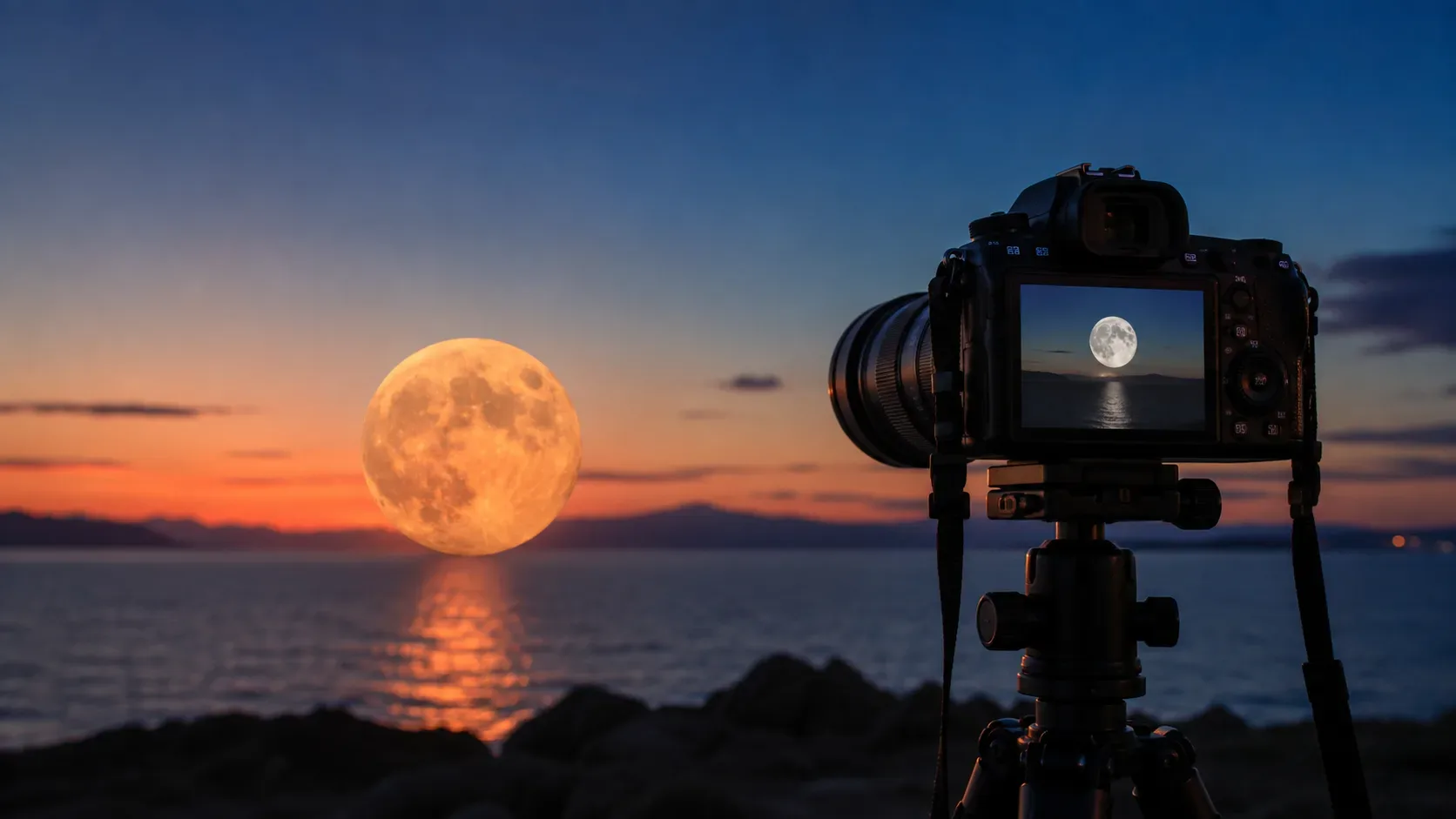
You watch the Moon rising behind buildings, trees or mountains and it looks huge. A few hours later, already high in the sky, it appears to have shrunk. But, if the two positions are photographed with the same equipment and the same focal length, the recorded diameter changes very little. The contradiction has a name: illusion of the Moon.
The short explanation is that our eyes and our camera are not responding to context in the same way. The Moon does not physically enlarge when it reaches the horizon. In fact, to an observer on Earth's surface, it is about 1.5% farther away when it is at the horizon than when it passes high in the sky. Still, it can feel much bigger.
Photography measures something that perception interprets differently
When we use a camera with the same focal length, the number of pixels occupied by the lunar disk is mainly determined by the angular size of the Moon in the sky. In photographs taken on the same night, one close to the horizon and another with the Moon higher, this value tends to remain almost the same. NASA itself presents a comparison in which the horizontal diameters of the two images coincide.
The visual experience is different. Our perception system does not evaluate an object in isolation like a ruler would. It uses information about distance, perspective, position, and the surrounding elements to build an interpretation of the scene. Therefore, two images that reach the eye with very similar angular dimensions can be perceived as objects of different sizes.
This is the point that makes the photograph seem so revealing: when you keep the optical frame comparable and measure the lunar disk, much of the spectacular effect that we perceive with the naked eye disappears.
The horizon gives the brain many more references
Near the horizon, the Moon usually appears next to houses, trees, posts, mountains and other references of scale and depth. We also see a landscape that seems to stretch far away. All of these elements give the visual system information that is not present when we look at a bright disk isolated in a large empty region of the sky.
One of the best-known hypotheses relates the phenomenon to the Ponzo illusion. In it, objects of equal size appear different when they appear in a context with clues of perspective and distance. Applied to the Moon, the idea is that our brain interprets the horizon as a distant region and adjusts the perception of the size of the lunar disk. NASA, however, emphasizes that this is a popular hypothesis, not a definitive explanation.
Research on perception also indicates that the phenomenon probably does not depend on a single mechanism. A work published in the journal Perception describes the illusion as multifactorial and notes that its intensity varies with details of the horizon scene, in addition to discussing factors such as contrast in size, position of the eyes and head, atmospheric perspective and color.
Therefore, it is more correct to say that we know that the perceived difference is an illusion, but there is still no consensus on a single cause capable of explaining all cases. NASA maintained this reservation in its material consulted in August 2026.
The atmosphere does not act as a magnifying glass for the Moon
An intuitive explanation would be to imagine that the atmosphere enlarges the lunar disk when it is close to the horizon. Measurements and photographs do not support this idea.
The most evident optical effect of the atmosphere in this position may occur precisely in the opposite direction. Because refraction is different between the top and bottom of the disk when the Moon is very low, its image may be slightly compressed vertically. In the photographic example published by NASA, the horizontal diameter remains equivalent while the vertical appears reduced near the horizon.
The atmosphere also helps explain another change that is real: the low Moon may appear more yellow, orange or reddish because its light travels a longer path through the atmosphere before reaching the observer, favoring the dispersion of shorter wavelengths. This alters the perceived color, but does not produce the enormous magnification that our eyes seem to see.
How to take the photo test suggested by NASA
The comparison works best if the Moon is recorded twice on the same night with the optical system kept constant. NASA proposes precisely this type of experiment.
- Photograph the Moon when it is just above a distant horizon.
- Later, photograph it again when it is higher in the sky, using the same equipment and the same focal length.
- Compare the horizontal diameter of the lunar disk in the two images, without applying different magnifications to each photo.
- If there is sufficient resolution for the measurement, the values should be very close. A small difference is expected because the observer's position relative to the Moon changes throughout the night.
The test also explains why it is more accurate to talk about “almost the same size” rather than requiring two mathematically identical disks. The observer's position changes, the Moon is not at the same distance at all times, and refraction near the horizon can warp its image slightly. What does not appear in the photograph is an enlargement comparable to the enormous growth that many people report seeing with the naked eye.
So why do some photographs show a gigantic Moon?
There is a difference between using photography to measure the lunar disk and producing a photograph in which the Moon dominates the landscape.
With a long telephoto lens, the photographer can fill a much larger part of the frame with the Moon and distant terrestrial elements. A mountain, a building or a person positioned at a great distance can appear in the same frame as a huge Moon. NASA notes that this type of composition can visually reproduce the sensation of the Moon illusion.
This does not mean that the atmosphere has enhanced the Moon. It means that the photographer chose distance, vantage point, lens and framing to produce a composition in which the lunar disk occupies a large fraction of the image.
The difference becomes simpler when we separate three ideas: the physical diameter of the Moon does not change because it was born on the horizon; its angular size may undergo small geometric variations; and the size we believe we are seeing can change much more because of how perception works.
This is precisely why the Moon can appear extraordinarily large before your eyes and, minutes later, appear much less impressive in the measurement of a photograph. The camera does not eliminate the beauty of the scene: it only helps to reveal that part of the spectacle is being constructed by our own visual system.
To get out of perception and return to practical observation, see also when to observe the Moon in Brazil in the article “What you can really see in the sky in Brazil in August 2026”.