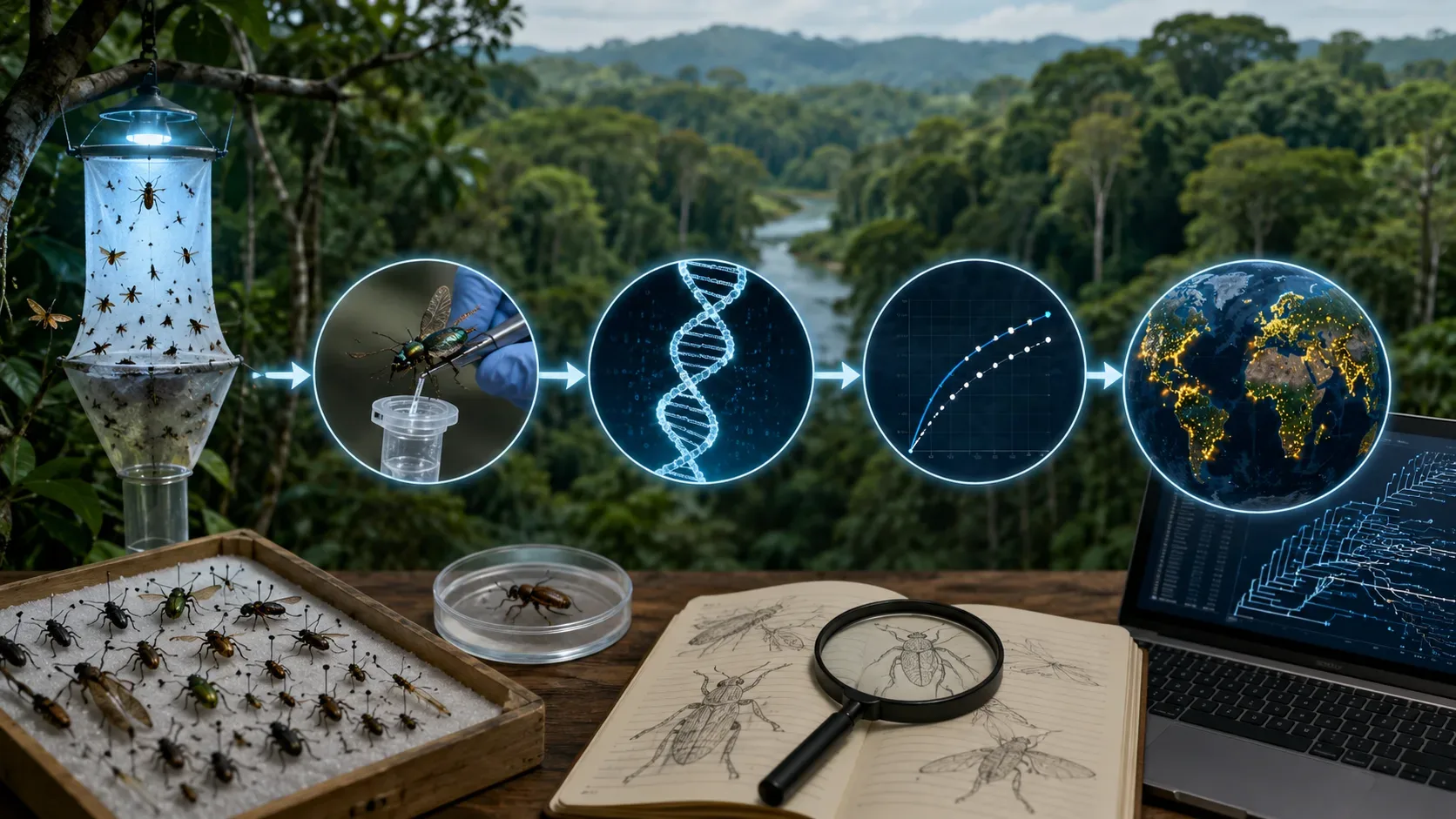
No one has counted 20 million species of insects. What the scientists did was build a chain of inferences: capture an exceptionally large sample, separate the specimens into genetic units, estimate how many species escaped collection, correct local undersampling and, finally, extrapolate the result to the planet.
This distinction is essential to understanding the estimate of 14 to 20 million insect species published online by PNAS on June 29, 2026. The range is presented by the authors as a set of lower-bound estimates, obtained with different groups used in the extrapolation. It is neither an observed count nor a single confidence interval that guarantees that the true total necessarily lies between these two numbers.
The study received a timely counterpoint on August 4, 2026, when Nature highlighted a large inventory of insects in the Amazon, carried out from the ground to the canopy at hundreds of points. The magazine's headline states that a small area of forest is likely home to around 40,000 species. This Amazon work and the PNAS study help answer the same question — how many species of insects are there? — but they operate at different scales and with different objectives. Local inventory and global estimate are not the same survey
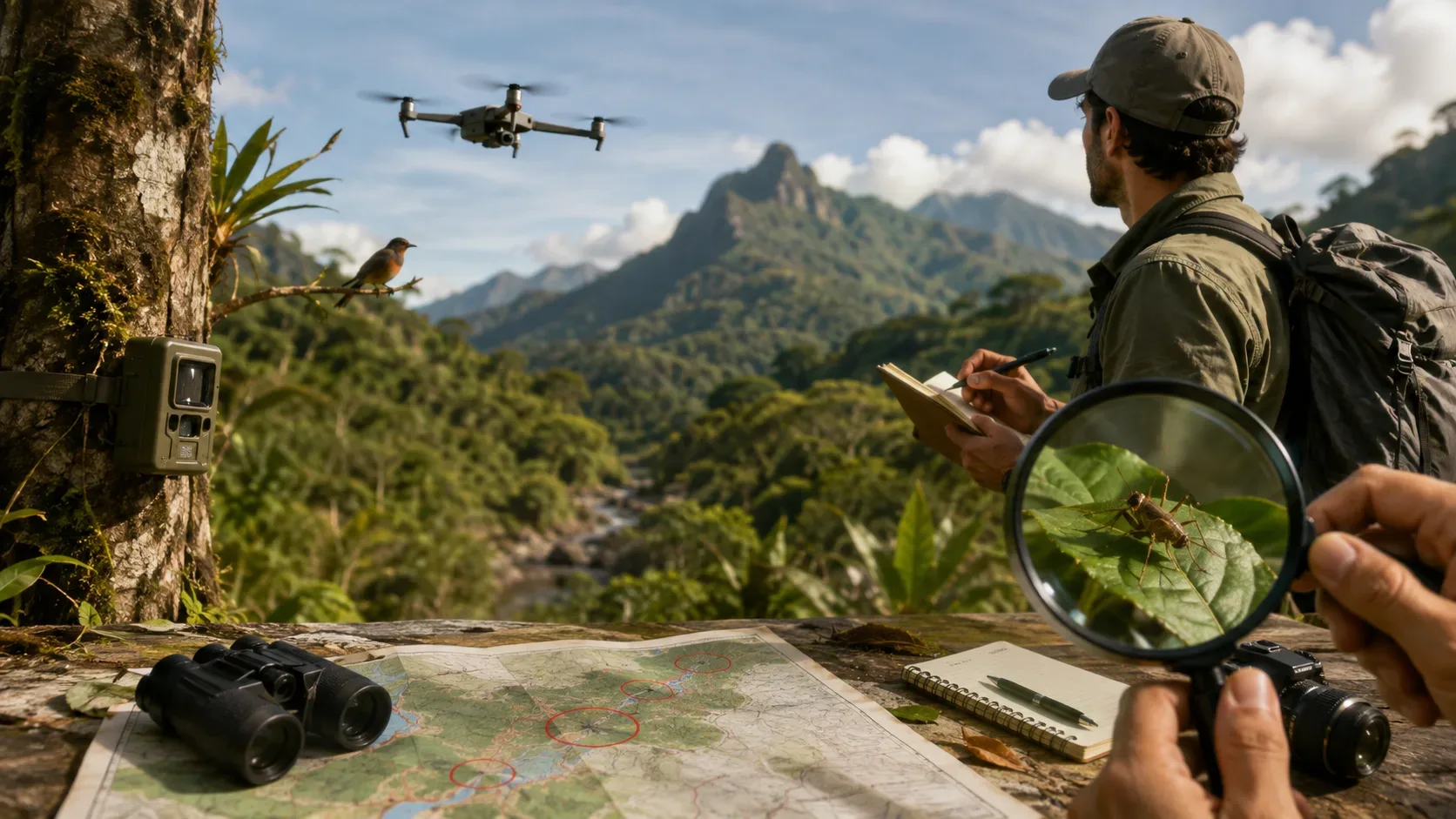
The project reported by Nature seeks to document the diversity of a region in the Amazon. It measures how species are distributed between the soil, intermediate strata and treetops, environments that can harbor very different sets of insects.
The PNAS study, in turn, uses data collected in the Guanacaste Conservation Area, in northwest Costa Rica, to produce a global estimate. Your main question is not which species live in the Amazon, but how many species of insects might exist in the world when considering the species that the traps missed.
| Appearance | Amazon inventory | PNAS Study |
|---|---|---|
| Scale | A region of the Amazon, in hundreds of points | Guanacaste Conservation Area and global extrapolation |
| Objective | Discover which and how many species occur locally | Estimate a lower limit for global wealth |
| Collection | Different heights, from ground to canopy | Ground-level Malaise Traps and Caterpillar Rearing |
| Result | Inventory and estimation of regional diversity | Approximately 14.2 to 20.3 million species in the world |
| Main interpretative risk | Confusing a studied area with the entire Amazon | Treat extrapolation as direct counting |
In Brazil, INCT-BioDossel is part of this effort to investigate canopy fauna. The project brings together taxonomy, molecular biology and traps installed at different heights, including 8, 16, 24 and 32 meters, to discover which species appear exclusively in certain layers of the forest. Its network involves dozens of institutions and hundreds of researchers, students and experts in taxonomic groups. Infographic: the five steps of global estimation
1. Intensively sample a diverse region
The basis of the PNAS estimate was formed by 1,633,855 insect specimens, collected by 15 Malaise traps considered central. Combined, they operated for the equivalent of 69 years of continuous operation of a trap.
The equipment was distributed over approximately 100 kilometers, crossing dry lowland forest, montane cloud forest and tropical rainforest in the Guanacaste Conservation Area.
After sequencing, the specimens were distributed into 53,945 BINs, genetic units used in the article as species approximations. This is the number directly observed in the core sample — not the 14 or 20 million in the conclusion.
2. Transform DNA sequences into comparable units
DNA barcoding works as a molecular identification system. For animals, a small section of the mitochondrial gene COI is generally sequenced, whose variation allows individuals to be compared and grouped.
In the BOLD system, similar sequences can be put together into a Barcode Index Number, or BIN. Each BIN functions as an operational taxonomic unit: it allows organizing diversity even when organisms have not yet received a scientific name or have not been formally described.
This does not mean that each BIN is necessarily a species. A grouping can bring together biologically distinct species or divide a single species into more than one BIN. The BOLD system itself defines BINs as units that “often” or “generally” correspond to species, and not as perfect equivalents. PNAS authors cite previous tests in which BINs and species delimited by morphology coincided in 89.2% of cases. Even so, both groupings that brought together species and cases in which a species was divided into several BINs were recorded. Therefore, the result should be read as an estimate of wealth based on genetic proxies. # 3. Estimate the species that did not appear
Even a sample of 1.6 million individuals remains incomplete. In biodiversity surveys, a large number of species represented by just one or a few specimens usually indicates that other species remain undetected.
To measure this deficit, the researchers chose the Microgastrinae, an extremely diverse subfamily of small parasitoid wasps. They were studied by three independent sources:
- 3,781 specimens and 388 BINs in the 15 central traps;
- 6,515 specimens and 576 BINs in 15 peripheral traps;
- 11,373 wasps, distributed in 889 BINs, obtained by breeding parasitized caterpillars.
The three sources totaled 21,669 copies and 1,414 BINs observed. Of these, 403 appeared only once. Applying a statistical coverage estimator developed by Anne Chao and collaborators, the team calculated a lower limit of 2,394 species of Microgastrinae in the area, with a 95% confidence interval between 2,221 and 2,604. The logic is similar to that of searching for people in several lists: when many records appear only in one source and few are repeated between sources, there are signs that a relevant portion of the population has not been registered.
4. Calculate subsampling ratio
Of the 2,394 species of Microgastrinae estimated for Guanacaste, only 388 had appeared in the central traps. The reason used by the study was:
388 ÷ 2,394 ≈ 0.162
In other words, the central sample would have detected approximately 16.2% of the estimated minimum wealth for that group. The inverse of this value produces a correction factor of about 6.17.
The authors applied the same degree of subsampling to the 53,945 BINs of all insects captured by the central traps:
53,945 ÷ 0.162 ≈ 332,846 species
Thus, the insect richness of the Guanacaste Conservation Area was estimated at approximately 332,846 species, with a confidence interval of 306,847 to 364,963.
This stage contains one of the most important premises of the work: it is assumed that the proportion of undetected species among the Microgastrinae is an adequate approximation of the subsampling of the group of insects. The premise is plausible to the authors because these wasps are very diverse and have been intensively studied, but it cannot be verified for all groups.
5. Extrapolate from Costa Rica to the planet
To reach a global scale, the team compared how many species from certain groups exist in Guanacaste with how many are estimated for the entire planet.
Trees were the main reference group. Guanacaste would have between 1,200 and 1,500 species of trees, while global estimates considered by the study ranged from around 60,000 described species to more than 89,000 estimated species. The ratio between the global total and the local total was applied to the approximately 333 thousand insect species estimated for Guanacaste.
The study repeated the procedure with other groups to test the sensitivity of the result. After considering differences in the size of distribution areas and the replacement of species between regions, the authors kept trees, amphibians, mammals and moths from the Saturniidae family as references.
These four paths produced estimates of between 14.2 and 20.3 million species, with an average of 17.3 million. The value of 20.3 million came from the extrapolation preferred by the authors, based on trees. Where are the main margins of error
The range of 14 to 20 million does not eliminate uncertainty. It makes some methodological choices visible, but other possibilities remain outside the disclosed range.
| Premise | Why it matters |
| BINs bring species together | Improper mergers or divisions can change estimated wealth |
| Microgastrinae represent the general subsampling | Other groups may be easier or more difficult to capture |
| Malayse traps represent the local fauna | They favor flying insects that intercept the trap structure |
| Soil data represents other strata | Species unique to the canopy may remain absent |
| Reference groups reproduce the distribution of insects | Trees, mammals or moths can have different geographic patterns |
| Guanacaste can support a global extrapolation | The region is very diverse, but does not contain all biomes and ways of life |
The authors themselves acknowledge that the central traps were installed at ground level and that additional methods could increase the observed richness. Groups associated with canopy, soil, wood, freshwater or open environments may respond differently to the collection design.
A previous study on a tower north of Manaus helps demonstrate this problem. In just two weeks, traps positioned between the ground and 32 meters high collected 37,778 insects. Among the 856 fly species analyzed, 527 — or 61.6% — did not appear at ground level. The Amazon inventory highlighted by Nature is important precisely because it expands vertical observation. Cascade trap systems allow you to sample different heights without relying exclusively on metal towers or large permanent structures. In tests described in 2025, the method was presented as a scalable solution for investigating previously inaccessible canopy fauna. “Lower limit” does not mean absolute certainty
In the PNAS article, “lower bound” has a statistical and methodological sense: the authors chose estimators and assumptions that they consider conservative. That doesn't make 14 million an indisputable floor.
A change in the correspondence between BINs and species, the representativeness of wasps, the effect of traps, or the groups used to extrapolate can shift the result up or down.
It is also important not to confuse different types of uncertainty:
- the range of 306,847 to 364,963 represents the statistical uncertainty reported for the estimated local wealth in Guanacaste;
- the range of 14.2 to 20.3 million compares results from different groups used to extrapolate;
- global estimates close to 30 million appear when the authors use a less conservative point estimate of local wealth, accompanied by broad uncertainty. However, “there are 20 million species” is an excessively categorical formulation. The conclusion supported by the study is that an extensive empirical basis, combined with certain scaling corrections and assumptions, points to global diversity possibly two or three times greater than the previous consensus of approximately six million.
What science really knows
Approximately 1.2 million insect species have been formally described, while many previous estimates placed the existing total at closer to six million. The new analysis proposes that the real number may be much higher, but its main contribution may not be replacing one number with another.
The study shows how science works when direct counting is impossible: it collects observable data, measures what was left out, compares alternatives and presents the premises that connect one stage to the next. report on the Amazon adds the other half of the problem. Before extrapolating, it is necessary to improve local inventories — including in the treetops, where traps installed in the ground do not reach all the diversity.
Save the five steps infographic and subscribe to upcoming explanations of scientific studies. When a new number seems too big to count, the most useful question will be: What observations, corrections, and assumptions support that estimate?