When a pan boils on an induction stove, there is no flame, no glowing element, nor a "burner" that needs to turn red before transmitting heat. The coil hidden under the glass receives alternating current, creates a changing magnetic field and transfers energy to the base of the container. It is in the pan itself that most of the useful heat appears. This detail explains both the quick response of the system and the requirement to use compatible containers.
What happens between the coil and the bottom of the pan
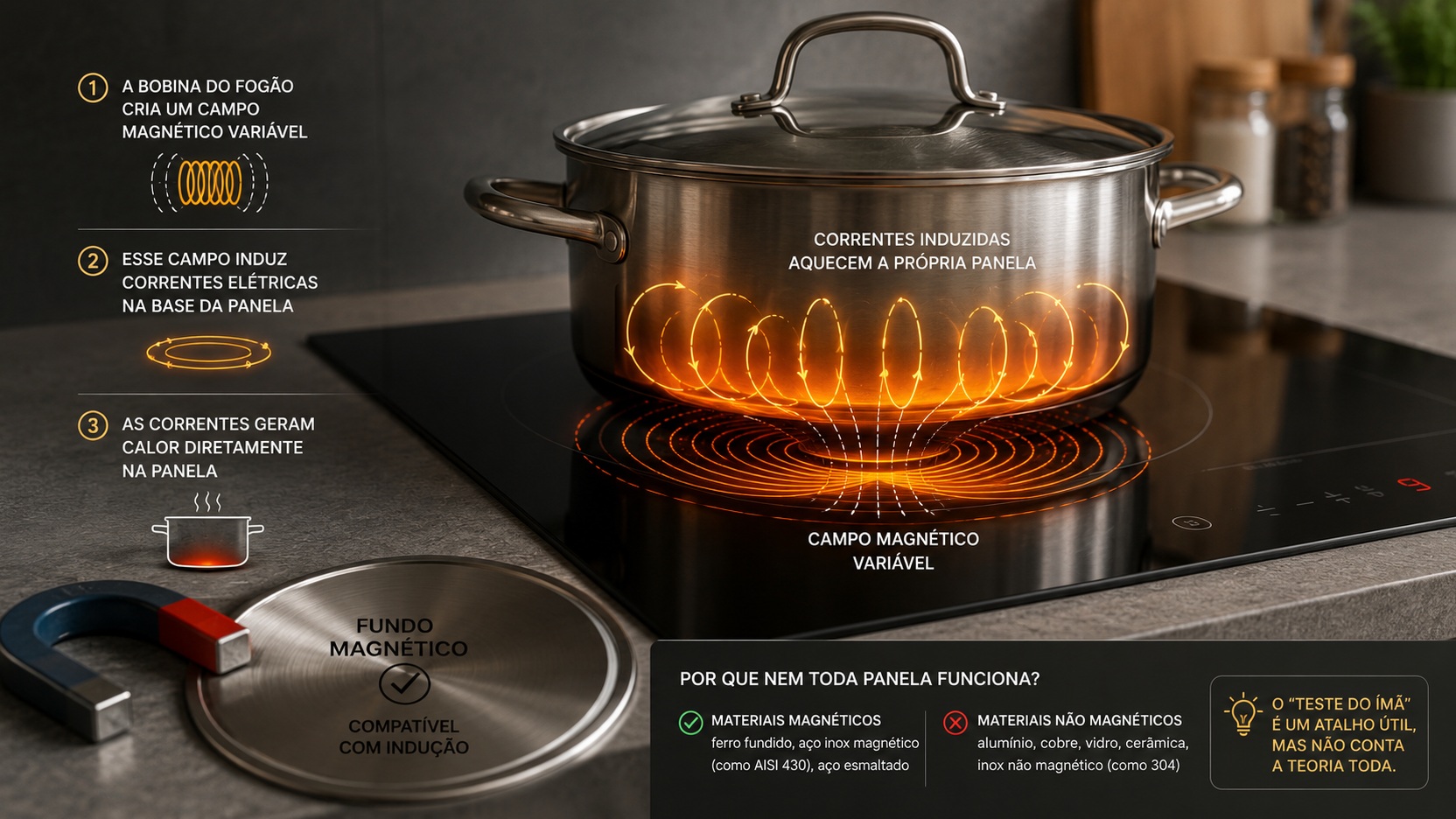
Under the glass-ceramic surface there is a coil, normally made of copper. When the cooktop electronics powers this coil with alternating current, the magnetic field around it continually changes. If a suitable pan is nearby, this field variation induces closed electrical currents in the base metal.
These currents are called eddy currents or eddy currents. They travel through a material that has electrical resistance and, due to the Joule effect, part of the electrical energy is converted into heat. Instead of first heating a resistance and then transferring heat to the pan, the system makes the metal base itself participate in the electromagnetic circuit and heat up.
A useful analogy is to imagine the set as an unconventional transformer. The stove coil would be the powered winding; the base of the pan would function as a load in which induced currents appear. The comparison does not describe all the details of the system, but it helps to understand why removing the pan from the cooking zone almost immediately stops useful heating.
Why isn't it enough for the pan to be made of metal
The phrase "induction only works with metal" is incomplete. Aluminum and copper, for example, are metals and excellent electrical conductors. They can also have induced currents when subjected to varying magnetic fields. The problem is that most common home induction cooktops are designed to transfer energy efficiently to loads with specific magnetic behavior, especially ferromagnetic bases.
Ferromagnetic materials, such as cast iron, carbon steel and certain stainless steels, have high magnetic permeability. This improves the coupling with the field created by the coil and changes the distribution of currents on the surface of the container. The result is a power transfer appropriate to the frequencies, coils and power circuits for which the device was designed.
For this reason, a pure aluminum frying pan is usually not recognized or does not heat up on a conventional induction cooktop. But a pan that has an aluminum body and a ferromagnetic steel disc incorporated into the bottom can work perfectly. For the stove, what matters is the region of the base that interacts with the coil.
Limitation is also not a law of nature. So-called "all-metal" systems demonstrate that aluminum and copper can be heated by induction when the frequency, current, coil and electronics are designed to do so. The point is that a regular cooktop and a pan form a system: compatibility depends on how the two are designed to couple power.
Cast iron, steel and stainless steel are not all the same
Cast iron tends to work very well because it is strongly ferromagnetic. Carbon steel also tends to be compatible. With stainless steel, however, the name of the material is not enough.
There are different families of stainless steel. Ferritic stainless steel, like type 430, is magnetic and frequently appears on induction-compatible bases. Austenitic stainless steel, such as 304 in typical condition, has a low magnetic response. Furthermore, cold forming processes can make some regions of austenitic stainless steel partially magnetic, without necessarily transforming the utensil into a good load for the stove.
This explains why two pans that appear to be "stainless" can behave in opposite ways. It also explains why the side of the pan can be made of a low-magnetic alloy while the bottom has a ferromagnetic layer suitable for induction.
The magnet test is excellent, but it's just a shortcut
Touching a magnet to the bottom of the pan is a practical way to predict compatibility. If the magnet sticks firmly to the bottom, there is a good chance that there is a ferromagnetic layer there capable of working with a conventional induction cooktop.
But the test does not tell the whole theory. The magnet only reveals a magnetic feature of the base. It does not measure the thickness of the active layer, the resistivity of the material, the useful diameter, the flatness of the bottom or how closely the pan will be coupled to the actual coil of the device.
A weak attraction can also be deceiving. Certain austenitic stainless steels become slightly magnetic after mechanical deformation, especially at edges and worked regions. This little attraction is not the same thing as a base designed for induction. Therefore, in addition to testing, it is worth looking for the manufacturer's compatibility information and checking the cooktop manual.
If the "mouth" doesn't heat up, why does the glass get hot?
The glass or glass-ceramic surface is not the main source of heat in an induction zone. It sits between the coil and the pan and allows the magnetic field to cross the region without acting like an electrical resistance on a conventional stove.
This does not mean that the glass stays cold. The heated pan touches the surface and returns part of the heat through conduction. After cooking for some time, the area under the pan may become hot enough to cause burns. This is why induction cooktops display residual heat warnings even after the power has been turned off.
The difference is the origin of the heating. In a radiant cooktop, the heating element itself under the glass heats up intensely and then transmits energy to the pan. In induction, most of the useful heating begins in the pan and the glass receives heat back from the pan.
Why a magnetic pan can still malfunction
Compatibility is not just a "yes" or "no" answer. The size of the base, the position over the zone and the distance to the coil influence the electromagnetic coupling.
A pan that is too small may not be detected in a certain area. A container that is too far from the center may heat with less power or unevenly. A warped bottom increases the distance at some points and impairs energy transfer. Multilayer bases may also vibrate or produce humming noises as magnetic forces and currents vary during operation.
The cooktop's own electronics monitor the load. If it does not recognize a suitable pan, many appliances will not release power to the zone. This detection is an important part of security and also helps prevent the system from operating in conditions for which it was not designed.
What “induction compatible” really means
In practice, a good check combines three signals. The base must have a sufficiently strong magnetic response, it must be flat and appropriately sized for the cooking zone, and the utensil must be indicated by the manufacturer as induction compatible.
This last point is especially useful in multi-layer pans. An aluminum body can distribute heat very well and at the same time have a magnetic steel outer bottom to receive power from the cooktop. Just looking at the visible material on the side can lead to the wrong conclusion.
It is also worth remembering that a metal adapter for induction changes the mechanism. The compatible disc heats by induction and then transfers heat by contact to the pan placed on it. It works as an intermediary, but loses part of the advantage of heating the container itself directly.
"Sticking to the magnet" is not the cause of the heat
The attraction of a magnet and induction heating are related because they both depend on the magnetic properties of the material, but they are not the same phenomenon. The stove does not heat the pan simply because it is attracted to a magnetic field.
The complete process requires a variable field, induced currents, electrical resistance and adequate coupling between coil and container. In ferromagnetic materials there may also be additional magnetic losses, but the resistive heating associated with induced currents is central to understanding how they work.
This distinction solves the apparent mystery of the cooktop. The surface doesn't need to "light up" because the energy isn't waiting for a mouth to get hot before reaching the food. The coil creates the field, the pan receives this energy and converts it into heat. And it is precisely because the pan is part of the mechanism that choosing the right container is not a detail of use: it is part of the operating principle.