Wireless charging seems simple because it eliminates the connector, but beneath the glass there is a chain of conversions. The base transforms electrical energy into a variable magnetic field; the cell phone captures part of this field in another coil, converts the signal back into electricity and then feeds the battery charging circuit. Each actual step has resistance, switching, and coupling limits. That's where a lot of the heat comes from.
Therefore, the cell phone getting a little hot during wireless charging does not mean that the energy is being “thrown away” in an uncontrolled way nor that there is necessarily a defect. The important point is to understand how much of the energy reaches the receiving coil, how much is lost along the way and how the device reacts when the temperature rises. Alignment, distance, case and the Qi2 standard affect precisely these variables.
Wireless charging starts with two coils
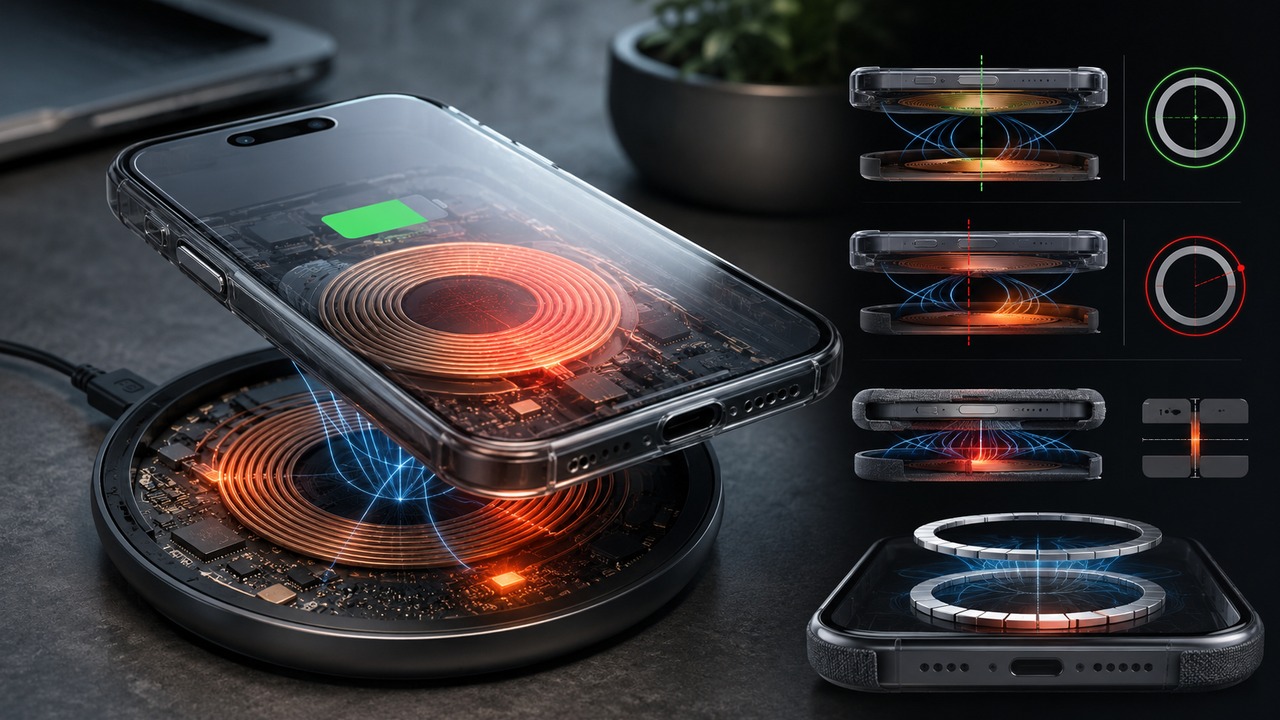
The basic principle is magnetic induction. According to documentation from the Wireless Power Consortium, responsible for the Qi standard, an alternating current runs through the base's transmitter coil and creates a variable magnetic field. This field induces a voltage in the cell phone's receiving coil. Internal electronics rectify and regulate this energy before delivering it to the battery charging system.
The two coils, therefore, do not need to touch electrically, but they need to be close and well positioned. The standard itself provides for communication between the cell phone and the charger so that the power is controlled during the transfer. This allows you to reduce or stop power when necessary, rather than keeping the base transmitting at maximum all the time.
Where the heat really comes from
A copper coil is not a perfect conductor. It has electrical resistance, and part of the power that passes through it turns into heat. The Wireless Power Consortium addresses this
relationship through the coil quality factor: the greater the resistive losses in relation to the magnetic energy that the coil can store and transfer, the worse the performance of the set.
There are also losses in the power electronics of the base and the telephone. Transistors do the switching, circuits rectify the induced voltage, regulators adjust voltage and current levels and the battery itself has internal resistance during charging. The result is simple: the power taken from the socket does not fully reach the battery. A fraction inevitably ends up as heat in the base, the phone, or both.
This detail helps to undo a common impression. The magnetic field is not a “heat source” in and of itself. The heating appears because the actual system has electrical and magnetic losses as it tries to transfer energy between two separate coils.
Why a few millimeters of misalignment makes a difference
Efficiency depends on the coupling between the coils. The Wireless Power Consortium defines coupling factor as the portion of the magnetic flux produced by the transmitting coil that actually passes through the receiving coil. Distance, size, shape, angle and relative position influence this factor.
When the coils are parallel and centered, coupling tends to be better. If the cell phone slides to the side, more of the field stops crossing the useful region of the receiving coil. The consortium's technical documentation explicitly shows that lateral displacement reduces coupling in a flat coil arrangement.
In practice, the effect can appear in more than one way. The charger may need to work under less favorable conditions to deliver the requested power, increasing losses; may reduce power to remain within thermal and safety limits; or it may interrupt charging if communication and coupling are no longer adequate. Therefore, a poorly positioned phone may charge more slowly, oscillate between charging and not charging, or heat up more in certain regions.
There is no universal rule like “one centimeter off center generates so many more degrees”. The behavior depends on the design of the coils, the negotiated power, ventilation, ambient temperature and device controls. What is general is physical steering: worse alignment reduces coupling and forces the system to handle a less efficient transfer.
The hood doesn't block the induction like a wall, but it changes the geometry
A thin plastic or silicone case does not need to impede charging. The magnetic field can pass through common non-metallic materials. The problem is that any layer adds distance between the coils, and distance is one of the variables that reduces coupling.
That's why a case can work perfectly on one set and harm another. If it is thick, has a structure that keeps the phone away from the base or makes the device rest on the protrusion of the cameras, the receiving coil may be a few millimeters further away or inclined. In a system already close to the coupling limit, this difference may be enough to reduce the useful power.
Metal deserves different attention. Metallic parts, brackets, rings and objects placed between the phone and charger can interfere with the transfer and heat up due to induced currents. The Qi standard includes foreign object detection mechanisms precisely to reduce the risk of the transmitter continuing to deliver energy when there is unwanted metal in the charging region. Apple, in its Qi charging support documentation, also advises removing thick, metal, or battery cases when your iPhone charges slowly or not at all.
This doesn't mean that every cover with a magnet is bad. The point is whether the assembly was designed to maintain correct geometry. The Qi standard history records, in version 2.1, specific support for magnetic accessory covers, as well as requirements for dealing with mechanical obstructions near the cargo area.
What Qi2 changes in alignment
Qi2's main conceptual leap was not to “invent” induction, but to make magnetic positioning part of the standard. Magnetic Power Profile, introduced in the Qi 2.0 family in 2023, uses magnetic attachment to align transmitter and receiver in a repeatable manner. The stated goal of the Wireless Power Consortium is to improve efficiency, speed and convenience precisely because coils no longer depend so much on the user manually hitting the center.
The original Qi2 brought certified charging of up to 15 W to devices compatible with this magnetic profile. In July 2025, the consortium launched the evolution commercially called Qi2 25W, increasing the certified power available in compatible equipment.
The presence of magnets, however, does not eliminate the laws that cause heating. The coils continue to have resistance, the electronics continue to convert energy and the battery continues to be charged. What improves is the coupling geometry and, with it, the chance of the system operating close to the condition for which it was designed.
It’s also not enough to look at a charger and assume that “Qi2” always means the same power. Effective power depends on what the phone and base support, the power supply, negotiation between the devices, and thermal conditions. Qi2 mainly solves the problem of docking and certified interoperability; final speed remains a complete system decision.
Why charging may start fast and then slow down
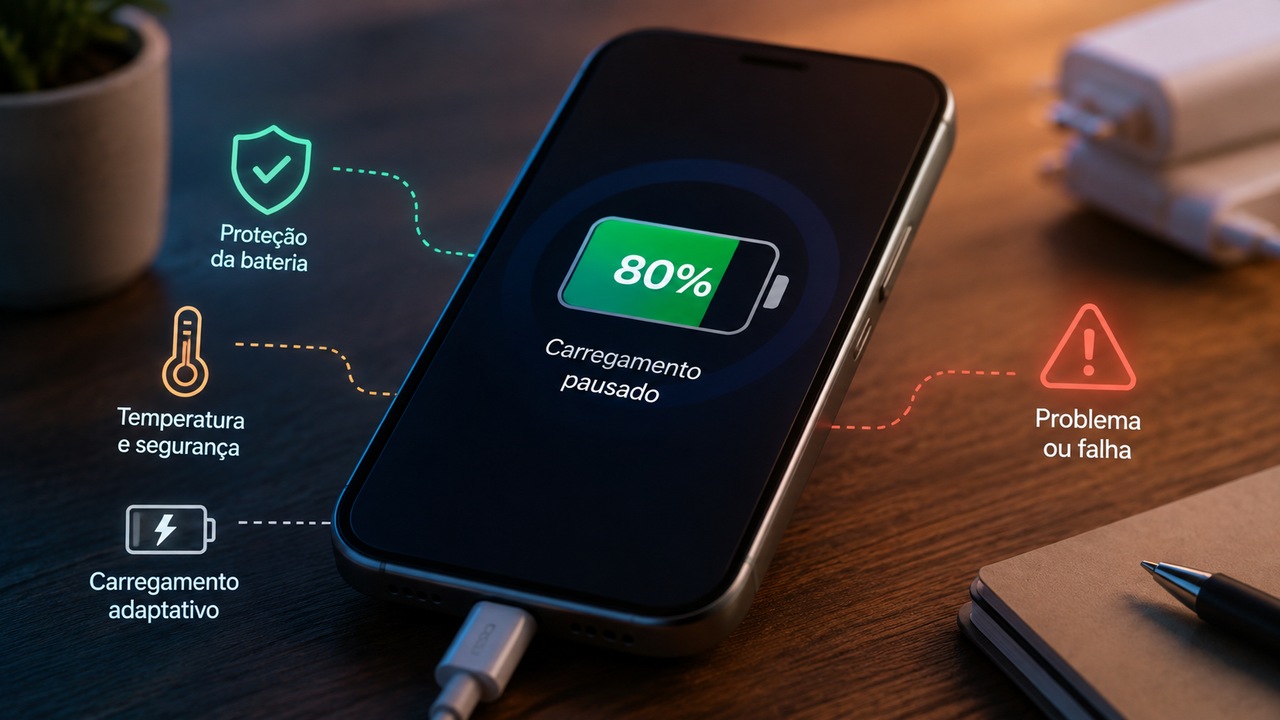
The charging power is not fixed from start to finish. The phone tracks temperature, battery status, and system activity. If the internal temperature rises, thermal management can reduce power to protect the battery and components.
Apple offers an explicit example of this behavior: the company reports that the iPhone may become slightly warmer during wireless charging and that the software may limit charging when the battery gets too hot. In documentation updated in 2026, the company also says that intensive tasks such as gaming, camera and high-quality video can reduce loading speeds.
This explains why two apparently identical sessions can have different results. A phone stationary, in a cool and well-aligned environment can maintain greater power
for longer. The same device, with a bright screen, heavy processing and high ambient temperature, adds the heat from the activity itself to the heat from the charging process. Thermal control then becomes an important part of perceived speed.
How to distinguish alignment, cover and temperature by behavior
If a small movement changes the load a lot
When charging becomes stable when repositioning the cell phone a few millimeters, alignment is a strong suspect. On bases without magnetic attachment, vibrations from notifications or a slightly inclined support may move the device throughout the session. Apple itself warns that this displacement may cause the base to stop supplying power in some cases.
If you take off the case it gets better immediately
If the same base and the same phone start to charge better without the case, the case is altering some part of the geometry or introducing unwanted material into the coupling region. This does not prove that the cover is “incompatible” in an absolute sense, but it does show that the operating margin of the set was worse with it installed.
It runs very cold and loses speed when it heats up
When charging starts normally and slows down after a few minutes, especially in a hot environment or while the phone is in use, thermal management gains weight in the explanation. In this situation, insisting on repositioning the device may not change anything: the system is reducing power because temperature, not alignment, has become the dominant limit.
Why cable often has an efficiency advantage
In cable charging, the energy does not need to go through a magnetic coupling step between two separate coils. There are still losses in the adapter, cable, regulators, and battery, but a major source of wireless charging inefficiency is simply not present.
This does not mean that all cable charging is cold or efficient by definition. Thin cables, poor power supplies, resistive connectors and high-power loads also heat up. The correct comparison is that the wireless path adds conversion and coupling that needs to be managed, and this creates extra opportunities for loss.
Qi2 improves fit; the physics remains the same
Wireless charging gets hot because the energy transfer goes through real components, with resistance and conversions, and because the coupling between the coils is never perfect. Poor alignment reduces the portion of the field that reaches the receiving coil. A case can increase the distance, tilt the device or introduce materials that hinder the transfer. High temperature causes the software to reduce power to protect the assembly.
Qi2 attacks one of the most visible causes of this inefficiency: position. By using standardized magnetic alignment, it makes it more likely that the transmitter and receiver will be where the design expects. This may improve efficiency and stability, but it does not transform the
wireless charging in a lossless process.
The practical difference is in seeing the load as a system, not as a base that “sends energy through the air”. Coils, distance, materials, power and temperature work at the same time. When one of these conditions worsens, the cell phone may charge more slowly, heat up more or reduce power. When they align - literally and thermally - wireless charging comes much closer to the performance it was designed for.