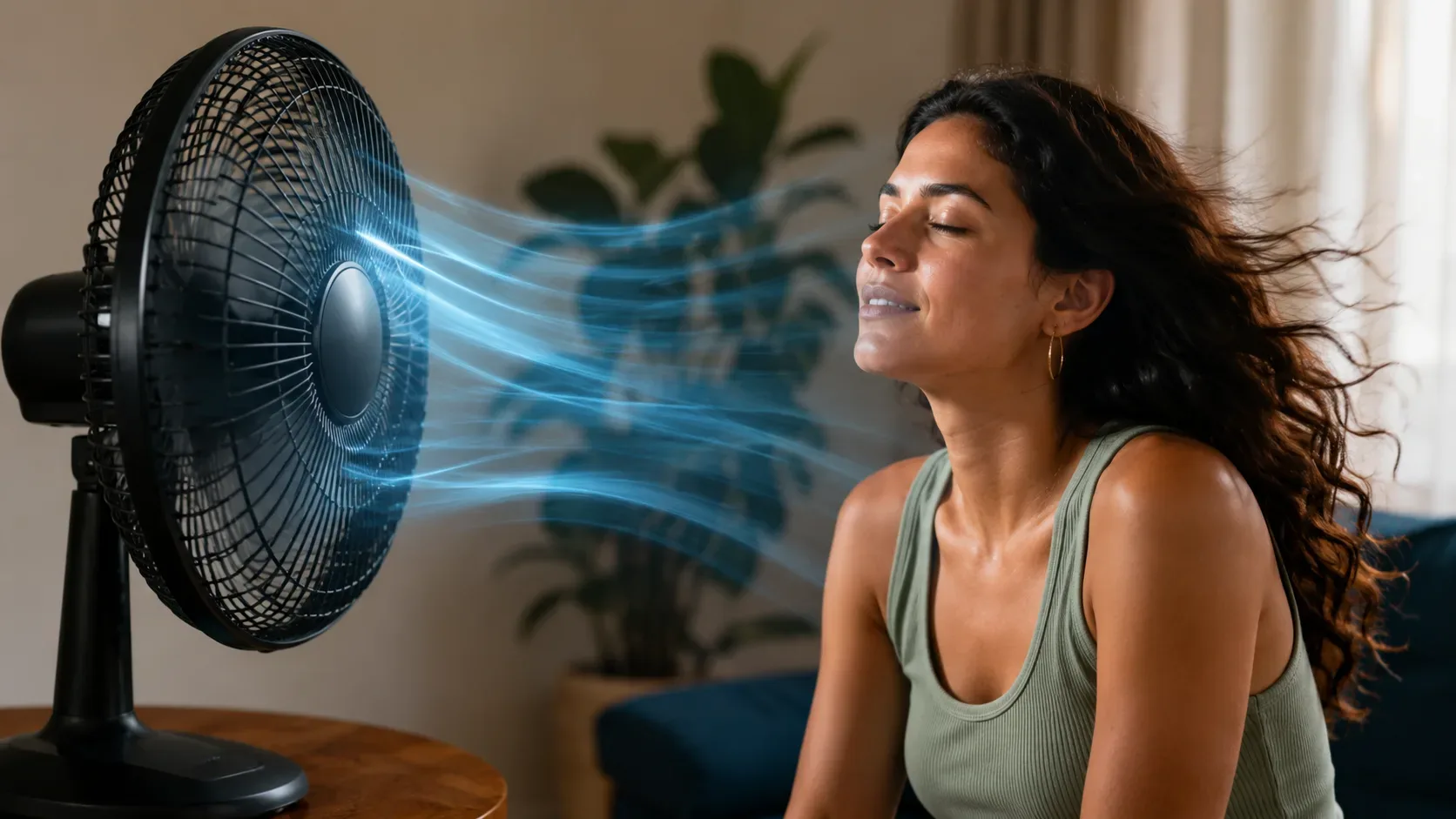
Turning on a fan can produce almost immediate relief, even when the fan is just moving the same hot air that was already in the room. There is no contradiction: air temperature and feeling of freshness are not the same thing.
A common fan does not work like an air conditioner. It does not remove heat from the environment nor does it produce, by itself, a current of air at a lower temperature. Its main effect is to increase air speed over the skin, changing the way the body exchanges heat with the environment. The US Department of Energy summarizes this difference by saying that fans move existing air and can make people feel cooler.
The fan affects the air, not the room thermometer
Imagine a closed room at 30 °C. When turning on a table fan and leaving it to recirculate the air, a thermometer that correctly measures the ambient temperature should not read, for example, 26 °C just because there is wind over it.
The blades push the air and create circulation, but there is no system in the device to remove heat from that air and transport it out of the room, as occurs in refrigeration equipment. In a closed environment, the motor itself still converts part of the electrical energy consumed into heat.
This explains why leaving the fan running in an empty room is not the same as leaving an air conditioner running. When you enter later, you may find the air at practically the same temperature, although you will feel relief as soon as you position yourself in front of the flow.
The situation changes if the fan is being used to exchange air. A device next to a window, for example, can help expel hot internal air or bring in colder external air when there is this difference in temperature. In this case, it is not the wind alone that cools the room: it is the replacement of a warmer air mass by a colder one.
Why does the skin feel cold if the air stays the same?
There are two especially important mechanisms: convection and evaporation.
The body heats the thin layer of air that is almost stationary next to the skin. When the environment is colder than the surface of the skin, this layer receives heat from the body. Without wind, it stays there longer and gradually reduces the speed of this transfer.
The fan continually removes some of this heated air and replaces it with air from the rest of the room. This circulation increases heat exchange by convection.
It's the same basic reason why a breeze can feel pleasant and why blowing on something hot speeds up its cooling: the movement of air changes the speed at which heat energy is transferred.
The second mechanism is usually even more noticeable when the skin is moist. For sweat to go from liquid to vapor, energy is needed. Part of it is taken from the skin itself. Therefore, the sweat that evaporates removes heat from the body.
The National Weather Service explains that evaporation is a cooling process and that high relative humidity slows the rate at which perspiration can evaporate.
The fan helps because the moving air moves away the water vapor accumulated just above the skin and encourages continued evaporation.
This is why dry skin and wet skin respond differently
If you have dry skin, you may still feel the effect of moving air because of convection.
If the skin is moist, evaporative cooling also comes into play. This is why coming out of a pool wet and caught in the wind can produce a much more intense sensation of cold than standing still under the same air temperature.
The water does not need to be cold for this to happen. What matters is that part of it manages to evaporate.
This principle also appears in wet bulb temperature measurement. The National Weather Service describes a thermometer covered in wet material: as the water evaporates, the instrument cools. The mechanism imitates, in a simplified way, the cooling of the body through the evaporation of sweat.
Where does humidity come into this story
Air can only receive a limited amount of water vapor under its current conditions. The closer it is to saturation, the less easily it is for new water to evaporate.
Therefore, with temperature, wind and other similar conditions, a very humid environment reduces the potential for cooling through the evaporation of sweat. The fan continues to move air and convection continues to exist, but an important part of the feeling of freshness may lose efficiency.
This is also why the same temperature can feel more suffocating on a humid day. The problem is not that humidity has magically increased the temperature measured by the thermometer: it interferes with the body's ability to get rid of heat through evaporation. The heat index used by the National Weather Service combines air temperature and humidity to represent part of this effect on human sensation.
This does not mean that the fan stops helping as soon as the humidity rises. Air movement can also increase evaporation compared to a situation of still air. The difference is that there is less room for water to evaporate when the environment already contains a lot of vapor.
A simple experiment shows the difference
The principle can be visualized by comparing a dry surface with a wet surface.
- A dry thermometer exposed to a fan tends to continue indicating approximately the air temperature in the room, as long as there is no other source of cold or heat acting on it.
- A wet surface can stay below this temperature while evaporating, because the change from liquid water to vapor consumes energy.
- The more humid the air is, the less evaporative cooling tends to be. Near saturation, the difference between a dry measurement and a measurement influenced by evaporation decreases.
It's the same separation that resolves the fan's apparent contradiction: air doesn't need to get colder for a surface — including your skin — to lose heat faster.
There is a limit: wind does not always mean more cooling
Convection also depends on the difference between skin temperature and air temperature. Under common conditions, the movement of air cooler than the skin helps the body lose heat. When the air becomes extremely hot, this relationship can reverse and the airflow can increase heat transfer from the environment to the body.
At the same time, evaporation continues to participate in the thermal balance. Therefore, temperature, humidity, air speed, sweat, age and individual conditions need to be considered in extreme heat situations.
This point should not be turned into a household rule based on a single number. Current public recommendations even differ. On a page updated on July 20, 2026, the US CDC recommends using fans indoors only below 90°F, approximately 32°C. The World Health Organization publishes different guidance, recommending electric fans below 40°C and warning that above this they can heat the body.
This divergence is a good reason not to treat the fan as universal protection against dangerous heat. During episodes of extreme heat, especially for the elderly, children and people with health problems, guidance from local health authorities should prevail.
The feeling of freshness is an exchange of heat
The fan appears to produce “cold air” because our skin does not function as a room thermometer. It responds to the energy exchanges that are happening at that moment.
Moving air can remove more heat from the skin by convection and encourage the evaporation of sweat. The dry thermometer in the room, however, continues to measure essentially the same temperature.
Humidity completes the explanation: the more difficult it is to evaporate sweat, the smaller the amount of cooling that depends on evaporation. That's why two rooms with the same temperature and the same fan can provide very different sensations.