Is it possible to know that something hit the Moon even without seeing the impact in person? Yes, with a high degree of orbital confidence — but that is not equivalent to having a photograph of the collision or the crater.
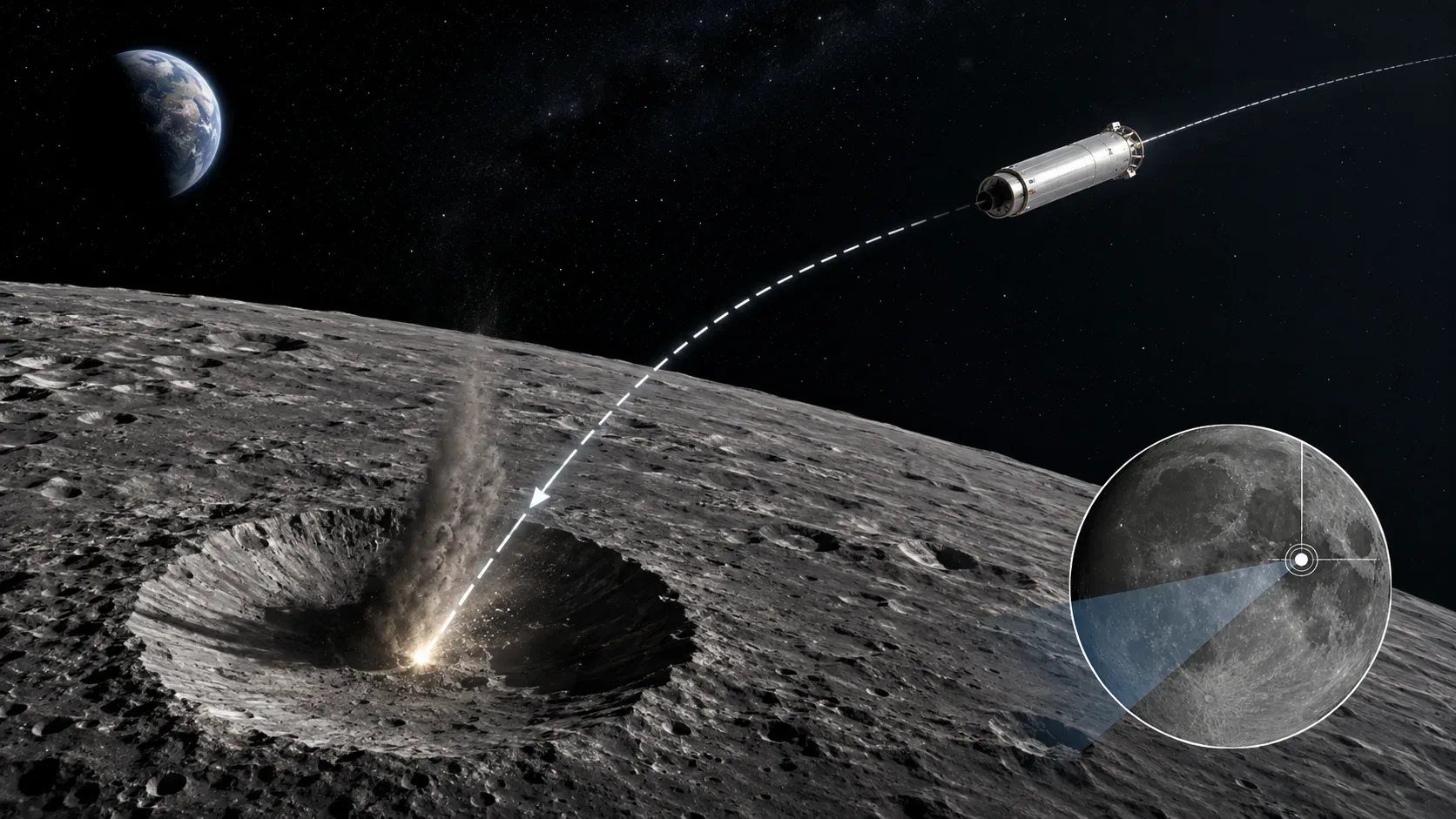
Object 2025-010D, identified as the upper stage of a Falcon 9 rocket, was expected to reach the lunar surface around 06:34 to 06:35 UTC on August 5, 2026, equivalent to approximately 03:35 UTC time. Brasilia. Observations made before the meeting indicated a collision trajectory, and experts interviewed after the scheduled time considered the impact practically inevitable. Until this article was updated, however, no public image of the new crater had been presented.
Therefore, the phrase “Falcon 9 reached the Moon” needs important precision: it was not the entire rocket, but its discarded second stage. And there is a difference between concluding that the impact occurred based on the trajectory and directly confirming where it happened and what marks it left.
What is predicted, what is likely and what has already been confirmed
| Predicted | Probable | Confirmed |
|---|---|---|
| 2025-010D would reach the Moon around 06:34–06:35 UTC, in an area near the craters Bell and Einstein. Models also predicted a flare, a cloud of material and a new crater, but with great uncertainty about size and brightness. | As the stage continued to point directly at the Moon in observations prior to the encounter, experts consider that it reached the surface. The lack of immediate optical detection does not mean you missed the target. | The object's artificial identity, its association with the January 2025 launch, and its designation 2025-010D are well supported. It is also confirmed that the calculated time has passed. What is not yet confirmed by public images is the position and appearance of the crater. |
The “probable” column does not represent a balanced bet between collision and deviation. In this case, it describes a very strong physical conclusion: upon reaching the final hours on a trajectory that intercepted the body of the Moon, the stage would not be able to simply continue its previous orbit. The editorial caveat exists because direct observation of the result is still a separate step.
Where did object 2025-010D come from
The stage was part of the Falcon 9 launched on January 15, 2025, in the mission known as Ghost Riders in the Sky. The flight sent the Blue Ghost Mission 1 modules, from Firefly Aerospace, and Resilience, from the Japanese company ispace, on their way to the Moon.
After releasing the payloads, the second stage remained in a very elongated Earth orbit that extended into the region covered by the Moon. It was given the international designation 2025-010D and the catalog number 62719. In June 2026, the Horizons system, from NASA's Jet Propulsion Laboratory, already offered a specific trajectory for the object and informed its lunar impact destination.
The association was not based solely on a catalog label. A second study, made available as a preprint on August 1, reconstructed the orbit back to launch and analyzed the spectrum of light reflected by the object. The researchers found characteristics compatible with thermal control materials used in spacecraft and similarities with another Falcon 9 upper stage, ruling out the hypothesis that it was a temporarily captured small natural body.
How can an impact of this type be predicted
Most of the motion can be calculated by the gravitational forces of the Earth, Moon, Sun, and planets. The problem is that a large metallic cylinder also suffers from what is called solar radiation pressure: the light exerts a very small push, but this accumulates over months.
As the stage was rotating, its area exposed to the Sun and the direction of the force could vary. New observations were incorporated into the calculations to refine the time and point of impact. According to Bill Gray, responsible for Project Pluto, data available on July 17 indicated 06:34:32 UTC, with a margin of a few seconds in the model then used.
Another group, employing different modeling and previous observations, calculated 06:33:23 UTC, with an uncertainty of about 55 seconds, and placed the meeting between the craters Bell and Einstein, just beyond the lunar limb. The observational planning study worked with approximately 06:35 UTC and a slightly different position.
These variations did not change the collision conclusion. They show why the exact point can only be determined later: different orbital solutions agreed on the general region, but not on each coordinate of the future crater.
Sources also adopted different descriptions for the east or west side of the lunar disk. To avoid ambiguity, the safest formulation is that the impact was predicted near the limb, in the region of Bell and Einstein, possibly just beyond the directly visible part of the Earth.
Why the impact was not easily seen from Earth
Three difficulties combined.
First, the area was illuminated by the Sun. Impact flashes are easier to distinguish on the dark portion of the Moon; over an already bright terrain, the contrast drops a lot.
Second, the point was close to the edge of the lunar disk. Small differences in trajectory and the local topography itself could hide the flare behind the lunar horizon, even if some of the dust rose above it.
Third, the quickest phenomenon—the initial flash—should last less than a second. The cloud of material could remain for longer, but its luminosity, height and shape depended on the angle of the stage, the type of soil hit and how its structure would break. The planning study recognized a very wide range of possible outcomes.
At least one astronomer who tried to observe the site from Earth did not detect the phenomenon. This is not proof of absence: the campaign was already considered a low probability attempt because of the lighting and geometry.
Probes in lunar orbit were also not positioned to record a simple live impact sequence. Planning instead called for later imaging by NASA's Lunar Reconnaissance Orbiter and the Korea Pathfinder Lunar Orbiter, also known as Danuri.
How future images can locate the crater
The search does not depend on photographing the entire Moon and manually looking for a new hole among millions of craters. The process can follow four steps:
- Delimit the likely area. Orbital calculations produce a band of uncertainty around the predicted point, reducing the extent that needs to be examined.
- Select previous images. The researchers use records from the same region taken before August 5 as a reference. The planning study reported that baseline images had already been acquired.
- Obtain a new orbital pass. The camera needs to photograph the area after impact, ideally with resolution and lighting conditions that allow comparison.
- Align and compare pixels. After registering the two images to the same geometry, the team can divide or subtract one from the other. Elements that have remained the same tend to disappear from the comparison, while the new crater, rays and ejecta deposit appear as changes.
This technique has already been used to locate other impacts. In 2022, the Lunar Reconnaissance Orbiter compared before and after images and found an unexpected double crater produced by another rocket body. In previous searches, the LROC camera team also aligned temporal pairs and highlighted differences to find craters too small to be easily seen in an isolated image.
According to the most recent Associated Press coverage, passage of the LRO suitable for confirmation was expected within the week following impact. The schedule for acquisition, transmission, processing and dissemination of images may be different from the time the photograph is taken.
The size of the crater is still just an estimate
The planning study calculated a crater in the range of 20 to 30 meters, with a central estimate closer to 27 meters. Another work, based on a different physical characterization, estimated a diameter of up to approximately 40 meters.
These numbers are not measurements. The result may vary depending on the composition of the terrain, the inclination of the stage and the way in which the cylinder fragmented when it touched the ground. It is also not confirmed whether there was a single cavity, an elongated structure or more than one crater.
The same care applies to estimates of dust, cloud height and energy transferred to the ground. Models help plan observations, but only the data collected can show which predictions came closest to reality.
What the event can teach science
A known artificial object functions as a kind of unplanned experiment. Its origin, approximate shape and speed are better known than those of a meteoroid that appears without warning. This allows you to compare the real crater with impact models of hollow structures, elongated and slower than many natural bodies.
Observations can also help:
- test impact localization methods for future lunar seismic networks;
- study how dust and fragments spread in an atmosphere without atmosphere;
- improve identification of distant artificial objects;
- assess how stages and equipment should be disposed of when space traffic between the Earth and the Moon increases.
The case did not pose an immediate threat to people or facilities. Its interest is in the precedent: the more missions that occupy cislunar space, the greater the need to track the fate of stages, adapters and probes that stop responding.
What remains to be confirmed
The decisive update will be an orbital image showing a change within the predicted area. From there, you can check:
- the final coordinates of the impact;
- the number, shape and dimensions of the crater;
- the distribution of ejecta;
- the correspondence between the observed scar and the models;
- if any telescope recorded a weak signal that can only be recognized after processing.
Save this article for updates when the first verifiable images of the site are released.