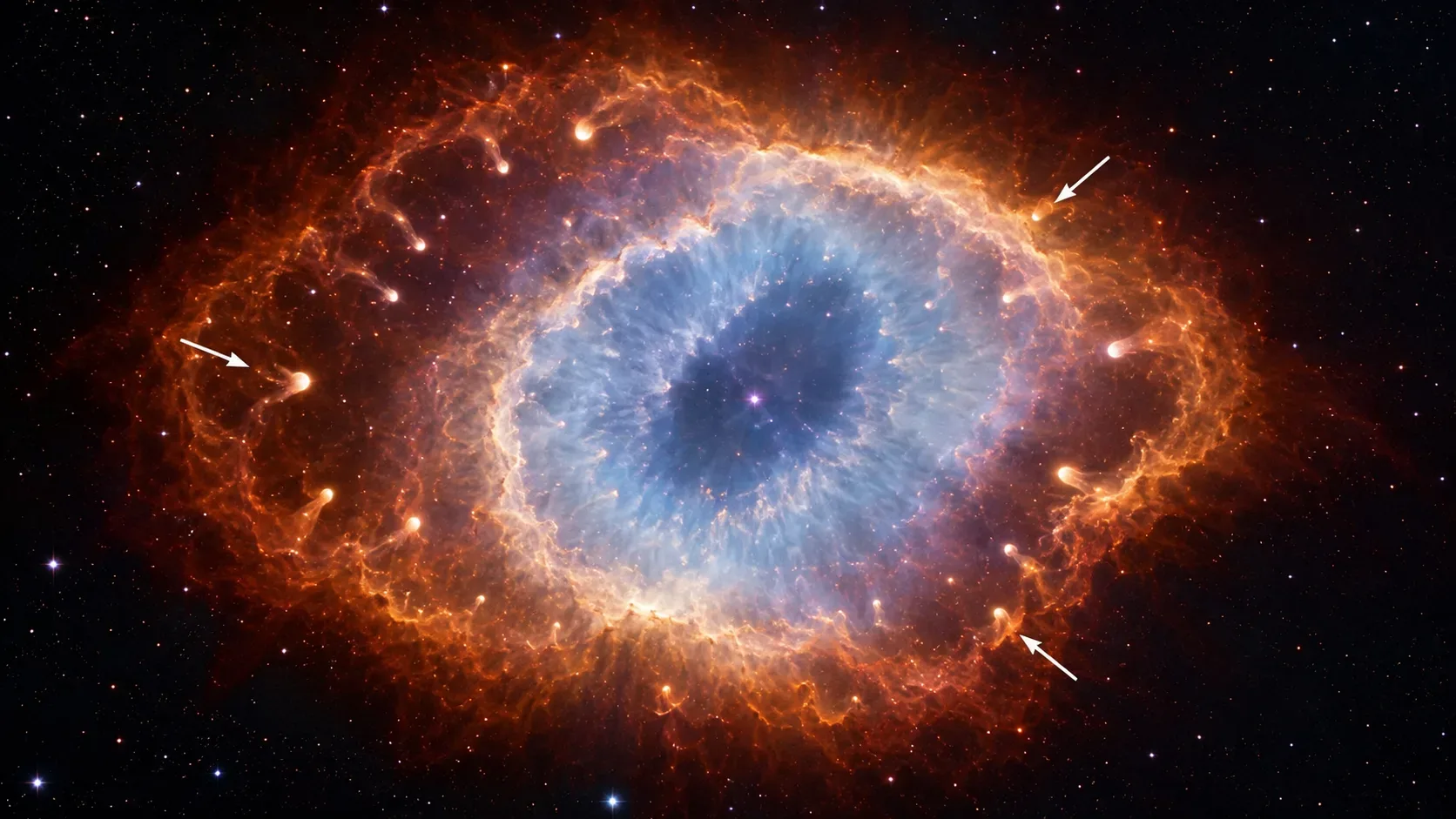
They look like comets, occupy regions larger than the orbits of the most distant planets in the Solar System and can gather an amount of matter comparable to the mass of the Earth. But the “cometary knots” seen in the Helix Nebula are not giant comets.
These are dense concentrations of gas and dust embedded in the matter expelled by a star at the end of its life. The comparison with comets only describes their appearance: a compact, head-like region, followed by an elongated structure that resembles a tail.
The image highlighted by NASA's Astronomy Picture of the Day on August 4, 2026 allows you to observe thousands of these formations in infrared light. The detail offered by James Webb helps to separate three different questions: what the image records, how these structures are being sculpted and what science has not yet been able to determine about their origin.
Image was not captured on August 4, 2026
The date of August 4th corresponds to the publication of the image on APOD, and not to the moment of observation. Data was acquired by Webb's NIRCam camera on October 24, 2024. The scientific image was released publicly on January 20, 2026 and was highlighted again in NASA's daily selection in August.
This separation avoids a common error in astronomy news:
| Step | Data | What happened |
|---|---|---|
| Observation by Webb | October 24, 2024 | NIRCam recorded infrared data |
| Scientific dissemination of the image | January 20, 2026 | NASA, ESA, CSA and STScI published the composition |
| Featured on APOD | August 4, 2026 | NASA selected the image and explanation of the nodes |
The Helix Nebula, also cataloged as NGC 7293, is approximately 650 light-years away, in the direction of the constellation Aquarius. Webb's frame covers only a portion of the nebula — a region about a light-year wide — and does not include the white dwarf that remains at the center of the system.
What are the cometary nodes of the Helix Nebula
Nodes are dense clusters of molecular gas, neutral gas and dust immersed in a more diffuse and ionized environment. The part facing the central star receives intense radiation and forms a bright edge. Behind it, material protected or removed from the surface produces the elongated structure we see as a tail.
An estimate published in 2005, based on Hubble molecular hydrogen images, indicated that the Helix Nebula may contain around 23 thousand knots. The number is an extrapolation from the density observed in different regions, not a direct and definitive count of each structure.
Why they're not comets
A Solar System comet is a relatively compact body, rich in ice and dust, that orbits the Sun. When it approaches the star, part of its material is heated and forms a coma and one or more tails.
The Helix nodes are different:
| Feature | Solar System Comet | Helix Cometary Node |
|---|---|---|
| Nature | Solid body or aggregate of ice, rock and dust | Dense cloud of gas and dust |
| Environment | Orbits a star | It is embedded in the shell of a nebula |
| “Tail” | Material released by solar heating | Gas sculpted, ionized, or shielded from radiation and stellar fluxes |
| Scale | Nucleus usually small in front of its coma | Head and tail can occupy hundreds of astronomical units |
| Name | Physical classification | Visual comparison with the shape of a comet |
A scientific article from 1996 even considered, among several possibilities, that the structures could result from the loss of matter from huge comet-like bodies. The authors themselves treated this alternative as less likely: it would require volatile objects with masses and dimensions very different from those of known comets.
Earth-like mass does not mean a hidden planet
The APOD explanation states that the nodes have masses similar to Earth. This comparison serves as an order of magnitude, but should not be read as a single, exact measurement for all of them.
The 1996 study estimated about 1.5 × 10⁻⁵ solar mass for the best-observed neutral cores. This is equivalent, by conversion, to approximately five Earth masses. Publicity works and texts also describe nodes with approximately one Earth mass, reflecting differences between objects, measurement techniques and definitions of the region included in the calculation.
Therefore, “mass comparable to Earth” does not mean that there is a planet there. The matter is spread across an extremely extensive and rarefied structure when compared to a rocky world.
The same caution applies to the claim that they measure several times the orbit of Pluto. Some numbers refer to the head; others, the head plus the tail or the region detected at a given wavelength. Old Hubble images depicted heads larger than the planetary Solar System and tails that could reach around 100 billion miles. The comparison conveys scale, but does not define a hard boundary for each node.
How to read the Webb image
1. Look for the densest “heads”
The orange and gold structures have rounded or arched ends. In many cases, this end faces the direction of the central star, while the elongated part projects toward the opposite side. Previous studies have found this orientation in molecular hydrogen imaging.
2. Don't confuse the colors with what the human eye would see
Webb recorded infrared light, invisible to the eye. The composition combines six NIRCam filters, between 1.15 and 4.70 micrometers, and assigns visible colors to different ranges: two filters appear in blue, two in green and two in red.
In the interpretation released by NASA, bluish tones indicate the hottest and most energized regions; yellow areas highlight regions associated with molecular hydrogen; and reddish tones accompany colder material, where gas and dust can remain more protected. Colors encode physical and chemical properties — they are not a “natural color” photograph.
3. Use the scale bar before judging the size
The annotated version includes a bar of 0.25 light years, equivalent to approximately 15,800 times the average distance between the Earth and the Sun. It demonstrates that the image covers an enormous interstellar region, despite each node occupying only a small fraction of the frame.
4. Remember that the central star is out of frame
The tails appear to point in a common direction because the radiation and gas streams come from the central white dwarf region. It is the remaining core of the star that has expelled its outer layers, but it does not appear in this Webb clipping.
5. Don't interpret every blue dot as part of the nebula
The field also contains stars located at different distances. Photography projects all these objects onto the same surface, although they do not necessarily belong to the Helix structure.
What Webb's infrared adds
Webb's gain is not just in “enlarging” a known image. NIRCam combines high resolution with filters capable of highlighting specific emissions, including lines related to molecular hydrogen at 2.12 and 4.70 micrometers. This makes colder and more protected regions visible, in addition to making it possible to follow the transition between the ionized gas and the molecular material.
The result shows that the nebula is not a homogeneous cloud. It contains edges, dark pockets, filaments and thousands of concentrations capable of harboring molecules while the surrounding environment receives intense radiation from the white dwarf.
The image, however, does not alone resolve the origin of the nodes. It offers new morphological and chemical details that can be compared with previous models, spectra and observations.
How these structures may have formed
One possibility is that the knots arose near an ionization front — the region where the star's radiation began to transform neutral gas into ionized gas — and were subsequently sculpted as that front advanced. Changes in the shape of the nodes depending on their position in the nebula support this scenario.
Another proposal relates the nodes to the fragmentation of a shell of gas compressed by stellar winds or ionization fronts. Instabilities in this shell could produce thousands of fragments with masses and separations similar to those observed.
It is also discussed whether some concentrations already existed in the material expelled by the star before the planetary nebula phase and were later remodeled by radiation, photoevaporation and gas movements. Observations on molecular hydrogen show that the appearance changes between the inner and outer regions, indicating that more than one process can influence its evolution.
The safest formulation, therefore, is: radiation and stellar streams help sculpt the knots we see, but the exact timing and mechanism of their formation is still under investigation.
“Planetary nebula” also does not mean a system of planets
The Helix Nebula is classified as a planetary nebula, but the name is historical. These objects got their designation because they looked like planet-like disks in ancient telescopes. In reality, they are shells of gas released by low- or medium-mass stars during their final phases of evolution.
Thus, there are two language traps in the same image: the nebula is not formed by planets, and the cometary knots are not comets.
Open the original image and the scaled version to compare the structures. Save this guide and observe, in this order: heads, direction of tails, color transition, scale bar and position of the central star.
As further reading about perspective in astronomical photographs, the article “A meteor ‘photobombed’ a nebula: what the photo really records” explains why an object in the foreground can appear integrated into a much more distant nebula.