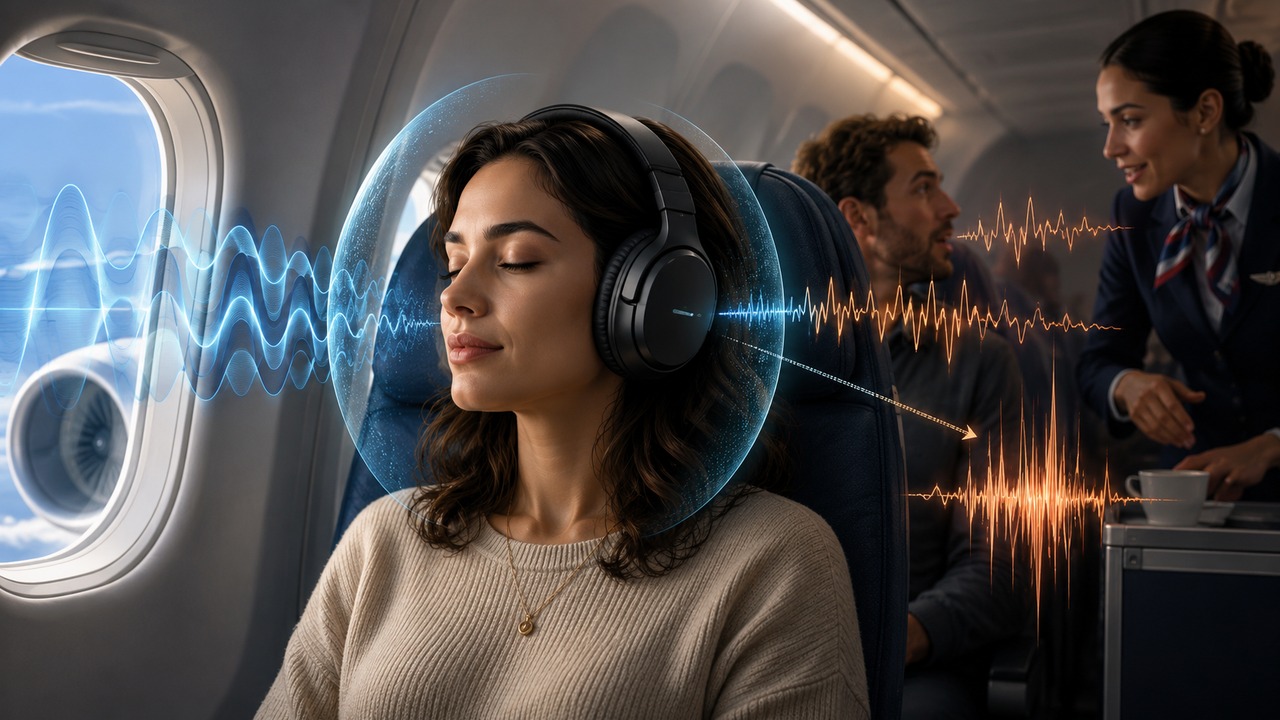
If you put on headphones with active noise cancellation during a flight, the effect seems selective: the continuous bass in the cabin recedes impressively, while the conversation in the next row remains recognizable and the click of a tray still attracts attention. This does not happen because the phone “knows” that one sound is motor and another is voice. The difference arises from the physics of sound and the time the system has to react.
ANC, which stands for active noise cancellation, is a real-time control system. Microphones measure part of the external noise or the sound that remains inside the earphone, a processor calculates a response and the speaker produces a signal that opposes the noise in the ear. The more stable, serious and predictable the noise, the more favorable this work is. The faster the sound changes, the more high frequencies it contains and the less scope there is to correct phase and amplitude before the wave reaches the eardrum.
ANC does not erase ambient sound: it creates another sound
The simplest image of active cancellation is destructive interference. If two waves of the same frequency and amplitude arrive at the same point with opposite phases, one reduces the other. For a pure tone, this is often represented as a wave shifted by 180 degrees.
In a real phone, however, the noise is not a perfect sinusoid. There are several frequencies at the same time, the speaker response is not flat, the cavity between the earphone and the ear changes the sound and the user's position changes the acoustic path. Therefore, the system does not just “turn the wave upside down”. It uses filters to produce a waveform that, after passing through the speaker and the acoustics of the headphone itself, reaches the ear with the amplitude and phase necessary to reduce noise at that point.
This detail explains an important limit: cancellation is local. The objective is to reduce the sound pressure near the ear, not to eliminate the sound wave throughout the cabin. Outside of this small region, aircraft noise continues to exist normally.
Why plane noise is such a favorable target
The background sound of a cruising cabin has strong, continuous components at low frequencies, coming from engines, airflow, structure and ventilation systems. Even though the level and spectrum vary throughout the flight, the change is usually much slower than speech or a sudden impact.
Low frequencies also give the system more time. A 100 Hz tone completes one cycle in 10 milliseconds. A 1 kHz tone completes a cycle in just 1 millisecond. The absolute delay caused by microphone, conversion, processing, amplifier, speaker and acoustic propagation takes up a much larger fraction of the cycle as the frequency rises. In other words, a small timing error that barely bothers a bass can represent a large phase error in a treble sound.
This is why ANC traditionally excels at “hum” and continuous snoring. These sounds provide the system with a more stable target, with long, repetitive cycles. The algorithm can estimate how noise passes through the earphone and generate a consistent response before small phase deviations destroy the cancellation efficiency.
Why do voices get through more
Speech is a much less well-behaved signal. It changes intensity, frequency and timbre with each syllable. Vowels can have a lot of energy in lower regions, but consonants and details that make words intelligible also occupy mids and highs. The result is a signal that is wide in frequency and full of fast transitions.
Isso cria dois problemas ao mesmo tempo. First, higher frequencies tolerate much less delay and phase error. Second, the shape of the wave changes quickly. Even when ANC reduces some of the voice's energy, some components survive and the brain is very good at reconstructing speech from incomplete cues. Therefore, a conversation can appear quieter without disappearing.
There is still a difference between canceling “sound” and canceling “meaning”. A classic ANC does not semantically identify that it is a voice and let it pass. He simply has more difficulty with certain spectral and temporal content. Some modern headphones add transparency modes, adaptive audio or specific processing to preserve external sounds; In these cases, part of the speech may be retained on purpose. But this is an additional layer, different from the basic principle of the ANC.
Sudden sounds put the system against the clock
A door slam, the clash of cutlery, a clap of hands or the dry click of a tray have an annoying characteristic for active cancellation: the sound front appears suddenly. These events typically spread energy over a wide range of frequencies and change within a few milliseconds.
The system cannot generate anti-noise until it has some information about the noise. An external microphone can provide a small “preview” of the sound before it passes through the ear pad or tip and into the ear, but this interval is short. The circuit still needs to measure, process and reproduce the response. If the first part of the impulse has already reached the eardrum, there is no way to go back in time to erase it.
This doesn't mean ANC is useless against sudden sounds. It can reduce part of the body of the event or its most serious components. What usually survives is precisely the fast edge rich in higher frequencies, which the ear perceives as a pop, impact or attack.
Feedforward, feedback and hybrid systems
ANC architectures differ mainly by where the system “listens” for the problem. In feedforward, a microphone faces outside the earpiece. It measures ambient noise before that noise reaches the interior region and provides a reference for the cancellation filter. A vantagem é ter informação antecipada sobre o que está vindo. The difficulty is to accurately predict how this sound will be transformed by the seal, the geometry of the earpiece and the path to the ear.
In feedback, a microphone is located inside the shell or close to the ear canal and measures what actually remains in the protected region. This error signal allows you to correct differences between the model and the real situation, including fitting changes. The cost is that the system works with the result already present inside the cavity and needs to keep the mesh stable.
Hybrid systems combine the two: an external microphone provides ambient reference and an internal one checks the residual. This combination is common in advanced headphones because it expands the correction capacity, but does not eliminate restrictions on delay, frequency range, position and acoustic response.
ANC and physical sealing do different jobs
Active cancellation and passive isolation are not synonymous. Passive isolation comes from the foam, cushions, tips and the geometry itself that blocks the passage of sound. It works without a battery, microphone or algorithm.
In practice, the two techniques complement each other. ANC is especially valuable where compact passive barriers struggle the most, especially in bass. The physical seal helps a lot in the mids and highs, exactly where the active control is more sensitive to delays and small changes in position.
That's why fit matters so much. A tip that doesn't seal the channel or a shell with a gap changes how much sound enters and also changes the acoustic response that the algorithm is trying to control. The same earpiece may look excellent on one person and just average on another if the seal is different. Glasses, hair, ear shape and ear cushion pressure can influence the result in over-ear models; In in-ear headphones, the size and position of the tip play an equivalent role.
What to expect on a plane
With a good headphone, the most striking effect tends to appear in the bass and continuous background of the cabin. The noise doesn't have to disappear completely for the difference to be big: by removing a significant portion of the low-frequency energy, the environment seems less tiring and the music or podcast can be heard more clearly.
Nearby voices will likely continue to appear, although quieter or more muffled depending on the fence. Dry sounds, such as the service cart passing over a seam in the floor or an object banging, can also pass through noticeably. This is consistent with a properly functioning ANC.
When comparing headphones, therefore, it makes no sense to evaluate cancellation just by asking whether the person next to you can still be heard. A device can be exceptional against severe snoring and, at the same time, allow part of the speech to pass through. Another may have better passive isolation and hide more consonants, even if the active algorithm is not much superior. The result heard is the sum of these two layers.
A simple test to understand the limit
Imagine three sounds in the same environment: the constant hum of an air conditioner, a conversation and a key falling on a table. The first is repetitive and dominated by relatively low components, so it is an excellent candidate for ANC. Conversation changes all the time and distributes information across a wider range of frequencies, so some of it tends to survive. The key produces a short, fast, high-frequency pulse; its initial edge is especially difficult to neutralize in time.
This contrast is more useful than thinking about “strong noise” versus “weak noise”. Intensity matters, but it does not alone decide effectiveness. Frequency, predictability, event duration, source position, sealing, and system latency may be more determinant.
ANC silence is selective in nature
Active noise cancellation is impressive precisely because it solves very well a problem that compact passive acoustics solves poorly: continuous, low-frequency noise. The roar of an airplane is almost the ideal demonstration scenario. Voices and sudden sounds, on the other hand, require greater temporal precision, spread energy across more difficult frequencies, and change before the system has a comfortable window to react.
Therefore, the best result does not come from waiting for the ANC to “erase everything”. It comes from the combination of good active bass control with efficient physical sealing in the rest of the spectrum.. When this pair is well adjusted, the plane seems much quieter without the world around it having to disappear completely.