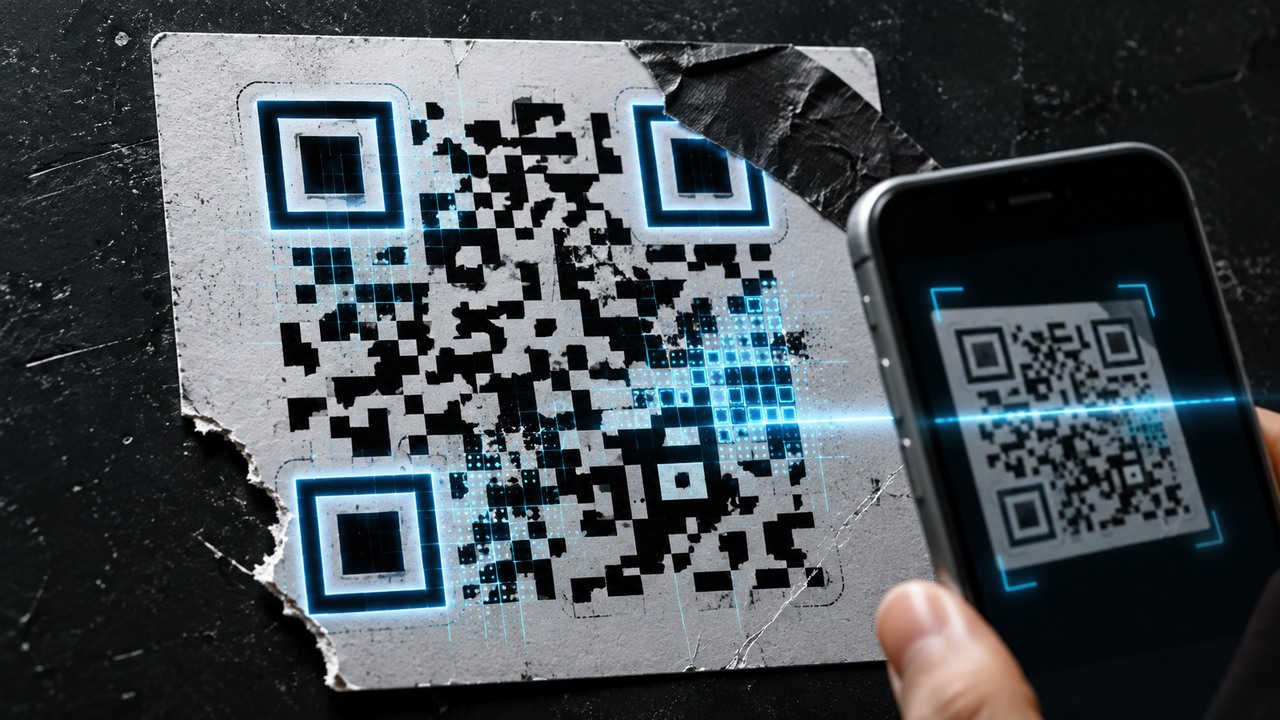
A QR Code can continue to work after a tear, a stain or partial coverage because it does not depend on each square being intact. Part of the symbol is dedicated to redundancy: the reader can detect certain errors in the data and reconstruct the original information within a limit. The counterintuitive part is that this limit doesn't directly correspond to the percentage of physical area that can disappear.
Before correcting any data, the reader needs to locate the QR Code, understand its orientation and estimate the grid of black and white modules. Only then does he transform what he saw into data units and apply error correction. Therefore, a small amount of damage in one functional region can be more destructive than a larger area lost elsewhere.
The QR Code is not a uniform mosaic of information
The small black and white squares are called modules. They do not all have the same function. Some form fixed patterns that help the reader find and interpret the symbol; the others carry data, control information and redundancy for correction.
The three large squares in the corners are the location patterns. They help the reader quickly recognize that there is a QR Code in the image and determine its orientation. In Model 2 QR Codes, alignment patterns also help to compensate for geometric distortions, especially when the symbol is larger, tilted or appears deformed in the image. There is also a synchronization pattern, formed by alternating modules, which helps to establish the reading grid.
Around the symbol there is another important region that does not even appear to be part of the QR Code: the clear margin, called the quiet zone. In the conventional QR Code, it must be equivalent to four modules wide. This separation helps the reader distinguish the code from its surroundings.
After these structures are recognized, the reader can sample the grid and reach the area where the codewords, eight-bit units used in the data area, are located. It is on these codewords that error correction works.
What Error Correction Really Recovers
QR Code uses Reed-Solomon codes to add redundancy to the original data. Instead of just storing the message, the symbol also carries enough mathematical information to correct a limited number of codewords that were entered incorrectly or were lost during reading.
The standard offers four levels of correction. Level L allows you to restore approximately 7% of the symbol's codewords; M, around 15%; Q, about 25%; and H, around 30%. The higher the level, the greater the correction capacity, but also the greater the amount of redundancy required. For the same amount of content, this may require a QR Code with more modules or reduce the available data capacity.
These percentages are easy to misinterpret. "30% correct" does not mean that any 30% of the surface can be painted, torn off, or covered over and the code will still work. The reference is the approximate proportion of restorable codewords, not the geometric percentage of the design.
Why the percentage of covered area is misleading
A physical tear does not cleanly erase codewords. It eliminates modules. Depending on where these modules fall in the internal organization of the symbol, the same piece torn out can affect many bits distributed across different data units. The reader may also interpret some damaged modules as black when they should be white, or the opposite.
Furthermore, the Reed-Solomon correction only comes into play after the image has already been located and converted into a data sequence. If the damage prevents the reader from finding location patterns, estimating the grid, or interpreting information needed for decoding, there may not be enough organized data for the fix to work.
This is why two QR Codes with the same H level can react differently to apparently identical coverage. Version, module size, contrast, camera quality, focus, perspective and exact position of the damage change what reaches the decoder.
Why a torn QR Code sometimes remains readable
Imagine that part of the paper has been torn off at the edge, but the three large location patterns remain recognizable and the grid remains well defined. The reader can still map most modules. If the compromised codewords fall within the correctability of that symbol, the original message can be reconstructed.
Dirt, scratches and small covered areas can produce the same effect. For the camera, these imperfections become missing modules, unreliable or reading the wrong value. Redundancy exists precisely so that the content does not depend on a perfect reading of each unit.
This also explains why a QR Code seen on a cell phone screen can work even with reflection, moiré, image compression or small printing defects. The system is designed to tolerate a certain amount of error as long as the structure remains discoverable and the amount of corrupted data remains correctable.
The center is not a magically safe area to place a logo
Many custom QR Codes display a logo in the center and continue to work. This may give the impression that there is a central region reserved for images. It doesn't exist.
The logo acts as a deliberate obstruction. It covers modules that could carry data and, depending on the version, may come close to alignment standards. When the QR remains readable, it is usually because the hidden area was kept small enough, the most important functional patterns were preserved, and the available redundancy was able to absorb the errors introduced.
Using a high correction level increases the tolerance margin, but does not turn the center into free space. An oversized logo, an opaque border that encroaches on important patterns, too little contrast, or too much reduction in final size can cause code that worked in the original file to fail once printed or displayed at another scale.
Therefore, the safest rule of thumb is not "can cover up to 30%". It is to treat the logo as planned damage, keep your interference conservative and test the QR Code in the final form in which it will be used.
What usually makes the reading fail first
Detection failure: reader cannot find symbol
If a tear removes much of a localization pattern, if the quiet zone disappears into the surrounding background, or if the contrast is too low, the application may not even make it to the decoding stage. In this situation, data redundancy is present, but it doesn't help because the reader hasn't yet managed to turn the photo into a reliable grid.
Geometry failure: grid cannot be sampled safely
Strong perspective, blur, tiny modules, paper distortion or damage to structures used for positioning can make the reader misplace the squares. The problem stops being just "which bits were lost" and becomes "where the bits are."
Correction failure: there are too many errors in the codewords
Even with the symbol perfectly located, there is a mathematical limit. When the number of corrupted codewords exceeds the capacity predicted by the level of correction and the structure of that QR Code, Reed-Solomon is unable to recover the original message reliably. At this point, the code is no longer decodable.
A simple way to visualize the reading process
Reading takes place in stages. First, the camera captures an image with imperfect noise, perspective, and lighting. The software looks for location patterns and delimits the symbol. It then estimates the grid of modules and decides which positions are light or dark. It then organizes the bits into codewords and identifies the parameters needed to interpret the symbol. Only then does error correction try to fix codewords that don't match. Finally, the corrected data is converted into the original message, such as a URL or text.
This order explains the difference between "the code is corrupt" and "the data is corrupt." Error correction is very good in the second case. It does not completely replace the structures that allow the reader to get to the data.
How to evaluate a partially destroyed QR Code
There is no universal limit on centimeters, pixels or visual percentage. To estimate the chance of reading, the best sign is to first observe the functional structures. If the three major localization patterns are intact or still clearly recognizable, the surrounding margin has not been swallowed up by the background, and most of the grid remains clear, the reader has a good basis for attempting decoding.
Then, import the extent of the damage in the data area. A small, concentrated spot may be tolerated; a long stripe crossing much of the code can compromise many modules. A cut in the corner that carries a localization pattern may be more serious than a similarly sized sticker over a data region.
In important uses, actual testing remains indispensable. Cameras, lenses and reading algorithms do not perform identically. A code that opens instantly on one device may require more distance, light or focus on another. If the QR Code will be printed with a logo, on curved material, exposed to dirt or read from a distance, validation must be done on the final size, material and scenario.
Correction protects the information, not any part of the drawing
The strength of a QR Code comes from two ideas working together. The first is structural: specific patterns allow locating, orienting and sampling the matrix. The second is mathematics: redundant data makes it possible to correct part of the codewords that arrived incorrectly.
When the damage primarily affects data modules and remains within repair capability, the QR Code may appear surprisingly destroyed and still open normally. When it reaches the structure needed to find the grid, or when too many errors exceed the redundancy budget, the read fails.
That's why the question "how much of the QR Code can be covered?" there is no answer just in percentage of area. What matters is how much of the correctable information was lost, which regions were affected and whether the reader can still get to the data before trying to recover it.