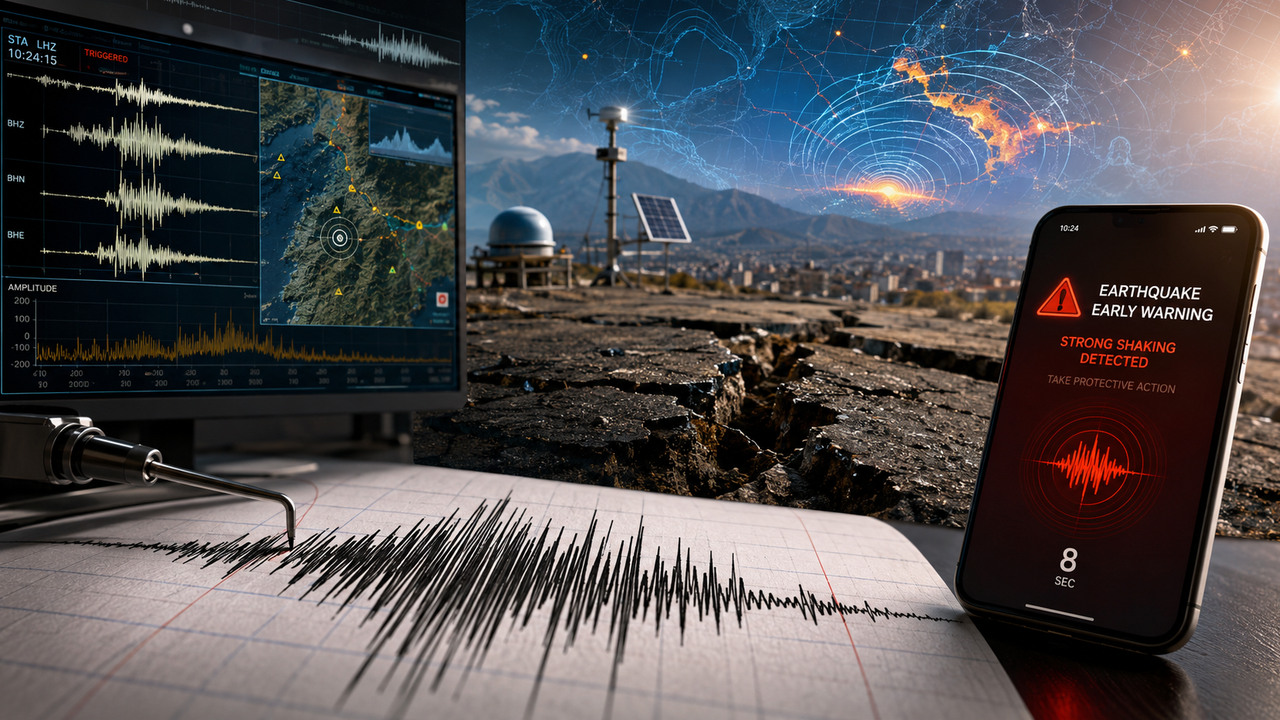
The short answer is no: Science has no reliable method of saying that a large earthquake will happen on a specific date and time, in a specific place, and with a specific magnitude. What exists is another family of tools: probability estimates, instrumental monitoring, near-immediate detection and, in some regions, early warning systems that can warn part of the population before the strongest tremor arrives at the location.
Confusion arises because all these tools talk about the future in some way. An earthquake probability talks about what could happen in a region over a period of time. An early warning system tells you what is likely to arrive at a specific point in the next few seconds. But in this second case, the earthquake has already started. It's a race between information and seismic waves, not a prediction before the event.
What would be a real earthquake prediction
For the U.S. Geological Survey, an earthquake forecast needs to specify three elements: date and time, location and magnitude. Simply saying that “a large earthquake could occur in a seismic region in the next few years” does not meet this standard, because it describes risk or probability, not a given event on the calendar.
To date, there is no validated scientific method capable of reliably providing these three elements for large earthquakes. Researchers have already investigated many possible precursor signals, such as swarms of small tremors, changes in groundwater, radon emissions, electromagnetic changes and unusual animal behaviors. The problem is that signals of this kind can appear without a major earthquake following, and many significant earthquakes happen without a clear and reproducible precursor.
This is essential to understanding the standard of evidence. A method does not become predictive because it gets an isolated case right. It needs to be testable, produce objective criteria before the event, and demonstrate consistent performance in many cases, including accounting for false alarms and events that occurred without warning.
Probability is not a hidden date
If deterministic prediction is not possible, seismology can still answer useful questions. One of them is: what is the chance of an earthquake of a certain range occurring in a region within a given time interval?
This type of estimate uses information such as known faults, records of past earthquakes, rates of deformation or movement, and recurrence models. The result may be something like a probability for the coming years or decades. It's language similar to that used in other risk problems: it describes the expected frequency in a set of possibilities, it doesn't schedule an event.
Imagine that a model indicates a relevant chance of a strong earthquake in a region over 30 years. This does not mean that scientists know the shaking will occur in the twenty-third year, nor does it mean that the absence of earthquakes in the first 29 years makes the last year a set date. The information is probabilistic and depends on the model, period and available evidence.
There are also shorter-term probabilistic forecasts, especially after an earthquake, when aftershock activity can be estimated statistically. Operational forecasting models seek to update probabilities based on observed seismic activity. Still, they deliver odds for regions and time ranges, not a deterministic identification of the next event.
Detection: first the earthquake happens, then the instruments recognize it
It's another very different thing to detect an earthquake. When a fault ruptures, the energy released propagates through the Earth in the form of seismic waves. Networks of seismometers record this movement and allow us to quickly estimate where the event occurred and how big it was.
P, or primary, waves propagate faster. S waves arrive later and are generally associated with stronger movements; Surface waves can also contribute to damaging shaking. This difference in speed is one of the keys to both locating earthquakes and building early warning systems.
Detecting, therefore, is looking at an event that has already started. An algorithm can recognize the first signals within a few seconds and calculate an initial estimate of location, magnitude and expected intensity. This is extraordinarily fast, but it doesn't go back in time: the rupture of the fault is already underway.
Early warning: information tries to arrive before the strong tremor
Early earthquake warning takes advantage of two advantages. The first is that P waves arrive before S waves and part of the more damaging movement. The second is that telecommunications signals travel much faster than seismic waves travel through the crust.
The system detects the beginning of the earthquake in sensors close to the source, processes the data and sends a message to areas where the strong tremor has not yet reached. Depending on the distance, the position of the sensors, the size of the event and the way the warning is delivered, some people may receive seconds of notice. In favorable situations, this interval may allow automatic or human protective actions.
The bottom line is that early warning “early” means before the strongest movement hits you, not before the earthquake starts. Near the epicenter, the interval between detection and intense shaking may be too small. Therefore, a user can receive warning before, during or even after feeling the jolt, depending on their position and system latency.
A timeline resolves the apparent paradox
Think of two cities, one close to the rupture and one further away. At the initial instant, the fault ruptures. Soon after, nearby sensors record the first waves and send data for processing. The system calculates an estimate and transmits an alert. Meanwhile, the strongest waves continue to advance across the land.
The city very close by may begin to shake before this entire cycle is complete. The most distant city may receive the message first and only then feel the most intense movement. For those in this second city, the alert appears to have “predicted” the earthquake. But what he predicted was the arrival of the shock at the location, using information from an earthquake that was already happening elsewhere.
It's the same difference between knowing that a storm has already formed and estimating that it will arrive in your neighborhood in a few minutes versus predicting, days in advance and with absolute precision, the exact time at which a yet-to-be-existing storm will arrive.
Why animals “perceiving first” does not prove prediction
Reports of animals agitated before earthquakes have existed for centuries. They are interesting, but they need to be separated into two very different timescales.
Seconds before a person feels the strong jolt, some animals may respond to P waves, which arrive first and may go unnoticed by many humans. In this case, the animal is reacting to an earthquake that has already started, in a way analogous to the physical principle explored by early warning systems. This is not a prediction prior to the rupture.
Stories of strange behavior hours, days or weeks before face another problem: a consistent and reliable pattern that works as a predictive method has not been found. An animal behavior can have many environmental and biological causes. To become a scientific signal, it would be necessary to demonstrate that it occurs reproducibly before earthquakes, with a known hit rate and without an impractical number of false alarms.
The possibility of an animal perceiving some real environmental stimulus should not be confused with the existence of a prediction method. Without a consistent signal, a demonstrated mechanism, and tests capable of distinguishing coincidence from predictive ability, the report remains insufficient evidence to pinpoint the date, place, and magnitude of a future earthquake.
What science can say before a big earthquake
Even without predicting the exact time, seismology provides practical information. Seismic hazard maps show where ground motion tends to be most relevant over time. Fault studies and seismic history help estimate probabilities. Short-term models can update chances in earthquake sequences. Building and planning regulations use this knowledge to reduce consequences before any specific event is known.
This difference changes the question. Instead of “what day will the next earthquake be?”, science works better with “which regions have the greatest danger?”, “what level of ground motion should be considered in the design of structures?”, “how does the probability change after an event?” and “how much time can a detection system gain before the strongest tremor reaches a given location?”.
How to interpret a warning without confusing terms
When information talks about chances over years or decades, it is describing seismic probability or danger. When you update chances after a sequence of tremors, it is a probabilistic forecast. When a network announces that an earthquake has been located and estimated, we are in the detection field. When your cell phone warns you that a jolt could arrive in seconds, it's an early warning.
A message that promises the exact date, time, place and magnitude of a future earthquake needs extraordinarily strong evidence. The fact of circulating technical language, graphs, maps or mentions of “precursor signs” does not replace scientific validation. Vague predictions can also appear correct after the fact because they leave enough room to fit an earthquake occurring over a wide region or in an extended time window.
The prediction limit does not make seismology useless
Not knowing the exact moment of a break does not mean being blind. Science can map danger, estimate probabilities, build stronger structures, detect earthquakes quickly and, in some places, use the difference in speed between data and seismic waves to gain valuable seconds.
The most useful distinction is simple: deterministic forecasting would try to say when, where and with what magnitude the earthquake will occur; probability describes chances within a range; detection recognizes an event that has already started; and early warning uses this detection to warn that the strongest tremor is still on its way to certain places. This is why an alert can arrive “before the earthquake” for those who receive the notification, even though, physically, the earthquake has already started.