In the photograph, a bright streak appears to cut through a reddish cloud in space. The phrase “meteor photobombed nebula” describes the visual effect well, but not a real encounter between the two objects.
NASA published the image in the Astronomy Picture of the Day (APOD) on August 3, 2026. According to the page, the capture had been made the previous month at Death Valley Observatories, in Nevada, in the United States, with credit and copyright attributed to astrophotographer Tom Burnett. The exact date of capture was not given.
The record brings together two phenomena with no direct physical relationship: a meteor that shone for a very short interval in the Earth's atmosphere and the Great Lacerta Nebula, or Sh2-126, located around 1,200 light-years away. They appear in the same direction as the sky and within the same camera exposure range. The image flattens distance and time into a two-dimensional surface.
What the image really records
The camera was pointed at the Lacerta constellation region and accumulated the faint light of the nebula. During the exposure, a meteor entered the field of view. Its intense glow left a streak, while the nebula continued to contribute light in the background.
This does not mean that the meteor passed close to the nebula or passed through its gas. He passed in the camera's line of sight. The difference is decisive: the coincidence is angular, not spatial.
The photograph records the direction from which the light arrived, but does not automatically display the depth of each element. A close object and a very distant one can occupy the same pixels, just as a plane can appear to cross the Moon without being close to it.
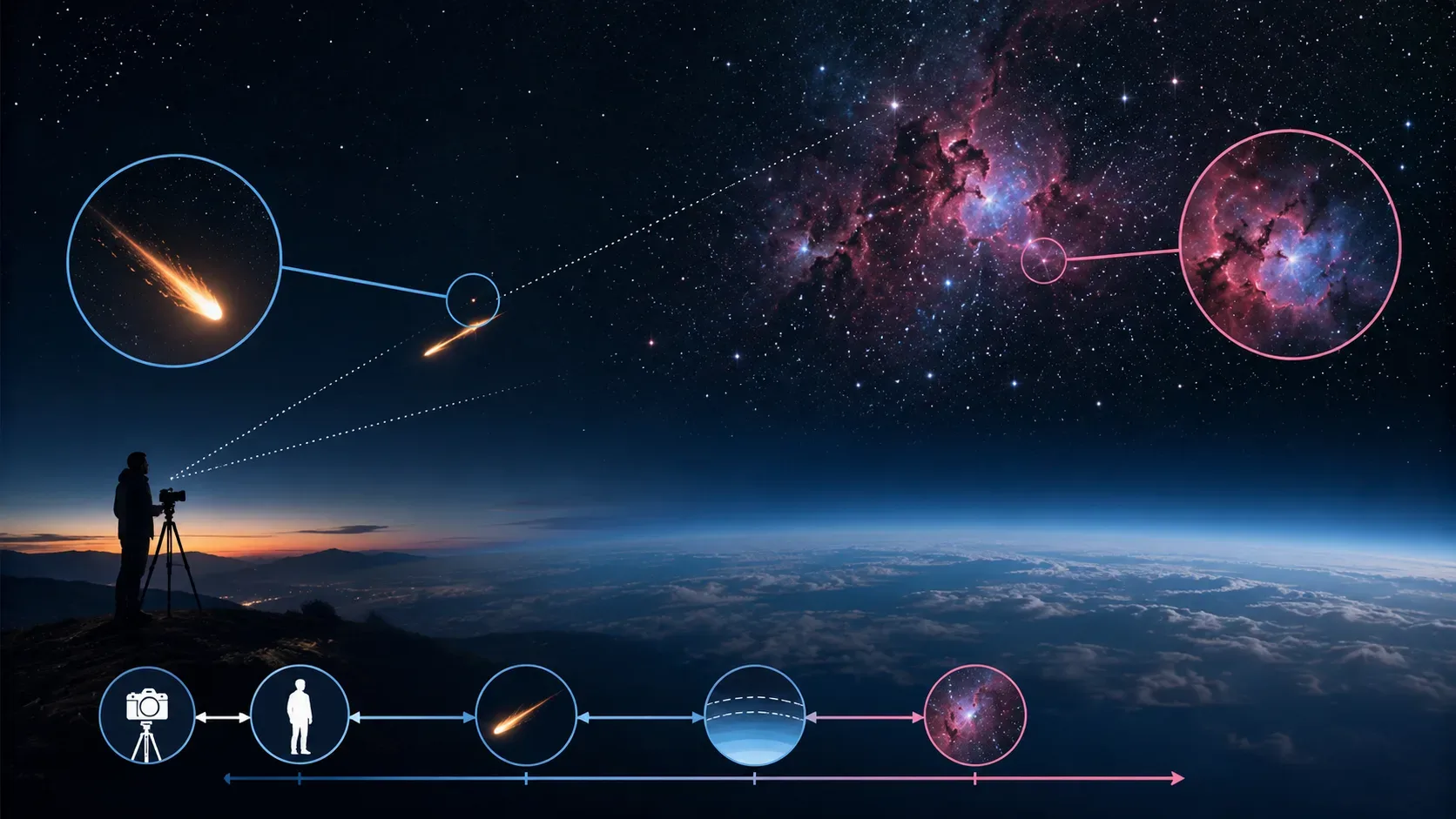
Scale diagram: from camera to nebula
| Registered layer | Approximate distance | Time scale in photo | What appears |
|---|---|---|---|
| Camera and observer | earth surface | entire exhibition | point of view |
| Meteor | tens of kilometers to about 100 km; specific altitude unknown | brief instant | light strip |
| Great Lacerta Nebula, Sh2-126 | about 1,200 light years | practically constant during exposure | reddish and faint emission |
NASA reports that most meteors become luminous in the mesosphere, a layer located approximately between 50 and 80 kilometers in altitude. This does not determine the altitude of the meteor in the photo, which was not published. The nebula, in turn, is approximately 1,200 light years away.
Using just these orders of magnitude, the nebular background is more than 100 trillion times further away than the atmospheric band. This is an editorial estimate to demonstrate the difference in scale, not a measurement of the trajectory of that specific meteor.
Visually, however, the light from both phenomena reached the same area of the sensor. It is this projection that creates the impression of crossing.
Time diagram: what happens during the exposure
Shutter opens → faint light from nebula accumulates → meteor appears and crosses field → possible trail disperses → exposure ends
Long exposure does not mean that the meteor remained in the sky for the entire recording. It means the sensor received light long enough to reveal a very faint target. The meteor contributed only as long as it shone, but its intensity was great enough to leave an obvious mark.
The final image, therefore, is not a “frozen instant” in the common sense. It represents the sum of light received during an interval: the nebula appears because its faint signal has been accumulated; the meteor appears because it produced an intense flash within that same interval.
The NASA page calls the record a long exposure, but does not inform its exact duration nor does it present the entire capture and processing sequence. It is not possible to say, based on the publication consulted, how many seconds the painting lasted or how any exposures were combined.
Meteor, meteoroid and meteorite are not the same thing
The International Astronomical Union defines meteor as light and associated physical phenomena—including heat, shock, and ionization—produced by the high-speed entry of a solid object into an atmosphere.
The body still in space is the meteoroid. If any fragment survives the luminous phase and reaches the ground, it becomes called a meteorite.
In the case published by APOD, NASA describes the meteoroid as probably small, comparable to a pebble. Its brilliance should not be understood simply as a rock “on fire” in the everyday sense. The phenomenon involves heating and excitation of the surrounding air, shock, ionization and loss of material from the object during its passage.
The photographed track can also preserve rapid changes in luminosity, colors and parts of the track affected by atmospheric winds. The final appearance blends the meteor's physical behavior with camera response and image processing.
The red background is the Great Lacerta Nebula
The Great Lacerta Nebula is cataloged as Sharpless 126, or Sh2-126. It is an extensive and very faint emission nebula, located towards the constellation of Lacerta.
In a previous post, APOD reported that it occupies approximately three degrees in the sky and is about 1,200 light-years away. The red glow is associated with the emission of hydrogen excited by radiation from the hot star 10 Lacertae.
Because its surface brightness is low, the nebula is best revealed by prolonged photographic exposures. Detailed records may accumulate data over multiple exposures or nights, depending on the astrophotographer's project.
This is another point that the photograph compresses: the nebula appears to be a flat spot in the background, but it corresponds to a vast interstellar structure. The meteor, in contrast, is a local, fast, atmospheric phenomenon.
Was the meteor a Perseid?
This cannot be concluded just because the image was published in August.
NASA contextualized the photograph with the meteor shower season. For 2026, the agency indicated the peak of the Perseids on the night of 12 to 13 August, under skies favored by the new Moon.
The APOD caption, however, does not identify the photographed meteor as a member of the Perseids. Rains are named after the region of the sky from which their trajectories appear to originate, called the radiant. To associate the event with a specific current, it would be necessary to check whether its apparent trajectory is compatible with that radiant.
Without this analysis, the object could belong to another active shower or be a sporadic meteor. The proximity between the date of the photograph and a known season does not prove its origin.
The scene should also not be automatically transported to Brazil. The photograph was taken in Nevada and documents a specific setting, time and local conditions. It does not demonstrate that the same composition could be observed in Brazilian territory.
How to read astronomical photos without confusing appearance and distance
Before interpreting an image of this type, it is worth asking four questions:
- What is the foreground? In this case, the Earth's atmosphere.
- What is the bottom? The nebular region of Sh2-126, about 1,200 light years away.
- How long did the camera accumulate light? The exact duration was not published, but the recording is described as a long exposure.
- Does the caption state a physical relationship or just a visual coincidence? Here, it is an overlap in the line of sight.
A scientifically accurate caption would be:
An atmospheric meteor, recorded during a long exposure, appears projected against the much more distant Great Lacerta Nebula.
In photography, they intersect. In space, they belong to such different scales that the image itself fails to show them. This is the value of the record: in addition to being visually unusual, it works as a lesson on perspective, distance and time in astrophotography.
Save the scale diagram and go to “What you can really see in the sky over Brazil in August 2026” to transform the physical explanation into observation planning.